
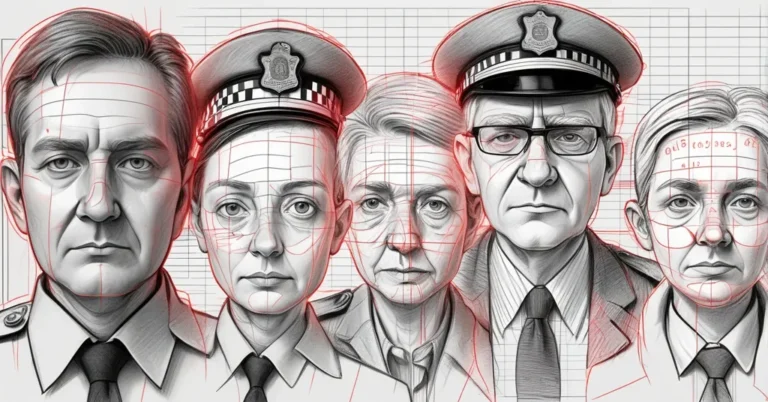
Facial Age‑Estimation at UK Borders: Why the AI Fails Where It Matters Most
TL;DR — Key takeaways
- What’s happening?
The UK Home Office plans to use facial age‑estimation (FAE) AI at the border to help decide whether asylum seekers are children or adults. - Why this matters
Internal testing and independent benchmarks show large average errors and clear demographic bias — errors big enough to turn a 15‑year‑old into an “adult” on paper (WIRED/Lighthouse Reports; NIST FRVT). - Operational risk
Border photos are low quality, encounters are hurried and stressful, and those conditions amplify algorithmic error. Rights groups urge a halt until independent validation and safeguards are in place. - What to do
Procurement and policy teams must demand transparency, human‑in‑the‑loop controls, quality standards, audits and clear redress mechanisms before any frontline deployment.
An encounter that should never be automated
Picture a frightened 16‑year‑old arriving at a UK port after a traumatic journey. A quick photo is taken for routine checks. An algorithm, trained on millions of images in a lab, returns a single number: “18.” That tag can remove access to specialist care, protections and legal pathways reserved for children.
Facial age‑estimation (FAE) systems predict an apparent age from facial features using machine learning. When the stakes are administrative — age‑gating a social platform or logging visitors — an error costs inconvenience. At a border, an error can change a human being’s legal status. That gap between technical convenience and human consequence is why a careful appraisal is overdue.
A quick explainer: What is facial age‑estimation (FAE)?
FAE algorithms analyze facial landmarks, texture and other features to predict age. Performance is usually reported as mean absolute error (MAE) — the average number of years the prediction differs from the true age — and misclassification rates at key thresholds (e.g., under/over 18). Benchmarks like NIST’s Face Recognition Vendor Test (FRVT) provide independent comparisons, but those tests are often run on high‑quality photos under controlled conditions.
Lab scores vs. the real world: What tests show
The Home Office tested seven FAE systems on more than 2.5 million images (internal testing reviewed by WIRED/Lighthouse Reports). Even the top performer showed “substantial deviations” on Sub‑Saharan African faces. For female Sub‑Saharan African subjects the average error reported was about 4.6 years — large enough to reclassify many teenagers as adults.
NIST’s FRVT benchmarks indicate that the best age‑estimation models can achieve MAEs around 2.5 years in controlled conditions (NIST FRVT). Real‑world border photos — lower resolution, off‑angle, poor lighting — commonly worsen performance. Public procurement records show the Home Office bought a system from Cognitec for more than £400,000 in May (procurement entry). Analysis of NIST scores and lower‑quality image scenarios suggested Cognitec’s system misclassified roughly twice as many 16‑year‑olds as adults on border‑style photos compared with high‑quality visa photos; West African 16‑year‑olds were disproportionately affected compared with Eastern European peers.
“FAE is a modernisation effort and an additional check to support officers’ judgments; uncertain cases will be treated as children until further assessment,” a Home Office spokesperson said.
That procedural promise matters, but it coexists with stark statistics: since 2010, 40% of people who undergo age assessments in the UK have been classed as adults (Home Office statistics). When an automated cue shifts an officer’s initial judgment, the practical burden of proof and the privacy of the individual can be affected.
Human cost: How errors strip protections
Being classified as an adult can exclude someone from tailored housing, specialist social work, legal protections and child‑safeguarding processes. The effects are long‑term: access to legal representation, welfare supports and education depend on that initial status.
Critics point out three compounding factors that raise the risk of harmful outcomes:
- Photo and capture quality. Border interactions rarely produce passport‑style, studio‑quality images. Low resolution, poor lighting and angled shots all increase FAE error rates.
- Temporary aging. Stress, trauma and dehydration can change how old someone appears on a given day. Algorithms don’t understand context; they see features and return a number.
- Demographic skew. Training data gaps and historical bias make systems less accurate for underrepresented groups — particularly Sub‑Saharan African faces and female claimants in the Home Office tests.
“Traumatized children should not be used as subjects for experimental technology that contains built‑in inaccuracies and racist bias,” said Martha Dark, co‑executive director of Foxglove, which led an open letter with 61 other organisations urging the government to abandon the plan.
Human Rights Watch warned that routine use of FAE risks normalising invasive automated decisions at borders (Human Rights Watch). Tim Cole, a former member of the scientific advisory committee on age assessment, described face‑scan age estimates as “extremely inaccurate and inappropriate” for decisions that determine care and rights.
Can it be fixed? Technical fixes and ethical limits
Technically, some mitigations reduce harm. They include larger and more diverse training sets, continuous benchmarking against independent datasets (NIST‑style), and calibrated confidence thresholds that err on the side of protection. Operational controls — strict photo quality standards, dual‑confirmatory checks and human‑in‑the‑loop decisions — help too.
But technical and operational fixes have limits. Lab improvements often fail to translate perfectly into the chaotic realities of a border. Raising thresholds (for example, flagging only those estimated to be under 20 rather than under 18) reduces wrongful adult classifications but increases the pool requiring follow‑up, which returns pressure to the system. And some harms — the initial shock of being denied child status, delays in accessing specialists, potential destitution — aren’t solved by better metrics alone.
Cognitec, the vendor named in procurement documents, said demographic differences are complex and related to image quality and that it is working to reduce bias through testing and diversified data. That response is reasonable as far as it goes. The counterpoint is structural: when the state uses FAE in high‑stakes contexts, improvements should be proven in the exact conditions of use and subject to independent scrutiny before deployment.
A procurement and policy checklist for public and private buyers
For C‑suite leaders, procurement and risk teams, these are practical controls to demand before approving any age‑estimation AI:
- Independent benchmarks: Require vendor results against NIST FRVT or equivalent public benchmarks and access to confusion matrices broken down by demographic groups (race, gender, age bands).
- Data Protection and Equality Impact: Mandate a Data Protection Impact Assessment (DPIA) and an Equality Impact Assessment before procurement, with public release of summaries.
- Human‑in‑the‑loop: Automations can only flag; final decisions must remain with trained humans. Define escalation workflows and decision audits.
- Photo‑capture standards: Specify minimum resolution, lighting, pose and capture protocols; enforce rejection of low‑quality images rather than plugging them into the model.
- Appeal and redress: Create clear, timely appeal mechanisms and fast remedial paths for people incorrectly classified.
- Ongoing monitoring and third‑party audits: Require periodic independent audits, public reporting on performance and bias metrics, and contractual liability clauses.
- Limited scope and sunset clauses: Use narrow, time‑limited pilots with explicit exit criteria; avoid open‑ended procurement that normalises the tech.
Questions people keep asking
- Who will be harmed if FAE is used at borders?
Children and young migrants — especially female Sub‑Saharan Africans and other underrepresented groups — face the highest risk of misclassification and the loss of protections. - Can the technology be fixed with more data and training?
Improvements are possible and necessary, but lab gains don’t guarantee safe performance in real‑world border conditions where image quality, stress effects and operational pressures dominate. - Does the Home Office have safeguards?
The Home Office says FAE will be an additional tool and that uncertain cases will be treated as children pending further assessment; it has commissioned the UK’s National Physical Laboratory for an independent review. Civil society groups and many experts argue the plan should be paused until independent validation and stronger governance are in place. - Should any automated age‑estimation be used in asylum processing?
Given current evidence of demographic bias and poorer performance on low‑quality images, most experts advise against relying on FAE for frontline decisions that determine legal status and access to care.
What to watch next
- Home Office planned roll‑out timeline aimed at 2027; look for the National Physical Laboratory’s independent review and any parliamentary scrutiny.
- Public releases: procurement documents, vendor benchmarks against NIST FRVT, and the text of the Foxglove open letter (with 61 signatories) are key documents to follow.
- Policy shifts: any mandatory DPIA, Equality Impact Assessment outcomes, or changes to capture protocols will signal whether safeguards are being taken seriously.
Algorithmic bias is not an abstract headline — it’s operational risk with human consequences. Using facial age‑estimation at borders without rigorous, independent validation and strong procedural safeguards transfers life‑altering decisions from accountable humans to opaque models. Governments tempted by speed and scale should pause, require hard evidence of safe performance in real conditions, and put human dignity and legal protections ahead of technological convenience.