
Robots growing human tissue: why Vivodyne thinks AI needs different data to make real therapeutic progress
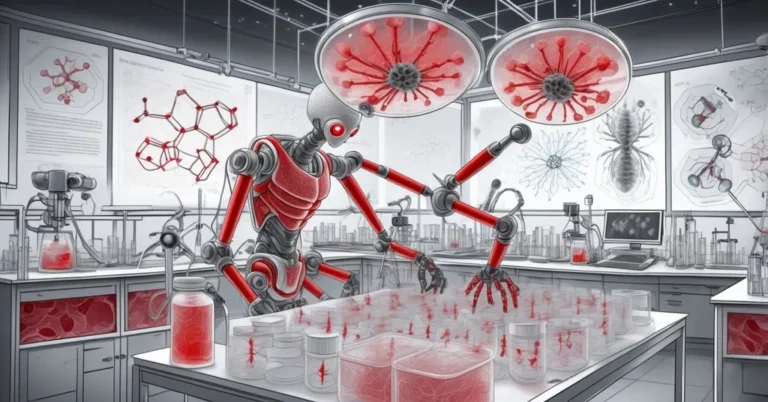
Picture a small-factory-sized lab where robotic arms culture tiny patches of human tissue, dose them with drugs around the clock, and record time-stamped intervention→outcome data. That is the image Vivodyne sells for HIVE, its modular automated-lab system. The company’s argument: without living, causal human data, today’s AI models will keep learning correlations, and keep failing to predict what actually happens in people.
“Absent human testing, what are these [AI] models going to do?”, Andrei Georgescu, Vivodyne CEO & co-founder
What Vivodyne claims
Vivodyne spun out of the University of Pennsylvania in 2021. The company says HIVE can culture roughly 20 kinds of human tissue, autonomously dose and monitor them, and produce high-throughput, longitudinal results intended to teach models causal biology rather than static associations.
- Headline assay numbers (reported by TechCrunch, per Vivodyne): liver toxicity assays with 94% predictive accuracy versus human outcomes, airway tissue matching real human behavior 96% of the time, and bone marrow assays showing 100% concordance across tests of 20 chemotherapy drugs.
- Funding: just under $80 million raised across two rounds led by Khosla Ventures (company reporting).
- Facility: last week Vivodyne opened what it calls a “human data center” just outside San Francisco (company reporting).
- Throughput claim: Vivodyne reports it is already achieving “twice the throughput of all the animal trials being held in the US, ” a company claim. Methods and definitions for that metric were not disclosed in reporting.
Why Vivodyne says current AI approaches fall short
The critique is twofold. First, much biological data feeding AI today are static snapshots: single-cell assays, protein sequences, or animal-model results. Those datasets describe states, not the causal paths between states. Second, models trained mainly on snapshots do not learn intervention→outcome dynamics. They can say “this is state A” or “this is state B, ” but not “A caused B because of drug X.”
“All the training is done on static snapshots of these cells, and the models are not conditioned at all by the how a cell got to that state, ” Georgescu said. “In other words, the model learns ‘this is cell state A, ’ ‘this is cell state B, ’ but never ‘cell state B is the effect of inflaming cell state A.’”
Vivodyne positions HIVE to generate longitudinal, intervention-linked datasets, the sort of sequences useful for causal inference or reinforcement-learning-style optimization, so models can reason about “what if we apply intervention X?” rather than merely correlating features with outcomes.
Where this fits in the wider AI + pharma conversation
There’s real excitement about AI helping drug discovery, but progress turning AI-originated ideas into approved human medicines remains limited. Reporting notes that “a handful” of AI-designed drug candidates have entered human trials and one program has reached Phase III. Breakthroughs like the “Nobel-prize winning Alphafold” (as described in coverage) reshaped structural biology workflows, but simply predicting protein structure has not yet produced an approved drug on its own.
Some industry voices have pushed back on optimistic rhetoric. Anthropic CEO Dario Amodei wrote on X (as paraphrased by reporting) that claims AI will cure cancer have become “more cliché than credible.” Isomorphic Labs, another AI-driven drug company, initially targeted early trials around 2025 and later adjusted its timeline in public comments, showing how delivery dates often shift once discovery runs into translation (company reporting).
Adding to the caution, a recent Nature Methods paper (published last month) reported “no clear data scaling laws when training generative AI models on existing cellular data, ” suggesting that simply increasing volumes of current snapshot datasets has not produced predictable gains in generative-model performance for cell biology.
Credibility checklist, what to verify before you bet on HIVE-like data
- Independent validation: The liver (94%), airway (96%), and bone marrow (100% concordance on 20 chemo drugs) figures are company-reported via TechCrunch. Ask for peer review or blinded third-party replication, plus sample sizes and comparator definitions.
- Metric definitions: Have vendors define “predictive accuracy” and “concordance” (for example, sensitivity, specificity, overall accuracy), provide confidence intervals, and explain the clinical endpoints used as ground truth.
- Throughput methodology: For claims like “twice the throughput of all the animal trials in the US, ” require the math: what counts as an experiment, what exactly is being replaced, and how throughput scales across tissue types.
- Regulatory engagement: Has the vendor shared pre-IND/IDE briefings with regulators or participated in formal qualification pathways? Early FDA interaction matters if you plan to use these data to de-risk trials.
- Ethics and sourcing: Demand transparency on tissue sourcing, donor consent, IRB oversight, donor diversity, and whether tissues are primary, iPSC-derived, or organoid-based.
- Data access and IP: Clarify who owns raw tissue-derived data, models trained on it, and what licensing or data-access arrangements the vendor offers.
Why causality (not just scale) matters for combination therapies
Combination treatments, which target multiple pathways at once, make the experimental space explode. Running every combination in animals or organoids is impossible. What you need is a model that can propose interventions to achieve a desired effect and then reliably predict downstream outcomes in human-relevant biology. That requires datasets that link interventions to outcomes over time, across contexts and cell types.
Vivodyne’s pitch is that HIVE-generated intervention→outcome data provide that missing link. If those datasets prove reliable and are widely validated, they could re-prioritize candidates, reduce late-stage failures, and speed multi-pathway drug strategies. If not, the industry stays stuck converting model outputs into expensive and often unsuccessful human trials.
Practical guidance for R&D and investment leaders
- Require blinded external validation: Before changing go/no-go criteria, insist on independent replication on an external cohort with reported sensitivity/specificity and confidence intervals.
- Insist on data lineage: Negotiate access to raw data or well-documented feature pipelines so your modelers can test hypotheses rather than accept black-box predictions.
- Engage regulators early: If you intend to rely on human-tissue causal data to de-risk trials, brief the FDA or relevant agencies early to align on acceptable evidence and endpoints.
- Set clear KPIs: Define what would justify investment, for example, a demonstrated X% reduction in Phase II/III failure rates, a Y-month reduction in time-to-IND, or a validated uplift in toxicity prediction versus current standards.
- Audit ethical practices: Require documentation on consent, donor diversity, IRB approvals, and safeguards for sensitive donor information.
Key questions, short, honest answers
- Can AI already cure cancer?
No. A small number of AI-originated programs have reached human trials and one report reached Phase III, but routine translation into approved, curative therapies has not occurred (per reporting).
- What is Vivodyne building that’s different?
HIVE: modular, robotic labs that culture about 20 human tissue types and run automated, longitudinal dosing and monitoring to generate intervention→outcome datasets intended to teach models causal biology (company reporting via TechCrunch).
- Are Vivodyne’s headline accuracy numbers verified?
The liver (94%), airway (96%), and bone marrow (100% on 20 chemo drugs) figures are company-reported; methods, sample sizes, and third-party peer review were not disclosed in the reporting describing them.
- Why do static datasets fail for drug discovery?
Static snapshots capture states, not the interventions that caused those states. Without intervention→outcome sequences, models struggle to predict the causal effects of manipulating human biology.
- What would make this approach meaningful for business?
Transparent methods, blinded external validation, regulatory acceptance of human-tissue causal data, and demonstrable reductions in late-stage clinical failures would be the signals that change industry economics.
The pragmatic takeaway
Vivodyne’s message is a useful corrective to hype: algorithms alone will not automatically cure disease. The quality and structure of biological data matter. Generative models trained on snapshots have moved the science forward, but to prioritize safe, effective human therapies at scale we need datasets that link actions to outcomes in human-relevant systems.
Watch for independent validations, published methods, and any formal regulatory engagement from Vivodyne or its partners. If their numbers hold up under scrutiny and regulators accept human-tissue causal data as a credible bridge to human trials, preclinical decision-making could shift. Until then, “AI will cure cancer” is aspirational, and the less glamorous work of creating and validating the right human datasets is where the next practical gains are likely to come from.