
The AI trade priced a Congress that had not yet passed anything
Wall Street did not wait for a bill. After Democrats’ success in that week’s US midterms, traders spent Thursday 5 November 2026 repricing the AI boom on the fear of what a new Congress might do to data centres, not on a law anyone had passed. By Friday morning the Guardian’s market desk was calling it an AI panic. On the evidence in that morning’s reporting, policy had not changed. Prices had.
Thursday’s tape, as the Guardian reported it, was brutal. The Nasdaq fell 5.5%. The S&P 500 lost 4.36%. The Dow dropped 1, 833.06 points, or 3.44%. Jim Reid at Deutsche Bank called that S&P move the biggest slump since the Liberation Day tariff volatility of April 2025. Siraj Datoo put the Nasdaq’s one-day loss of market value at $2.5 trillion. The same coverage also said more than $3.2 trillion came off the wider US stock market. Those are different cuts of one session, not two crashes stacked together.
The sharpest damage sat in the hardware the buildout actually buys. SanDisk slumped 22%. Micron and AMD each lost 17%. Nvidia led the Dow’s fallers, down more than 9%. Reid said the Philadelphia semiconductor index fell 12.25%, its worst day since the pandemic slump in March 2020. The VIX, the market’s implied-volatility gauge, jumped 11.6 points to 28.2, which he called the highest since March, and its biggest daily jump since that Liberation Day period.
Friday’s follow-through was global, and the live prints were still moving. The Guardian had Japan’s Nikkei down about 6%, its worst drop since 7 April 2025, South Korea’s Kospi off 6.7% in one update and about 6.5% in a later caption, and Taiwan’s TAIEX down 4.5%. Reuters put the MSCI Emerging Markets Index down 2.7%, at its lowest since April and heading for a sixth straight weekly decline.
London, with few tech stocks, could not shrug it off. By late morning the FTSE 100 was down 189 points, or 1.75%, at 10, 593, which the desk said would be its biggest one-day drop since 19 March, a session it linked to the Iran war hitting markets. An earlier update had the loss nearer 1.5%.
Two AI fears were trading, and they are not the same fear. Chip and memory names were sold on the bet that spending slows. WPP, off 4.9%, and Relx, off 4.44%, were companies the desk described as thought to be under threat from AI itself. One bet is that the buildout stalls. The other is that the software works.
A story you could trade in an afternoon
The version of events that fit on a screen was simple. A Democrat-controlled Congress would slow data-centre approvals, cool the AI investment boom, and tighten rules on both the models and the buildings full of chips that train them. Stuart Clark, portfolio manager at Quilter, put the mood in one line.
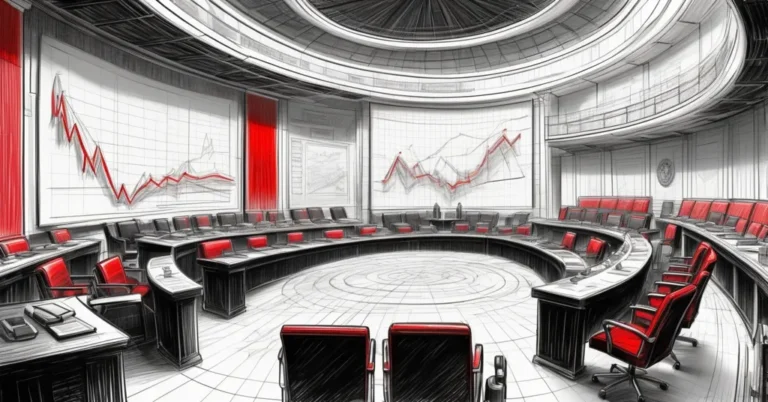
The blue wave at the ballot box has quickly been replaced by a sea of red on investors’ screens.
Clark’s catalyst was tougher AI regulation, covering the models and the data-centre infrastructure behind them. He also made the point that matters if you own an index rather than a stock. A handful of technology and semiconductor names carry so much weight that their falls become the Nasdaq and the S&P 500.
Kyle Rodda, senior financial market analyst at Capital.com, tied the drop to that same contemplation. “The tumble in tech stocks that took hold in the immediate aftermath of the US midterm elections resumed as investors contemplated what a Democrat-controlled Congress may mean for tech regulation and the overall AI boom.” Control of Congress was the thing being contemplated. Friday morning’s reporting did not include chambers, margins, a permitting change, an export rule, or a competition bill.
Christopher Forbes, head of Asia and Middle East at CMC Markets, told Reuters that clients who “were long index, long stocks” all got “carried out.” He framed the session as more than a valuation slap.
And it’s not just a slap in terms of valuation. It’s basically a whole policy and six-year structural shift that says we’re now going to pause, we’re now going to cool AI, we’re now going to cool data centres, approvals and equity capital markets.
That six-year structural shift is his characterisation. Prices do not come with a voter file attached.
The oversight worry was already a Wall Street talking point before Thursday’s crash. On 4 November, Bloomberg reported that some strategists were telling clients to temper the usual post-midterm optimism, because tougher federal and state AI oversight from newly empowered Democrats could slow corporate earnings, and because interest rates were already elevated. The same piece noted that midterm results have historically boded well for stocks whichever party wins, then warned this cycle might not rhyme. In that excerpt, history is a sentence. It does not define which past results count as comparable, and it does not hand anyone a return to hide behind.
What a chief executive should actually take from it
If you are deciding whether an AI-for-business programme still earns its keep, Thursday was a bad teacher and a useful warning.
The stocks that broke were the buildout: memory, accelerators, and the platforms funding new campuses with debt as well as cash flow. A sales team piloting AI agents, or a finance team automating a close, is not the Philadelphia semiconductor index. Those projects live or die on cycle time, error rates, and whether a vendor’s unit economics survive a less giddy capital market. A violent day in Nvidia does not answer that.
It does change the backdrop. A lot of corporate plans quietly assume that cloud capacity, model access, and implementation partners stay abundant and cheap, because public markets will keep funding the build. If Amazon, Meta, Microsoft, and Google (the hyperscalers) stretch their schedules or get pickier about which regions get the next campus, capacity and pricing for AI automation get less predictable. The bottleneck moves from getting the chips to whose capital-spending committee still likes this quarter.
That risk premium is already in the story investors are trading, whether or not a single permit is delayed. Forbes may be wrong about a six-year pause. He is not wrong that clients were positioned for a boom nobody was going to interrupt. A delay, a new rule, or a slower committee is not, by itself, a reason to freeze a well-scoped internal project. It is a reason to stop treating unlimited upstream spending as a feature of nature.
The trade was already arguing with its own bill
Rodda’s other point is the one an election narrative tends to swallow. Regulatory fear, he said, arrived while the AI trade was already on shakier foundations. Earnings season had disappointed. Magnificent Seven results had undershot growth expectations and were flashing warning signs that the pace of AI spending was slowing.
The months before the vote look the same. Reuters, in the Guardian’s account, said tech stocks had been dropping since early October, when the Nasdaq Composite hit a record, and that the Nasdaq 100 then plunged 6.6% over the following month, its biggest monthly fall in 18 months. JPMorgan estimated that global hedge funds lost 3% in October. Reuters also reported that several large multi-manager platforms had cut leverage and laid off loss-making teams in recent weeks, according to market participants who expected more layoffs if the declines continued. The cited problems, before any blue wave, were elevated AI-related borrowing costs and worries over returns.
Borrowed money then did what borrowed money does. Dan Coatsworth, head of markets at AJ Bell, described investors selling tech indiscriminately, some to lock in years of gains, others because they had borrowed to buy and now had no choice. A margin call demands more cash or a sale, and those sales press the market down further. Forced selling does not pause to ask whether the political thesis is subtle.
Valuations had been flashing for weeks. By September, the Guardian noted, the cyclically adjusted price-to-earnings ratio (CAPE, the long-run valuation gauge associated with Robert Shiller) had risen to its highest since 2000. The week’s losses pulled it down. The desk still called it historically high, and gave no current number.
Datoo argued against reading a short burst of red as a regime change. On his figures the Nasdaq was still up 4.6% for the year, even after that $2.5 trillion hit to its market value. The worry he named is the one worth keeping: large companies have invested enormous sums, often with added debt, in a US data-centre buildout, on the bet that it eventually produces big returns. Investors are less sure how long that takes.
A slower buildout is a credit argument
Not everyone on Friday’s tape thought a cooler pace was a disaster for the companies writing the checks.
Mark Dowding at RBC BlueBay Asset Management made the case from the credit side.
Indeed, a regulatory-induced slowing of AI-related projects may actually help ensure that the pace of growth is more sustainable going forward.
Constant upward revisions in spending plans, he said, had produced a deluge of debt and equity issuance, with demand failing to keep pace with supply. If that issuance slows, BlueBay thinks spreads (the extra yield investors demand to lend to those hyperscalers) may stabilise. The firm had been very sceptical of AI-related debt, and was considering adding some. That is a bond argument. It says nothing, by itself, about AI revenue, and it is not a prediction of what Congress will pass.
Mohit Kumar at Jefferies reached a similar refusal of the panic ending, under the louder label “Blue Tsunami.” He admitted that policy uncertainty raises real concerns over AI investment and the pace of the data-centre buildup. He also argued that those projects create jobs, and that Democrats would be reluctant to watch those jobs move to other states or out of the country. AI investment has been a key driver of US growth, he wrote, and he does not see Democrats giving up that engine.
A fortune is not a mechanism
Elon Musk became the face of the chart. That is not the same thing as a cause. The Guardian, citing Bloomberg’s Billionaires Index, put his paper wealth down $33.5 billion on Wednesday 4 November and $79.7 billion on Thursday, around $113 billion in two days, to $785 billion. Set against Jeff Bezos at $370 billion, he was still the richest person on that ranking, by a wide margin. Paper wealth is a mark-to-market. A rebound restores it without a sale. A further slide erases it the same way.
The Guardian also reported that he put $446 million of support into Republican campaigns, which is why his name sits in the political story. Tesla and SpaceX, it reported, fell on both Wednesday and Thursday. None of that explains a double-digit drop in the semiconductor index, which was ugly far beyond those two companies.
Questions worth sitting with before you rewrite the plan
- Did Democrats actually change AI or data-centre policy this week?
No enacted change shows up in the reporting. The sell-off is a bet on future oversight and approvals. A six-year pause is one analyst’s framing, not a statute, and Friday morning’s accounts did not establish which chambers Democrats would control, or by how much. - Should a business pause AI agents and automation because the Nasdaq had a terrible Thursday?
No. Drop the assumption that cheap, endless upstream capacity is guaranteed. Judge the internal project on payback (cycle time, error rates, whether the vendor still makes sense if capital gets pickier), not on a semiconductor index that fell 12.25% in a day. - Could a slower data-centre buildout help the companies paying for it?
Dowding is talking about bond spreads, not about AI revenue. Less debt and equity issuance, in his view, could steady the extra yield investors demand to lend to the hyperscalers. It is a minority credit view beside the panic, and it is a view, not a result. - Is the AI trade already a losing year?
Not on Datoo’s numbers. He had the Nasdaq still up 4.6% for 2026 even after a $2.5 trillion one-day loss of market value. A bad week and a broken bull market are different claims.
What Friday lunchtime still could not answer
With the New York cash open still ahead, the unsettled questions were larger than the red numbers already on the screen. What, exactly, were Democrats in a position to do? Would any of it touch permits, data-centre approvals, or rules on the models, or would the fear fade once the first committee calendar looked ordinary?
Kumar did not expect a rush back in. Institutions have stepped in during past bouts of retail selling, he wrote, but year-end limits risk appetite, and uncertainty around possible US action in Iran suggested investors would not hurry to add risk. Chris Beauchamp at IG still saw more selling as a live risk, with investors watching a possible resumption of the Iran conflict and the oil price after its slump earlier in the week. Daniela Hathorn at Capital.com pointed to the following Tuesday’s US inflation figures as a possible decider of whether equities stabilise or face another round of selling. Friday’s US jobs report was still on the agenda, not in the price as a known result.
The session, written as a tape
If you want the names and the percentages without the political gloss, start with the market desk that tracked the hardware sell-off as it happened.