
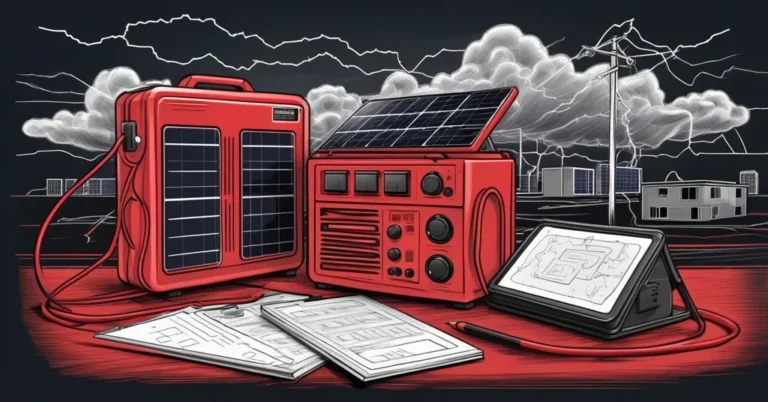
Storm‑Ready Solar Generators: A Practical Checklist for Home and Business
Power outages are more common and longer than many expect: the average U.S. power interruption lasts several hours, and extreme-weather events are increasing in frequency. A portable power station or home backup power array can turn a blackout into a manageable inconvenience — but only if you treat that battery box like the high‑power appliance it is. Small, disciplined steps before a storm make the difference between a lifesaving resource and a costly hazard.
Key actions in 60 seconds
- Store power stations cool, dry, and off the ground; fully charge if a storm is imminent.
- Secure or stow solar panels before high winds; use weather‑rated mounts or bring them inside above ~50 mph gusts.
- Disconnect from the grid during outages to avoid surge/backfeed risks; prioritize refrigeration, medical devices, comms.
- Pair batteries with a ventilated fuel generator for multi‑day outages and run drills to build muscle memory.
Why this matters
Portable solar generators and backup battery arrays give you control when the grid doesn’t. But they have operational limits: temperature and humidity affect charging and discharging, most units can’t get wet, and unsecured panels or heavy power stations become dangerous in wind. Treat them like fuel tanks and heavy power outlets: powerful tools that demand respect and a plan.
Power stations are essentially battery boxes that can also supply thousands of watts of AC — treat them with the same respect as any high‑power outlet.
Before the storm — practical prep that pays off
Make pre‑event work count. The goal is to reduce vulnerability, shorten response time, and preserve capacity.
- Store smart: Keep units indoors in a cool, dry place and off the floor (shelves or pallets). Rule of thumb: keep near normal room temperature; avoid use below freezing or above ~95°F (35°C).
- Top off now: If a storm is forecast, fully charge your portable power station using the grid. A full battery is your single best defensive move.
- Secure or stow panels: Anchor frames and cabling, use wind‑rated mounts, or stow panels indoors when gusts are predicted to exceed ~50 mph. For gusts between 20–50 mph, use straps and ballast.
- Protect from water: Elevate units above likely flood lines; most power stations are not waterproof. Use breathable covers for dust or light spray, but don’t seal wet equipment in plastic.
- Prepare access: Keep a trolley or dolly handy for heavy units; label cables and keep a short list of essential loads to power first.
- Surge protection & transfer: Install a transfer switch if you plan to run hardwired circuits, and use surge protection on grid‑connected inverters to guard against spikes when power returns.
Decision: stow or secure panels?
- Gusts < 20 mph: Secure in place with mounts and mild ballast.
- Gusts 20–50 mph: Strongly anchor, use straps, add ballast; consider stowing if practical.
- Gusts > 50 mph: Stow panels indoors. At these speeds panels can become dangerous projectiles.
During the storm — what to do when the grid goes dark
Act fast and prioritize what keeps people and systems safe.
- Charge essentials first: While mains power is still available, charge phones, radios, medical devices, and battery packs.
- Disconnect if needed: Disconnect your inverter or battery system from the grid during outages to reduce surge and backfeed risk. (Backfeed means sending power upstream into utility lines; it can endanger line crews.)
- Load prioritization: Refrigeration (to prevent food loss and preserve medicines), medical devices, communications, and essential lighting. Everything else is secondary.
- Conserve reserves: Limit nonessential loads and run equipment selectively to stretch uptime until solar or a generator can recharge batteries.
- Safety first: Avoid operating fuel generators indoors or in poorly ventilated spaces. Keep batteries away from combustibles and open flames.
If you expect a storm, fully charge your power station (use mains if needed) and secure or pack away panels—better safe than sorry.
After the storm — recovery and reset
Post‑event hazards are real: downed lines, flood contamination, gas leaks. Do not assume the all‑clear until authorities say so.
- Inspect before reuse: Check units and cabling for water intrusion or physical damage. Don’t charge wet equipment.
- Replenish safely: Recharge with solar when safe; if using a fuel generator, ventilate properly and refuel only when the generator is cool.
- Conserve fuel and charge: Use the generator to top up batteries rather than run all loads directly when fuel is limited — this extends runtime and reduces noise/emissions.
- Document and learn: Note runtimes, failure points, and any surprises. Update your checklist and run another drill.
Quick runtime example and how to size a battery
Concrete math helps planning. Example: a small refrigerator draws roughly 150 watts average (startup spikes higher). A 2 kWh usable battery (2,000 Wh) will run that fridge for about 2,000 / 150 = 13.3 hours idealized. Factor in inverter inefficiency (~85% usable), so realistic runtime ≈ 11 hours.
Simple sizing primer:
- List essential loads and their watts (fridge 150 W, router 10 W, lights 60 W, phone charging 10 W).
- Sum the continuous load. Apply a safety margin for startup surges (refrigerators, pumps) and inefficiency (multiply by ~1.2).
- Decide target hours of autonomy (e.g., 24 hours). Battery capacity (Wh) = total adjusted watts × hours.
- For business use, add redundancy and consider surge capacity for servers/UPS systems.
Li‑ion vs LiFePO4 — practical differences
- Li‑ion: Lower upfront cost, higher energy density, shorter cycle life, and more sensitive to high heat.
- LiFePO4: Longer cycle life, better thermal stability, heavier and more expensive up front.
- For wildfire or extreme heat, placement and distance from combustibles matter more than chemistry; safe installation and ventilation are critical.
Two short case studies
Homeowner — saved groceries and peace of mind: A suburban family topped off their 2 kWh portable station when a hurricane watch hit. They stowed panels and unplugged from the grid. During a 24‑hour outage they powered a small fridge, lights, and phones, lasting through the worst of the storm without food spoilage.
Small business — kept operations running: A neighborhood pharmacy paired a 10 kWh battery cabinet with a propane generator. When a storm caused a multi‑day outage, the pharmacy ran critical refrigeration and point‑of‑sale systems by rotating the generator on to recharge batteries at night, avoiding medicine loss and keeping cash flow intact.
Maintenance, checks, and governance
- Monthly: visual inspection, cable check, firmware updates for smart inverters.
- Quarterly: run generator under load for 20–30 minutes to keep it healthy.
- Annually: full system test and review with a certified electrician, especially before hurricane/winter seasons.
- For businesses: maintain runbooks, assign on‑call responsibilities, and log tests for auditors and insurers.
Advanced: AI, automation, and remote monitoring
Smart energy management makes resilience easier and more efficient. AI agents and automation can:
- Pre‑charge systems automatically when a storm forecast flag trips (weather API integration).
- Auto‑prioritize loads in real time based on criticality, time‑of‑day tariffs, and remaining battery life.
- Predict battery degradation and pre‑schedule maintenance before failures occur.
- Send alerts to operators or on‑call staff and provide remote diagnostics so technicians can triage before arriving onsite.
Look for systems that expose telemetry via APIs or standard telemetry (Modbus, MQTT) and vendors that support secure remote access. For businesses, integrating AI energy management into building management systems can shave costs and reduce downtime during prolonged grid outages.
In high winds, unsecured panels and heavy battery boxes can become dangerous projectiles.
Checklist: Before, During, After
- Before: Charge batteries, stow or secure panels, elevate units, label cables, ready a trolley, install surge protection and transfer switch if needed.
- During: Charge essential devices, disconnect grid if required, run only prioritized loads, operate generators outdoors with ventilation.
- After: Inspect for water/damage, recharge carefully, log runtimes, update plans, run a drill.
Frequently asked questions
How do I protect a solar generator from flood damage?
Elevate units above expected flood lines, move portable stations to higher floors if possible, and never charge or operate wet equipment. Replace any items exposed to contaminated flood water unless a professional inspects them.
Should I disconnect my battery system during a power outage?
Yes, if your system doesn’t have anti‑islanding protection or if instructed by your inverter/manual. Disconnecting reduces surge and backfeed risks. Use a transfer switch or follow manufacturer guidance.
What temperature range is safe for charging portable power stations?
Keep batteries near room temperature. As a practical rule: avoid charging below freezing and avoid charging above ~95°F (35°C). Manufacturer specs vary—check the manual.
Do I need a fuel generator with solar batteries?
For multi‑day outages, yes — a fuel generator extends uptime. Propane stores longer, gasoline has higher energy density. Use the generator to top up batteries rather than run everything directly when fuel is limited.
Where to go for authoritative guidance
Consult FEMA and Ready.gov for generator safety basics, NOAA for storm forecasting and seasonal risk, and manufacturer safety pages (UL/CE specs, inverter manuals) for model‑specific constraints. For permanent or hardwired installations, work with a licensed electrician and check local code (NEC) and NFPA recommendations.
Solar generators and portable power stations are powerful enablers of resilience when used thoughtfully. The hardware isn’t the whole answer — planning, drills, simple precautions, and the occasional backup generator make the difference between an expensive paperweight and a lifeline. Run a practice, review the checklist, and make the small adjustments that keep power working for you when you need it most.
Next step: Run a timed drill this week: move one large unit indoors, deploy panels, and run your prioritized loads for an hour. Measure how long it takes and update the checklist. If your setup is hardwired, schedule an annual review with a licensed electrician.