
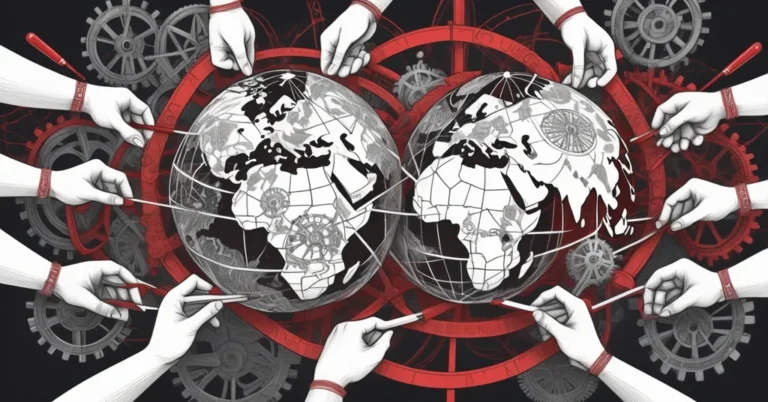
Doomsday rhetoric climbs while publics worldwide back cooperation, a political opening
Nuclear threats are back in the headlines, leaders trade blunt ultimatums, and the Doomsday Clock is “moving ever closer to midnight, ” yet a large new global survey finds most people favour working together across borders rather than retreating into zero‑sum nationalism.
The poll, conducted by Focaldata for the Rockefeller Foundation and cited in Gordon Brown’s new book The Future Starts With Us, covered more than 36, 000 people in 34 countries. Its headline findings: 55% of respondents say they would support “international cooperation”, even if it meant some compromise of their country’s “national interest”; 20% said no. More than 70% want governments to uphold human rights and the rule of law, tackle the climate crisis, regulate AI and strengthen cyber security, and fund humanitarian aid. Eighty percent back a global system to ensure policies that promote peace, stability and dignity, including action against poverty, disease, hunger and illiteracy.
A brief methodological note: the poll sample is large, but full methodological details (field dates, sampling frames, weighting and margins of error) are not supplied in the material here. Those details matter for judging representativeness and should be checked alongside the headline figures.
Why this mismatch matters
Two forces are colliding. On one side, public sentiment, especially among people active in their communities and those with cross‑ethnic or cross‑religious ties, leans toward cooperation. The survey finds such respondents are about 50% more likely to back international collaboration even when it involves some trade‑offs for national interest. Social connection, it turns out, predicts political willingness to compromise.
On the other side, major‑power rhetoric and behaviour are fraying confidence in rules and norms. Vladimir Putin’s line that “no one is ready to play by rules set by one person somewhere far away” and Xi Jinping’s statement that reunification with Taiwan “cannot be stopped by any force or anyone” underline a return to blunt power politics. A recent inflammatory threat against the Iranian people, quoted as “a whole civilisation will die tonight, never to be brought back again” and attributed in the discussion to Donald Trump, illustrates how apocalyptic language can escalate risk without resolving underlying disputes.
This combination, public appetite for cooperation on one hand and elite rhetoric pushing toward coercion on the other, creates a political opening. The question is whether cooperation‑minded states can translate civic preference into institutional change that raises the political and economic cost of coercion.
Institutional leverage, real, but complicated
Brown points to institutional levers as the most practical place to start. He argues that, outside the three most assertive great powers (the United States, China and Russia), a large bloc of countries together hold substantial influence in multilateral institutions, a fact he treats as a basis for coordinated reform. The piece quotes an analysis that, by one counting, puts countries other than Russia, China and the US and their aligned states in control of 75% of the votes at the IMF and World Bank, and it also cites “huge majorities” at the WTO and WHO and the phrase that “12 of the 15 votes, and two of the five vetoes, on the UN security council” are controlled by countries other than Russia, China and the US and their satellites.
Those tallies are not self‑evident and depend on how you define “control, ” “aligned states, ” and the counting method. IMF quotas and voting power is formally weighted by quotas and capital contributions, and the United States retains outsized influence in practice. Any claim about a 75% bloc requires a transparent calculation. Treat the institutional numbers as an argument‑starter rather than a settled technical fact. They show a pathway for coalition politics, but the arithmetic and legal levers need to be spelled out and verified publicly.
Even so, the practical point stands: multilateral organisations govern many of the levers that shape state incentives, lending conditionality, trade dispute mechanisms, pandemic financing, and development priorities. Reforming rules or changing how those institutions operate can alter costs and benefits for governments and corporations, nudging behaviour without relying solely on military deterrence.
Concrete reforms that cooperation‑minded states can pursue
“Renovating the plumbing” of global governance sounds abstract until you map it to specific, achievable moves. Here are practical, politically tractable levers that mid‑sized democracies, countries cited by poll respondents as trusted leaders (Canada, Australia, Italy, Japan, the UK, France, Brazil and South Korea, in that order), could push together.
- IMF and World Bank: Tie climate resilience and public‑health preparedness to lending conditionality and concessional finance, and create faster, smaller emergency finance windows for countries facing shocks. These are changes in operational policy rather than rewrites of articles of agreement, and they can shift incentives for investment and debt sustainability.
- WTO: Pilot expedited dispute arbitration tracks for digital trade and services, and agree mutual recognition arrangements for critical supply chains. Faster, predictable dispute resolution reduces the attractiveness of unilateral tariffs as a policy tool.
- WHO and global health: Back legally enforceable pandemic preparedness standards and a standing rapid‑funding mechanism for outbreaks so countries face clearer costs for nondisclosure and clearer rewards for cooperation.
- UN processes: Coordinate a programme with the incoming UN secretary‑general (Brown suggests agreeing an action agenda to begin work in 2027) that sets measurable milestones on climate finance, debt relief, and humanitarian response.
- AI and cyber governance: Use public procurement as a market lever (require audited, transparent AI systems for government contracts), create a model registry and external audit requirements for high‑risk AI systems, and harmonise export‑control lists for sensitive AI and cyber tools. These are modular, enforceable tools that collectively raise the cost of bad actors deploying risky systems across borders.
None of these is a silver bullet. Enforcing cross‑border norms, whether on cyber intrusions or on AI misuse, requires monitoring, verification and, crucially, credible penalties. Financial coercion remains available to powerful states via mechanisms like secondary sanctions or exclusion from international banking systems. Changing incentives through multilateral rules is a long game, but it is a defensible one.
Who should lead, and what the first steps look like
Leadership will be messy and coalition‑driven, not hegemonic. The countries poll respondents named, Canada, Australia, Italy, Japan, the UK, France, Brazil and South Korea, could form the nucleus of a cooperative coalition coordinated through finance and foreign ministers. Practical first steps:
- By Q4 2027: a memorandum of understanding among willing states to establish a multilateral AI audit fund and a pilot model registry for high‑risk systems.
- By mid‑2028: an agreement among major middle powers to operationalise a rapid WHO financing window for outbreaks and to pilot climate‑linked lending conditions at the World Bank.
- Immediate: begin trilateral or plurilateral dialogues (finance ministers, trade ministers, foreign ministers) to map where institutional voting blocs already support cooperation and where legal or procedural fixes can be implemented without long treaty negotiations.
Those milestones are small but credible. They create momentum, demonstrate benefits, and make coercion more politically costly because it increasingly isolates rule‑breakers rather than merely amplifying their leverage.
Checklist for leaders who want to act, fast
- Agree a 2027 agenda with the incoming UN secretary‑general focused on health, climate finance, AI governance and debt relief, with clear milestones and accountability.
- Use existing institutional majorities where they exist to pass operational rules on transparency, dispute arbitration and rapid financing at IMF, World Bank, WTO and WHO.
- Deploy procurement and market levers for AI (government buying standards, audited vendor requirements, model registries) to shape private‑sector incentives.
- Invest in social‑cohesion programmes at home that encourage cross‑community ties, because they measurably increase public willingness to accept international compromises.
Quick takeaways, three short truths
- Publics prefer cooperation: The Focaldata poll for the Rockefeller Foundation finds 55% globally would back international cooperation even if it required some compromise of national interest; only 20% opposed that trade‑off.
- Institutional reform is the practical lever: Multilateral organisations shape incentives, lending rules, trade arbitration and pandemic finance, and incremental operational changes there can raise the cost of coercion by creating predictable, collective responses.
- Leadership can be coalition‑based: A bloc of like‑minded middle powers can achieve useful binding outcomes without confronting great‑power coercion head‑on, provided they prioritise enforceable rules, credible monitoring and quick deliverables to build trust.
Key questions, honest answers
-
Are people really willing to sacrifice national interest for cooperation?
Yes. In the Focaldata/Rockefeller Foundation survey of more than 36, 000 people in 34 countries, 55% said they would support international cooperation even if it meant some compromise of their country’s national interest; 20% said no.
-
Which issues do publics prioritise for international action?
More than 70% of respondents prioritised human rights and the rule of law, climate action, AI and cyber security, and humanitarian aid; 80% supported a global system to promote peace, stability and dignity.
-
Do mid‑sized powers have institutional influence?
Potentially. Brown and colleagues argue that countries outside the most assertive great powers can marshal voting majorities or operational influence in many multilateral bodies; the exact vote‑share calculations are contested, but the practical point stands: coalitions can use institutional rules to change incentives.
-
Can such cooperation resist coercion from great powers?
Not fully. Financial and military levers remain powerful. The realistic aim is to raise the political, legal and economic cost of coercion by strengthening rules, enforcement and international political isolation when norms are broken.
Gordon Brown’s argument is straightforward: public opinion has already tilted toward cooperation, institutional levers exist, and a coalition of like‑minded states can start using those levers now. The hard work is political, translating civic preferences into verified rules, funding enforcement, and sequencing wins that demonstrate tangible benefits. For finance ministers, foreign ministers and coalition builders in Canada, Japan, the EU, Brazil, South Korea and beyond, the first task is operational: pick a measurable pilot, fund it transparently, and prove that cooperation can deliver better security and prosperity than the rhetoric of division.