
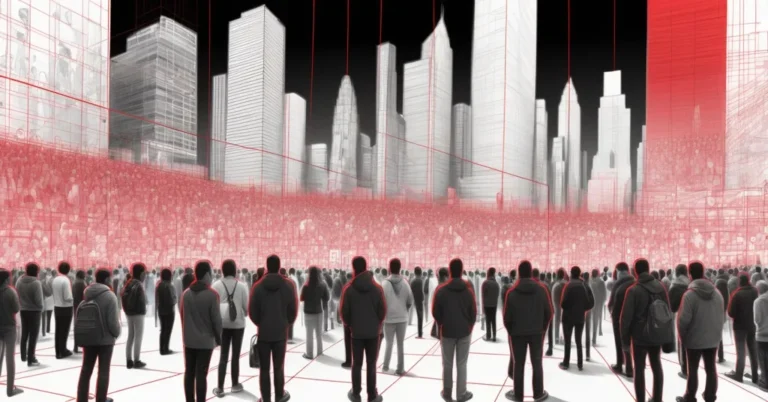
How live facial recognition turned public space into a snapping trap
Walk through a busy town centre and a camera no longer just records — it can compare the face in front of it to a watchlist in real time, ping an officer and trigger an enforcement response within seconds. That speed is the selling point police and retailers emphasise. It’s also what civil‑liberties groups, researchers and wrongly flagged citizens fear most.
How live facial recognition (LFR) works — plain and simple
Live facial recognition (LFR) converts a captured face into a biometric “template” — a numeric summary of facial features — and compares that template instantly to a list of people of interest (a “watchlist”). If the system finds a close match it generates an alert for a human operator to review. The key components are camera capture, template generation, matching against a watchlist, and human review before action.
Think of LFR like a high‑speed metal detector: it flags people for a second look. But just as a detector can misfire on keys and belts, LFR can misidentify people — sometimes with serious consequences.
What the rollout looks like on the ground
Deployments are expanding quickly. The Metropolitan Police has reported scanning more than 1.7 million faces so far this year — an 87% increase versus the same period in 2025 — underscoring the rapid pace of adoption by large public forces. Journalists following an LFR deployment in Croydon observed alerts prompting rapid officer convergences and at least one physical takedown, a scene described as an “instantaneous, technology‑enabled net closing” by a reporter who followed the operation (The Guardian, Robert Booth).
Retailers are adopting commercial products such as Facewatch to flag suspected shoplifters. Those systems have produced arrests and deterrent effects in some cases, but they have also generated well‑publicised false positives. One shopper, Ian Clayton, described being wrongly identified and ejected from a store as intensely invasive — “like being presumed guilty,” he said (Jessica Murray, The Guardian).
Bias, false positives and the human cost
Independent testing and research show a worrying pattern: facial recognition systems can have higher error rates for certain demographic groups. The National Institute of Standards and Technology (NIST) face recognition vendor tests (FRVT) have documented demographic differentials in error rates across multiple algorithms. Academic studies have similarly flagged higher false‑match rates for Black and Asian people compared with white people in many systems.
False positives in a policing or retail context are not a nuisance; they can lead to humiliating stops, wrongful detentions and disproportionate impacts on minority communities. Campaign group Liberty warns the technology can be used to intimidate protesters, applied retroactively to archival images and even used to track children as young as 12 — scenarios that deepen civil‑liberties concerns.
“The whole process happens in a flash,” observed a journalist who followed LFR deployments in Croydon, noting how quickly identification can escalate into enforcement.
Regulation is fragmented — and lagging
Oversight in the UK is split across bodies with different remits. The Information Commissioner’s Office (ICO) handles data‑protection issues and has published guidance on biometric data and surveillance. The Equality and Human Rights Commission (EHRC) focuses on discrimination and bias. Neither regulator on its own provides a complete accountability framework for how police and private actors use LFR.
The Home Office has said it is considering a legal framework for biometric surveillance — a necessary step — but governments repeatedly face a familiar problem: technology adoption outpaces legislation. Courts and watchdogs have intervened before, and several high‑profile cases have forced changes in practice; yet deployments often become institutionalised long before rules are set.
How other jurisdictions are responding
Responses vary. Several US cities moved early to ban government use of facial recognition (San Francisco being a prominent example). At the EU level, the AI Act includes stricter rules for high‑risk biometric systems, and regulators there are pushing for mandatory impact assessments and transparency. Those approaches contrast with jurisdictions that have allowed broad, operational use without explicit statutory limits — a split that illustrates the policy choices ahead.
When is LFR actually effective?
LFR can help identify suspects quickly and deter repeat offenders in some contexts. But effectiveness claims need scrutiny: were arrests based solely on an alert or corroborated by independent evidence? Were wrongful stops later overturned? Public bodies and vendors sometimes highlight operational wins without publishing accuracy metrics disaggregated by ethnicity, age or gender. Independent audits are essential to separate genuine capability from marketing claims.
Business implications: ROI vs reputational and legal risk
For retailers and transport operators, AI for retail security promises lower shrinkage and faster incident response. For police forces, the lure is faster suspect identification. For business leaders, the calculus must weigh operational gains against regulatory exposure, litigation risk, insurance impacts and brand damage when mistakes become public.
- Risks to consider: reputational harm, privacy litigation, civil‑rights complaints, compensation claims, and employee morale if staff must enforce biometric alerts.
- Potential benefits: faster suspect leads, deterrence of repeat offenders, and operational efficiencies when used responsibly and transparently.
Practical protections and procurement guardrails
Technical fixes help but do not remove social risk. Dataset improvements and algorithm updates can lower some error rates, but structural safeguards and policy limits are still essential. Procurement decisions are where businesses can make a real difference.
Procurement checklist for LFR buyers
- Require independent, third‑party bias audits with results published and disaggregated by ethnicity, age and gender (NIST FRVT comparison recommended).
- Set mandatory minimum performance thresholds across demographic groups, not just average accuracy.
- Insist on human‑in‑the‑loop verification before any enforcement action or detention.
- Specify strict data retention limits and deletion policies for biometric templates and camera footage.
- Demand transparent watchlist governance: who can add or remove names, what criteria apply, and an appeals process for flagged individuals.
- Require access logs, regular independent audits and contractual penalties for misuse or failures.
Quick risk matrix (for leaders)
- High likelihood, high impact: reputational damage from false identifications publicised in media.
- Medium likelihood, high impact: litigation and regulatory fines for data‑protection or discrimination breaches.
- Low likelihood, medium impact: operational gains that fail to materialise if public trust erodes and usage is restricted.
Alternatives and mitigations
If the risks outweigh the rewards, leaders have alternatives: improve staffed CCTV monitoring with clearer escalation protocols; invest in better lighting and store layouts to reduce shrinkage; use non‑biometric analytics (behavioural anomaly detection) cautiously; or restrict LFR use to very narrow, legally authorised operations with robust oversight.
What leaders should do now
- Demand transparency: ask vendors and internal teams for independent audit reports, watchlist policies and retention rules.
- Insist on human review: no automated decision should lead directly to detention or expulsion.
- Embed bias testing: require disaggregated performance metrics before purchase and as part of ongoing service levels.
- Update procurement contracts: include clauses for audits, data‑protection compliance, liability and public disclosure of incidents.
- Engage stakeholders: consult legal, compliance and community groups before deployment; prepare a transparent public communications plan.
- Prepare exit criteria: set measurable conditions under which use will be paused or terminated (e.g., breach, audit failure, legal change).
Key questions — answered
How does live facial recognition work?
Real‑time cameras capture a face, software converts it into a biometric template, and that template is instantly compared to a watchlist. Matches produce alerts reviewed by humans before action.
Is facial recognition technology effective?
It can produce operational gains in some cases, but effectiveness is mixed and often presented without independent metrics or demographic breakdowns.
What are the biggest risks?
False positives, demographic bias, covert mass surveillance, tracking of minors, intimidation at protests, and fragmented regulation that fails to enforce safeguards.
Are current oversight arrangements sufficient?
No. In the UK, responsibility is split among the ICO, EHRC and others, and watchdogs warn the patchwork is failing to keep pace with rapid deployments.
Final thought
Live facial recognition is no longer hypothetical — it’s operational, fast and consequential. Technology will keep advancing; the real question is whether public policy, procurement discipline and corporate governance will bend those advances toward safety, fairness and accountability, or allow error and bias to become entrenched. Leaders who act now — with transparency, human safeguards and strict procurement standards — can capture benefits while reducing harms. Those who delay will inherit problems that are far harder to unwind.
Sources and further reading: The Guardian reporting by Robert Booth and Jessica Murray on LFR deployments; National Institute of Standards and Technology (NIST) face recognition vendor tests (FRVT); ICO guidance on biometric data; Liberty reports and commentary on civil‑liberties risks; EHRC statements on discrimination and algorithmic bias; public reporting on Facewatch and retail use cases.