
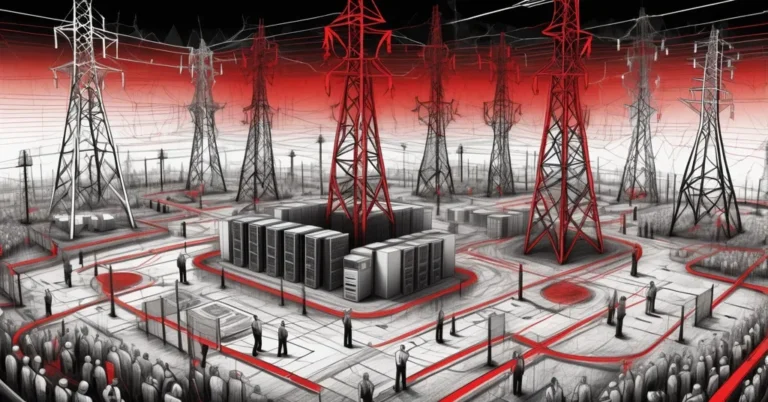
The datacenter backlash that’s uniting conservatives and progressives
Imagine a proposed 550‑acre Google datacenter on a patch of farmland outside a town of roughly 1, 600 people. County meetings reveal opaque negotiations, local officials bound by nondisclosure agreements, talk of new power hookups and transmission lines, and promises of a short construction boom followed by a handful of permanent jobs. The backlash that follows is not the usual partisan script. It is local, visceral, and, in many places, cross‑partisan.
Trackers and local reporting have documented growing resistance. Hundreds of counties and municipalities have placed moratoria, passed restrictions, or tightened permitting around hyperscale datacenters. Organizers on the ground say opposition comes from people who normally disagree, small‑town conservatives, union members, and city progressives, joined by environmental and consumer groups. That mix is what makes these fights politically interesting.
What hyperscale datacenters do, and why communities react
Hyperscale datacenters host thousands of servers that provide cloud services and the compute for large AI models, enterprise software, and other digital infrastructure. They demand significant electric capacity and, depending on cooling systems, can use considerable water. Those needs translate into worries about grid strain, higher rates for residential customers, groundwater withdrawals, industrial noise, and new transmission rights‑of‑way.
Companies respond with sustainability commitments, renewable‑energy purchases, and technical fixes such as more efficient cooling. Communities ask a different question, though: who pays for the upfront grid upgrades, who oversees environmental tradeoffs, and how many real, long‑term jobs will local residents actually get once construction ends?
“I had 50 people I talked to. Nobody wanted that datacenter in their community. And at least a half a dozen people came up to me to say, ‘Hey, I voted for Trump. What the heck’s he doing, supporting these things?’”, Bryce Gustafson, Citizens Action Coalition
Why these fights cut across the political spectrum
Local development disputes often fall into predictable partisan patterns. Datacenter fights do not always behave that way because the grievances are tangible and immediate: perceived secrecy in dealmaking, limited local hiring after construction, and concerns about the environmental and fiscal burden placed on small towns.
“People are realizing that the left‑to‑right divide isn’t as important as the divide between the working class and big corporate interests”, anonymous organizer
Ben Inskeep of the Citizens Action Coalition captures the surprise: “On many issues, people come in with a baked‑in partisan lens that influences their thinking. On datacenters, we don’t have those firm camps formed.” That lack of entrenched partisan alignment lets local opposition bring together unlikely allies.
Politics is already following the zoning map
Local fights have rippled into campaign rhetoric and state politics. Some politicians who once courted tech investment have reassessed their positions after constituent complaints. Others have doubled down on courting datacenter projects as economic development. That tension shows up across party lines: governors, congressional campaigns, and local officials have had to explain or defend their stances when projects land in their districts.
The potential broader political effect has a name in political science: “transformative repolarization, ” a concept tied to scholars such as Jennifer McCoy and Murat Somer. It describes intentionally remapping political conflict away from cultural axes and toward economic ones, for example framing contests as working people versus concentrated corporate power. Datacenter fights are a real testing ground for that idea because they are local and material, not abstract culture‑war quarrels.
“People are seeing that they’re stronger together. It’s a beautiful thing”, Ben Inskeep
That possibility is not guaranteed. Organizers warn that economic grievance can be redirected into exclusionary politics if leaders don’t provide an inclusive alternative. As Inskeep also warns, “Because this can also be used against us. If we are not effective at doing the political education and helping folks through that process, I do think you could have a far‑right, nationalist, anti‑immigrant person use this issue to come to power and then implement horrifying policies.”
Industry perspective and common pushbacks
From the industry side, hyperscalers and cloud providers say these projects bring capital investment, short‑term construction jobs, increased property tax bases, and opportunities for renewable‑energy procurement that can expand local clean energy markets. Companies often point to corporate sustainability goals and long‑term commitments to procure carbon‑free electricity.
Those claims win support in some places, but they do not always address the central community concerns, such as whether promised jobs become long‑term local positions, whether tax incentives are worth the tradeoffs, and whether permitting and deal terms are transparent enough for meaningful public oversight. Where promised benefits appeared thin or poorly enforced, opposition hardened quickly.
Three plausible trajectories
- Localized containment: Local governments strengthen zoning rules and impose moratoria, producing a patchwork of restrictions that slow but do not stop national buildout.
- Durable cross‑partisan pressure: Local fights coalesce into a broader political coalition that wins state or federal reforms on transparency, public costs, and community benefits.
- Co‑option: Grievances are captured by exclusionary or nationalist actors who translate local anger into harmful policy unrelated to community protections.
Which path prevails will depend on who organizes, the narratives they promote, and whether concrete policy alternatives are offered. The moment is an opening for policymakers, labor groups, climate organizers, and local leaders to convert diffuse outrage into enforceable rules rather than leaving a vacuum that opportunists can exploit.
“For the first time in generations, the billionaire class has overreached in a way that Americans of all stripes and ideologies are finding equally repulsive”, unattributed
Practical, politically defensible proposals
Policymakers and local leaders who want to preserve investment while protecting residents can pursue several concrete measures. These are practical proposals, not anti‑investment dogma, aimed at rebalancing who pays and who decides.
- Transparency in deals. Prohibit use of NDAs to hide the terms of public incentive packages or infrastructure agreements. Publicize any tax or utility abatements tied to a project before votes are taken.
- Independent environmental and grid impact reviews. Require third‑party assessments of water withdrawals, air and noise impacts, and the utility upgrades needed, and include mitigation plans that allocate costs fairly.
- Performance‑based incentives with clawbacks. Tie subsidies to verifiable outcomes (local hiring, sustained tax contributions) and include enforceable clawback provisions if promises aren’t met.
- Workforce and procurement conditions. Negotiate community benefit agreements and hiring pipelines so construction and operations translate into local economic opportunity.
- State‑level standards for resource use. Where local capacity is limited, set statewide thresholds for water withdrawals and require meaningful contributions to grid upgrades rather than socializing the costs onto ratepayers.
These steps do not block AI or cloud investment. They change the terms of engagement so communities receive clearer benefits and retain democratic oversight.
For business leaders: simple actions that reduce political risk
- Be transparent early. Publish the basic terms of any proposed incentive deal and allow for public comment before final votes.
- Make community benefits enforceable. Convert promises into contracts with measurable milestones, local hiring commitments, and clawbacks.
Key takeaways, questions you’ll want answered
-
Why are communities opposing datacenters?
Opposition centers on tangible, local impacts: worries about water withdrawals and noise, strains on local electric systems and ratepayers, opaque dealmaking (NDAs), eminent‑domain concerns, and relatively few long‑term local jobs compared with the scale of corporate investment.
-
Who is mobilizing?
Local organizers, consumer and environmental groups, climate activists, some labor voices, and residents across the partisan spectrum, from conservative small‑town voters to urban progressives, are at the forefront.
-
Could these fights reshape national politics?
They could. Political scientists call the possibility “transformative repolarization”: reframing conflict around economic power and oligarchy versus working‑class interests. Turning local energy into durable national pressure requires organization, policy proposals, and inclusive narratives.
-
Is there a risk of co‑option?
Yes. Organizers and some analysts warn that if the movement lacks inclusive leadership and political education, economic grievances could be co‑opted by exclusionary forces that pursue dangerous agendas.
-
Will this stop datacenter construction?
Local bans and moratoria can block individual projects, but federal policy, corporate strategies, and state incentives mean a nationwide halt is unlikely without coordinated state or federal action. Expect a patchwork of outcomes unless rules are harmonized at higher levels.
Datacenter fights are a rare political aperture: local, material, and embedded in the global business of AI compute. For policymakers and business leaders who want less conflict and better outcomes, the answer is not reflexive opposition to technology. It’s smarter rules that protect communities, ensure transparency, and align private incentives with public goods. Miss that chance, and a moment of cross‑partisan energy could either fade or be put to use in ways few intended.
“I’ve been waiting a long time for people to wake up to how they’re being ripped off.”, Bryce Gustafson