
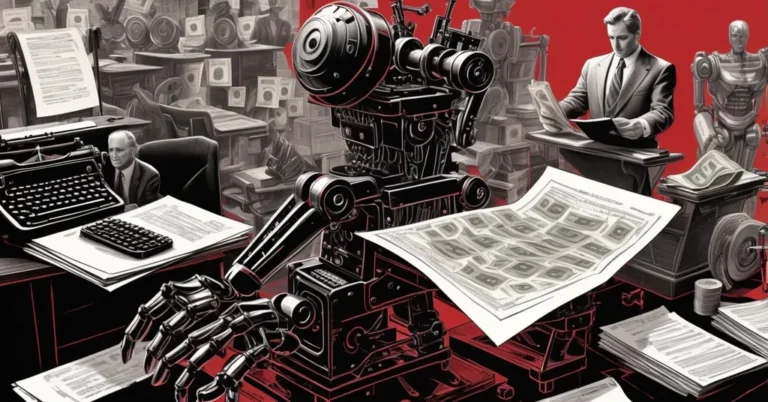
“It’s very production specific. It’s teaching it how to take our jobs.”
That line, from screenwriter‑producer Ruth Fowler, cuts straight to the paradox facing many seasoned Hollywood creatives. They are being hired to teach AI systems the workflows that define their careers. Writers, producers and directors with credits at BBC, Paramount and major U.S. networks are taking paid gigs to author evaluation exercises, correct outputs and demonstrate real working behaviors, because the steady pipeline of production work has become uneven and precarious.
Where the squeeze is coming from
Multiple forces converged: pandemic disruptions, the 2023 writers’ strike, and streaming platforms trimming investment. The industry data are stark. FilmLA Research registered deep declines in some production measures across recent years; the organization’s reporting is cited for a 48% drop in shoot days in Los Angeles between 2021 and 2025 (FilmLA Research). At the national level, the Bureau of Labor Statistics shows notable contraction, with jobs in motion picture and sound recording industries falling from 450, 000 in July 2022 to 326, 000 in May 2026 (Bureau of Labor Statistics).
Those shifts help explain why experienced creatives are doing short, paid evaluation gigs. As Ruth Fowler has said, “because I was thinking: wow, I’m always broke.” Freelancers describe those jobs as immediate cash, annotating shot lists, building mock pitch decks, or cleaning up noisy transcripts.
What this training work actually looks like
These engagements typically go beyond generic labeling. Training agencies recruit domain experts to craft realistic, production‑specific tasks, often called evaluation tasks, that teach or test model behavior. A public Micro1 posting asked for producers with “demonstrated mastery in film, television, digital, or live event production” and more than five years of credited project experience. The ad advertised pay up to $85 an hour and instructed candidates to “design and author evaluation tasks that simulate realistic production‑management scenarios, such as budget reconciliation, scheduling adjustments, and vendor or crew coordination” (Micro1).
- Design a detailed schedule for a hypothetical two‑day shoot, permits, daylight, child‑protection needs, crew per shot, based on emails and a shooting script.
- Assemble a pitch deck that lays out tone, market positioning and financing angles so the model learns how to structure sellable ideas.
- Transcribe noisy documentary footage, tag speakers visually, and characterize accents to improve speaker ID and subtitle quality.
Reported pay varies widely. Sources put the range between about $12 and $200 an hour; Micro1’s public posting shows rates up to $85 an hour. That spread reflects a market split between low‑paid microtasks and short‑term consultancy rates for senior practitioners.
The emotional cost, and the pragmatic logic
There’s a palpable ambivalence among people doing this work. An anonymous Los Angeles documentary director described the feeling bluntly: “I was essentially handed a shovel and asked to dig the grave of my profession.” Jody Wheeler, a 56‑year‑old screenwriter who has done evaluation work and taught at USC, frames it another way: “You can see this as kind of giving people a shovel to bury themselves with. It can also be the case that you’re giving people a shovel to help them unearth stuff that they wouldn’t have been able to do themselves before.”
Other practitioners emphasize the practical side. An unnamed TV writer with credits across major platforms said the work “is keeping me afloat without letting me have to stress, ” while also noting that current models “are no closer to approximating human emotion … there’s no nuance.”
Why studios, platforms and AI vendors are hiring creatives
Business demand is simple, fidelity equals product value. If a model can deliver reliable schedules, budget reconciliations, accurate noisy‑audio transcripts, and competent pitch decks, that’s a feature studios and post houses can deploy at scale. Netflix told reporters it used AI in 300 of its roughly 1, 000 titles in 2026 (Netflix). At the strategy level, Boston Consulting Group’s April analysis estimated that 10%, 15% of US jobs could be eliminated by AI and that more than half of roles could be reshaped (Boston Consulting Group, April analysis).
That creates immediate demand for short, domain‑expert engagements, because studios and vendors need domain knowledge to teach models how to act in industry‑specific ways. Whether the eventual outcome is augmentation, AI as a force multiplier, or substitution, AI replacing roles, depends on technical progress, procurement choices, contract law, and commercial incentives.
What we know, and what remains open
- Known: Experienced creatives are doing paid evaluation and annotation work for AI systems. Agencies such as Micro1 have publicly advertised producer roles tied to evaluation tasks, and creatives report variable pay and short engagements.
- Known: Production activity and employment in the sector have shifted notably since 2021, with FilmLA and BLS figures documenting declines in many measures (FilmLA Research; Bureau of Labor Statistics).
- Open: How many creatives overall are doing this work, the exact scale of the training‑gig market, and the detailed contractual terms under which their labor is used (IP, reuse, revenue share) remain unclear.
- Open: Which agencies contract directly with which large model developers, and on what terms, are matters best described as “reported by sources” unless confirmed on the record by the companies involved.
Risks that go beyond the paycheck
Short gigs pay now, but they carry structural risks for individuals and the industry:
- IP and reuse. Many contracts for evaluators and annotators grant broad licenses to use content in model training. Being paid once for work that becomes part of a commercial product is not the same as retaining ownership or sharing in downstream revenue.
- Bias and harm. Tasks that tag accents, describe appearance, or infer speaker attributes can bake stereotypes into models unless evaluation panels, rubrics and audits explicitly guard against that outcome.
- Unequal compensation. Wide pay dispersion, single‑digit hourly microtask rates versus senior consultancy rates, creates inequities. Those with bargaining power capture the upside.
- Creative flattening. Even if models today lack “nuance, ” repeated optimization on aggregated datasets risks smoothing distinctive voices toward an average, compressing the premium for singular artistic choices.
Practical moves for business leaders and creatives
This is a strategic choice, not merely a sourcing decision. Below are concrete actions for each stakeholder.
For studios and platforms
- Segment automation, automate administrative and repetitive workflows (transcription, file formatting, basic scheduling) but keep human control over story editing, tone and final creative decisions.
- Negotiate value sharing, consider licensing terms, attribution, or revenue‑share models when third‑party experts materially shape models used commercially.
- Track pilot KPIs, measure time to schedule, budget error rate, blind creative‑quality scores, and talent churn when deploying AI in production workflows.
For AI vendors
- Publish QA and ethics standards for creative tasks, require bias audits, diverse evaluator panels, provenance tagging and differential‑privacy approaches where appropriate.
- Be transparent about vendor relationships, disclose whether third‑party agencies provide evaluators and allow audit or redress routes for contributors.
For creatives and unions
- Demand contract clarity, insist on explicit language about IP, licensing scope, duration, and commercial reuse.
- Up‑skill into higher‑value roles, learn model supervision, prompt design, evaluation rubric authoring and curator roles that capture more of the value chain than raw labeling.
- Leverage collective bargaining, negotiate standardized pay bands and reuse protections for evaluation work performed by union members.
Simple contract checklist creatives should insist on
- Scope: Is the engagement a one‑time work‑for‑hire, or a license? If a license, is it exclusive or non‑exclusive, and for how long and where?
- Purpose limitation: Specify allowed uses, evaluation only; no commercial derivative products without additional compensation.
- Attribution and revenue: Who gets credit? Is there any revenue‑share or royalty if the material contributes materially to a commercial product?
- Revocation and audit: Can the contributor audit how their output was used? Can they revoke or limit reuse for sensitive content?
- Data hygiene and privacy: Requirements for anonymization, retention limits, and bias/ethics oversight for sensitive annotations.
KPIs leaders should track in AI-for-production pilots
- Time saved per task: e.g., average minutes to produce a schedule or transcript vs. human baseline.
- Error rate / rework: percent of outputs requiring human correction and average correction time.
- Creative quality: blind review scores by human evaluators comparing AI‑assisted outputs to fully human outputs.
- Talent impact: changes in freelance bookings and staff churn tied to automated workflows.
How to treat the moral paradox
It’s tempting to moralize, don’t teach the systems that can replace you. That’s a luxury few can afford. A more durable strategy balances short‑term survival with long‑term safeguards, including shrewd contracts, audit rights, transparency about reuse and active ethical review of evaluation tasks. The alternative is a market that monetizes creative labor once and then scales automated substitutes without sharing value.
Key takeaways, questions you should be asking
-
Why are established creatives training AI models?
Because production work has become patchy and unreliable; many seasoned professionals are taking paid evaluation and annotation gigs to supplement income while production declines. Ruth Fowler put it plainly: “because I was thinking: wow, I’m always broke.”
-
How much are people getting paid to train these systems?
Reported rates vary widely, from roughly $12 to $200 an hour in some reports, while a Micro1 job posting advertised pay up to $85 an hour for experienced producers. Pay depends on task complexity, the hiring agency, and whether the work is microtasked or consultancy‑style.
-
Which tasks are creatives teaching AI right now?
Concrete examples include constructing realistic shoot schedules (permits, child‑protection, daylight), authoring pitch decks, and transcribing noisy footage with speaker visual guides and accent characterization, tasks intended to teach models industry workflows and edge cases.
-
Is this accelerating job loss in the industry?
Industry employment and production activity have shifted significantly, BLS employment figures and FilmLA Research document major changes, but causality is complex. Boston Consulting Group warns of substantial labor reshaping (10%, 15% of jobs could be eliminated in some scenarios), while other indicators show category‑specific recovery in early 2026. Whether current training work predominantly enables augmentation or accelerates substitution remains an open question shaped by contracts, regulation and market choices.
-
What should companies and creatives do differently right now?
Make contract terms explicit about IP and reuse, audit evaluation tasks for bias, treat human experts as strategic partners rather than disposable annotators, and design workflows that keep high‑value creative decisions in human hands. Track KPIs in pilots and require transparency from vendors about how contributor labor is used.
The picture is clear, talented people are monetizing domain expertise to build tools that could reshape their industry. That tension won’t vanish on its own. Fix the contracts, require auditability and bias mitigation, and design procurement so subject‑matter experts are partners in value creation, not just unpaid inputs to someone else’s product.