
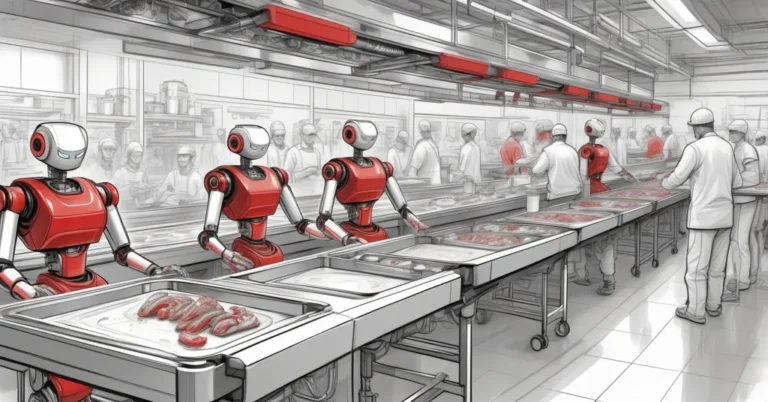
How Robotic Plating Helped a Tenderloin Kitchen Keep Meals Flowing
When a pair of robotic arms began scooping and placing trays at Project Open Hand’s Tenderloin kitchen, the sound was soft but the effect was immediate: the team could keep medically tailored meals moving out the door even as volunteer numbers stayed low. The point of the machines wasn’t to replace people—it was to pick up the repetitive, high-volume work that used to rely on large groups of volunteers.
The problem: a volunteer shortfall meets steady demand
Project Open Hand, founded in 1985 by Ruth Brinker, prepares and delivers medically tailored meals for people with conditions such as HIV, heart disease, diabetes, and kidney disease. Its assembly-line model historically leaned on volunteers and corporate groups. Since the pandemic, that labor pool has not rebounded to prior levels, leaving a capacity gap in a neighborhood—San Francisco’s Tenderloin—where need is concentrated.
The solution: robotic plating at the conveyor
Chef Robotics, a San Francisco startup, rents modular plating robots that attach to a conveyor assembly line. They don’t cook or chop; they scoop and deposit repeatable portions of ingredients. At Project Open Hand two robots run for a few hours each day. Human teams still prepare, cook, chop, and perform quality control—robots add a predictable burst of throughput when volunteers are scarce.
Here are the clear numbers from the deployment:
- Baseline human throughput on the line: ~500 meals per hour.
- Incremental throughput when the robots run: roughly +200 meals per hour (combined output from the two robots during their operating window).
- Robots operate a few hours daily during peak assembly shifts; they are integrated into an otherwise human-led process.
“The benefit isn’t primarily speed—it’s filling a gap caused by a lack of volunteers.” — Alma Caceres, sous chef
Chef Robotics focuses narrowly on plating and assembly (the robotic “hand” or tool is reconfigurable for different ingredients). The company treats how food moves and changes as an engineering problem—constraining the task so software and tooling can make it repeatable. That pragmatic approach is why the same robotic arms are already working in commercial kitchens for companies like Amy’s Kitchen and Factor.
“Turning the messy physics of food into repeatable motions makes plating a software and scalability problem.” — Rajat Bhageria, CEO of Chef Robotics
Five practical lessons for leaders
1. Pick one repeatable task
Start with a narrow, high-volume job—plating, portioning, or a single pick-and-place motion. Food is hard to automate because it changes shape and sticks; limiting scope boosts reliability and ROI.
2. Measure performance in simple KPIs
Track meals/hour, plate reject rate, downtime, and volunteer hours freed. Project Open Hand’s pilot shows a ~40% throughput boost during the robots’ operating window (500 → ~700 meals/hour). For pilot targets, aim for a 30–40% boost and keep plate rejects under 5% as an initial quality threshold.
3. Keep humans where judgment matters
Robots reduce repetitive strain and monotony, but humans handle cooking, troubleshooting, messy foods, and the dignity work—packing notes, personal interactions, and quality checks.
4. Use subscription models to avoid heavy capital outlay
Rentals typically include maintenance, software updates, and training. That makes it easier for nonprofits to pilot without large upfront investments, but negotiate short commitments and a clear exit clause.
5. Treat optics and communication as operational work
Explain to volunteers and beneficiaries that automation augments capacity, not community. Offer higher-value volunteer roles (quality control, community liaison, cooking assistance) so engagement evolves rather than disappears.
Costs, KPIs, and a short pilot roadmap
Financials vary by vendor and usage pattern. Rather than a cost figure, leaders should evaluate four variables when judging ROI:
- Incremental meals required each day to meet demand.
- Subscription fee structure (daily/weekly/monthly) and what it covers: maintenance SLA, spare tooling, software updates, and training hours.
- Operational uptime and error rates during the pilot window.
- Volunteer and staff hours reallocated to higher-value work.
A pragmatic 60–90 day pilot looks like this:
- Weeks 0–2: Define scope—one or two assembly shifts, set KPIs (meals/hour, reject rate, downtime).
- Weeks 3–6: Install, train staff, integrate with existing HACCP and food-safety procedures, and run initial trials.
- Weeks 7–12: Measure, tweak tooling and recipes, collect volunteer/staff feedback, and compare costs per meal pre/post pilot.
- End of pilot: Decide—scale, renegotiate, or exit with metrics-based justification.
Key questions leaders ask
- Can automation fix volunteer shortfalls?
Yes. Robotic plating can immediately supplement lost volunteer capacity and add measurable throughput, while leaving core cooking and human-facing work intact.
- Are robots ready to replace cooks?
No. Current food robotics excel at repetitive pick-and-place and portioning. Complex cooking, chopping, and judgment-heavy tasks remain human responsibilities.
- Does renting robots make sense financially for nonprofits?
Sometimes. The subscription model removes big capital expenses, but the decision should be driven by required meal volumes, the value of consistency, and alternative staffing costs.
- Will automation discourage volunteerism or attract corporate engagement?
Both are possible. Automation can remove tedious tasks and create new, higher-value volunteer roles; it can also act as a signal to corporate partners that the nonprofit is open to innovative partnerships.
Risks, ethics, and community optics
Automation introduces tradeoffs beyond cost and capacity. Consider three pragmatic mitigations:
- Community messaging: Frame robots as tools that protect service levels and improve meal quality. Publicize the roles humans continue to play.
- Job displacement concerns: Re-skill volunteers and staff into supervisory, quality-control, and meal-delivery roles. Use automation to reduce burnout, not headcount.
- Operational single points of failure: Maintain manual SOPs for peak days and ensure vendor SLAs include fast-response maintenance and clear escalation paths.
“Nonprofits often default to scarcity thinking; that prevents them from adopting innovations that improve quality for the people they serve.” — Paul Hepfer, CEO of Project Open Hand
Negotiation and vendor tips: what vendors want to hear
- Promise clear, short-term pilots and measurable outcomes.
- Ask for training hours, on-site setup, and a rapid-replace policy for tooling and parts.
- Negotiate a performance SLA tied to uptime and acceptable reject rates and include an exit clause after the pilot.
- Request data access for performance analytics—this helps quantify impact and supports future funding requests.
Executive checklist: five immediate actions
- Identify a single repeatable task — choose one station (plating, portioning) where the robot can run without touching cooking or final QA.
- Set 3 KPIs — meals/hour, plate reject rate (<5% target), and volunteer-hours freed.
- Negotiate a short subscription — 60–90 days with clear maintenance and exit terms.
- Plan communication — craft messaging for volunteers, donors, and beneficiaries emphasizing augmentation, not replacement.
- Prepare fallback SOPs — train staff to run the line manually during downtime and schedule regular maintenance checks.
Food robotics and AI agents are not a silver bullet, but they are a practical tool in the leader’s toolkit. When deployed thoughtfully—focused on a single, high-volume task, measured with simple KPIs, and paired with honest community communication—robotic plating can turn a volunteer shortfall into a reliable service model that keeps meals arriving for people who need them.