
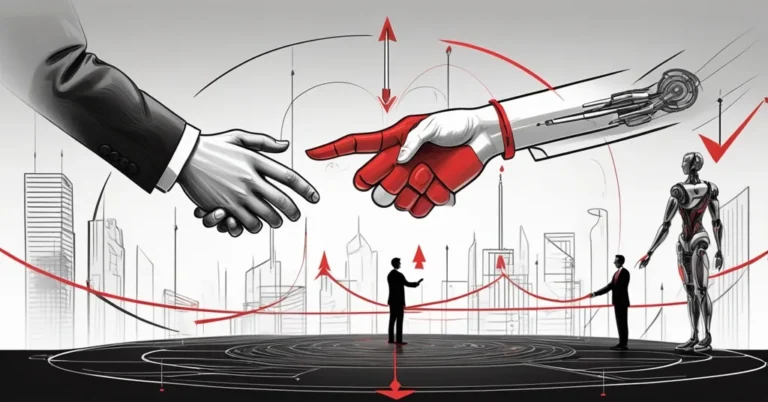
What technology takes from us — and how businesses can design AI to give it back
Convenience-first AI is shrinking the messy human practices that build judgment, trust and civic resilience — and companies need to design differently.
Convenience is a tool — not a destination. Use it to create time for the human work machines can’t do.
How AI agents change everyday human contact
A touchscreen at the counter saves a grocery chain minutes per customer. An app automates check-ins and replaces a receptionist. A startup ad promises an AI coach that will whisper the perfect line during a first date. These are small design choices. Together, they change what daily life feels like.
Silicon Valley’s ideology prizes measurable improvements: faster transactions, higher conversion rates, fewer support tickets. Chip Ward’s phrase, the “tyranny of the quantifiable,” captures the logic. When value is what you can easily count, systems push us to shave seconds and reduce human touch. The result is not only different UX; it is a different public life.
Examples point to a pattern. Restaurants offer app ordering that skirts a quick greeting. Bookstores and indie shops report younger customers avoiding eye contact and conversation in favor of search-and-buy. Wearable augmentation—think early Google Glass and newer smart-glass concepts—promises constant prompts and on-demand coaching. “Always-on” nudges become a substitute for the slow, exploratory habits that used to link neighbors to place and to one another.
Why ChatGPT and AI companions aren’t a substitute for human judgment
Large language models like ChatGPT and a new class of AI companions help professionals draft faster, summarize complexity and close transactional gaps. Yet their very strengths reveal their limits: scale, fluency and affirmation do not equal moral friction or embodied care.
Research offers clear signals. James Coan and colleagues have shown that simple physical contact—holding a hand—can dampen physiological stress responses when people expect a mild electric shock. That kind of social regulation matters for how people face danger, loss and grief. Sherry Turkle’s work documents how screen-centered life erodes the capacity for solitude—a quiet prerequisite for reflection and empathy. Neuroscientist Molly Crockett contrasts in-person spiritual and moral teaching, which tests and challenges students, with chatbot simulacra that often mirror back what the user already believes.
Philosopher Carissa Véliz warns about the danger of flatterers: when interfaces and agents affirm without contest, users lose a crucial reality check. Therapists note that useful friction—the small resistance and disagreement in human relationships—is often where growth happens. An AI that optimizes for comfort and engagement risks turning corrective friction into an afterthought.
That is not to say AI does nothing good. For many people, well-designed tools increase access to information, help maintain long-distance relationships, or provide cognitive scaffolding. But the claim that AI can fully replace embodied consolation, classroom apprenticeship, or the corrective force of a skeptical colleague is overstated. The right question for leaders is not “Can AI do this?” but “Should AI do this, and if so, under what human oversight?”
Evidence and real-world consequences
Education has been an early battleground. LLMs make drafting easier and have blurred the line between assistance and substitution. Some classrooms addressed this by integrating models as tutors—students submit drafts, receive model-generated feedback, and then meet in person with a teacher to discuss revisions. Those programs report better learning outcomes than either unrestricted model use or model-less instruction alone.
Healthcare and caregiving offer another illustration. Telemedicine platforms can triage cases and increase specialist access. Yet studies and clinician reports show tele-visits do not fully replace in-person checks for complex diagnoses or emotional care. Hybrid models—initial triage via telehealth plus scheduled in-person check-ins—tend to balance efficiency and embodied assessment.
Public life frays when micro-interactions disappear. Casual exchanges at local shops, libraries and transit stops seed trust and situational knowledge—key ingredients for community resilience during crises. Recent severe weather events highlighted how neighbors, volunteers and local institutions—people showing up in person—remain the backbone of rescue and mourning in ways algorithms can’t replicate.
Business impact: metrics, trade-offs and the long-term view
Short-term KPIs reward speed and lower cost. But those metrics can mask trade-offs with long-term assets: customer loyalty, employee judgment, and civic trust. Companies that automate every touchpoint may see short-term throughput gains but erode customer attachment and employee retention over time.
Concrete KPIs to consider when weighing automation against human contact:
- Net Promoter Score (NPS) and repeat visit rate
- Customer lifetime value (CLV) instead of single-transaction conversion
- Employee mentoring hours and internal promotion rates
- Quality audits of AI outputs (incidence of harmful or misleading advice)
- Wellbeing surveys for customer-facing staff and users
Case vignette — Retail. A regional coffee chain piloted an “assist, don’t replace” approach: AI prompts reminded baristas of returning customers’ names and recent notes, but customers always interacted with a person at checkout. Conversion metrics stayed stable; NPS improved and repeat visits rose 7% across test stores. The company tracked mentorship hours and found that pairing new hires with experienced baristas (rather than automated onboarding alone) reduced turnover.
Case vignette — Education. A public school introduced an LLM as a revision coach. Students received model feedback but were required to submit a revised draft and meet with a teacher for oral defense. Graduation rates for writing assessments increased, and teachers reported richer classroom discussions—because students came to class with concrete critiques to argue or accept.
Designing AI for human flourishing (not just efficiency)
Design patterns that preserve human practices are practical and scalable. They keep AI as a tool that augments judgment and presence rather than replacing them.
- Human-in-the-loop for high-stakes tasks: Require a real person to review or authorize AI outputs in areas like emotional support, legal advice, or educational assessment.
- Friction-preserving UX: Build small, deliberate moments that require human expression—e.g., a prompt that asks a barista to ask a guest one question about their day, or a checkout flow that offers a brief human greeting before completing a sale.
- Transparent AI: Clearly label AI-generated content and give users options to revise or contest suggestions. Make the model’s confidence and limitations visible.
- Social distribution features: Use AI to route volunteer requests, organize neighbor check-ins, or surface local resources—tools that strengthen social infrastructure rather than replace it.
- Encourage corrective perspectives: Build systems that surface dissenting viewpoints or critical feedback instead of always optimizing for agreement and engagement.
Practical checklist for product teams
- Map emotional stakes: Label features by emotional/civic impact (low, medium, high). Apply human-in-the-loop for medium and high impact areas.
- Define friction goals: Identify which interactions are valuable because of their friction (e.g., mentorship, negotiation) and preserve them in UX flow.
- Measure beyond speed: Add retention, CLV, NPS, mentorship hours, and wellbeing metrics alongside efficiency KPIs.
- Audit AI outputs: Regularly test for harmful advice, sycophancy, and hallucinations; publish remediation plans.
- Make contestability easy: Let users flag or edit AI suggestions and require human review for contested cases.
- Design for physical follow-through: If a digital nudge suggests a neighbor check-in, make in-person meetup options easy to schedule and safe to attend.
- Train teams on moral friction: Reward employees for difficult conversations and mentoring, not just throughput.
Nuance: where AI helps
Balance matters. AI expands access, helps people with disabilities communicate, connects relatives across distance, and automates error-prone administrative work. These are real, measurable gains. The goal is to deploy those strengths while avoiding wholesale substitution of human judgment and care.
Recommended reading and sources
- Sherry Turkle — Reclaiming Conversation (on solitude, attention, and empathy)
- James Coan — research on social regulation and threat response (hand-holding studies)
- Carissa Véliz — work on privacy and digital ethics
- Molly Crockett — research on moral psychology and social learning
- OECD and academic reports on human-in-the-loop AI and AI ethics frameworks
Visuals and accessibility suggestions
- Infographic: “What AI can do vs. what only humans can do” (single-column)
- Sidebar: One-page “Human-in-the-Loop Design Checklist”
- Alt-text examples: “Barista using an app to recall a customer’s name,” “Teacher and student discussing a revised essay after AI feedback,” “Neighborhood volunteers coordinating in person after a flood.”
Final prompt for leaders
Technology is not destiny; it is design. Product teams, executives and policymakers decide whether AI becomes a force that hollowed out everyday bonds or a set of tools that frees time for human repair. Start by measuring different things. Design for presence. Protect friction where it matters. And use AI to create space for the slow, difficult work that builds judgment, resilience and civic trust.
Next step:
Ask your product and policy teams to run a 90-day audit: catalogue features that remove human contact, identify the emotional stakes for each, and rerun your ROI models with retention and wellbeing metrics included. If your models change, you’ll know the work ahead is not just technical — it’s ethical and institutional.