
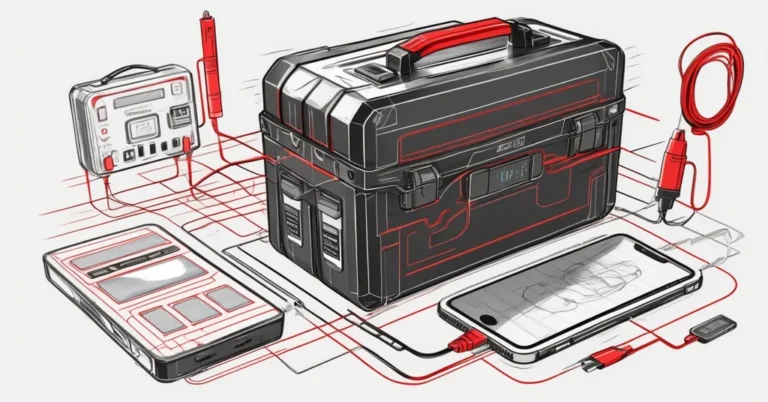
Bluetti AC180 Review: Portable Power Station for Business & Edge AI
TL;DR: The Bluetti AC180 is a mid-size LiFePO4 portable power station that balances high sustained output, fast recharge, and long battery life in a 35 lb package. It reliably meets advertised specs (1,152 Wh, 1,800W continuous, 2,700W surge), supports 1,440W “turbo” AC charging and 500W solar input, and is useful for pop-up demos, field AI work, and keeping connectivity (like Starlink) online during outages.
- Best for: pop-up AI demos and field labs; short-term backup for compact server boxes and connectivity nodes; portable UPS for network gear.
Quick specs (at a glance)
- Battery: 1,152 Wh LiFePO4 (rated ~3,500+ cycles)
- AC output: 1,800W continuous / 2,700W surge
- AC charging: up to 1,440W “turbo” (~60 minutes to full), 300W quiet mode
- Solar input: up to 500W (tested with Bluetti 120W panel)
- Ports: 4× AC outlets, 1× 100W USB‑C, 4× USB‑A, 15W wireless pad, 12V/10A DC
- UPS switchover: 20 ms
- Weight: ~35.3 lb (16 kg)
- Warranty: 5 years
Plain-English definitions
- LiFePO4: A lithium-iron-phosphate battery chemistry that lasts far longer than typical lithium-ion cells (thousands of cycles versus hundreds).
- Wh (watt-hour): Energy capacity; 1,152 Wh means the unit can deliver 1,152 watts for one hour (or 100 watts for ~11.5 hours before losses).
- UPS: Uninterruptible Power Supply; keeps equipment running through brief outages — the AC180 switches in ~20 ms.
- Surge watts: Short-term “micro-burst” power (like a sprint) to handle device startup; continuous watts are the steady “marathon” pace.
- Inverter: The circuitry that converts battery DC to AC for your devices; efficiency and heat from sustained loads depend on inverter design.
What matters here: LiFePO4 and fast recharge
Switching to LiFePO4 cells is the biggest practical upgrade for field deployments: the chemistry delivers thousands of cycles, which lowers lifetime cost and logistical churn for businesses that rotate units through remote sites. That durability pairs well with the AC180’s fast recharge options — 1,440W turbo AC charging can refill the battery in around an hour and 500W of solar input (multi-panel) can restore capacity in roughly 2.8–3.3 hours under good conditions. For operations that need short turnaround between shifts or multi-day deployments, that recharge speed is a game-changer.
Real-world performance and how it was tested
Testing used the UK-configured AC180 with Bluetti’s 120W IP68 solar panel under weak spring sun. The unit was subjected to sustained loads, solar charging, AC turbo charging, and transport/drop stress checks. Results:
- Measured capacity and load-handling matched advertised figures; overloads shut the unit down cleanly rather than failing catastrophically.
- Solar charging with the 120W panel delivered near-expected output even in less-than-ideal sunlight; stacked panels that approach the 500W input ceiling delivered fast recharge times.
- No thermal or electrical anomalies were observed under extended use; surface temperatures remained within safe bounds and the unit’s thermal management behaved predictably.
- The UPS transition time of ~20 ms is short enough to keep routers and many consumer network devices from dropping connections.
The unit lives up to its spec sheet — it met capacity and handled overloads gracefully, shutting down cleanly when pushed past limits.
Measured run-times (worked examples)
Use this quick formula to estimate runtime:
Runtime (hours) ≈ (Capacity Wh × Usable % × Inverter efficiency) ÷ Load (W)
Practical assumptions: usable % ≈ 90% (safe depth-of-discharge), inverter efficiency ≈ 92%. That gives usable energy ≈ 1,152 × 0.9 × 0.92 ≈ 955 Wh.
- 100W laptop: ~9.5 hours
- 300W mini-PC / inference box: ~3.2 hours
- 600W small GPU box: ~1.6 hours
- 1,200W constant load: ~0.8 hours (≈48 minutes)
- Starlink-style terminal (~60W): ~16 hours
These are practical estimates; real-world numbers change with actual draw, power factor, inverter load, ambient temperature, and firmware behavior. Sustained near-maximum continuous draws (approaching 1,800W) will raise heat and could shorten inverter lifespan if repeated frequently.
Business use cases: where AC180 fits
- Edge AI demos and pop-up labs: Power a compact inference rig and monitors for several hours, enabling reliable demos without relying on venue power.
- Connectivity continuity: Keep Starlink or cellular routers online during outages; the 20 ms UPS time prevents many devices from dropping sessions.
- Temporary field labs: Provide AC power for data-collection devices, small servers, and laptops where grid power is intermittent.
- On-site testing & commissioning: Portable, fast-recharging power for commissioning equipment during project rollouts.
Sizing guidance and a quick checklist
Start with a load profile: list devices and their steady-state wattage, then add startup surges. Use the runtime formula above to sum expected hours. For business deployments:
- Expect around 900–1,000 Wh usable per AC180 after inverter and safe-DoD deductions.
- For multi-shift operations, plan charging between shifts — 500W solar or turbo AC makes short turnarounds possible.
- If you need >1,800W continuous for extended periods, consider a larger wheeled unit or permanent install.
Comparing alternatives
How it stacks up against common competitors:
- Jackery Explorer series: Often lighter day-trip models with NMC cells — good for recreation but lower cycle life than LiFePO4.
- EcoFlow: Known for very fast AC recharge on some models; offerings span from portable to high-capacity wheeled units. Some EcoFlow models use NMC; compare cycle life if longevity matters.
- Anker (Solix): Competitive feature sets and portability; check chemistry and cycle ratings when comparing TCO.
Where Bluetti AC180 wins: LiFePO4 longevity, balanced mid-size capacity, and high AC charge rate. Where it loses: it’s heavier than small day-trip units and not as capacious as full-sized wheeled systems intended for whole-home off-grid use.
Pros, cons, and practical tradeoffs
- Pros: Long-life LiFePO4 cells (~3,500+ cycles), fast AC and solar charging, reliable UPS behavior (20 ms), clear display and simple controls, five-year warranty.
- Cons: Weight (~35 lb) may be a handling consideration for non-technical staff; sustained near-1,800W loads will generate heat and aren’t ideal long-term; app and fleet management capabilities are useful but may be limited for large-scale deployments.
Operational checklist for buyers (short)
- What’s your sustained load? If you need continuous >1,200–1,500W for hours, size up.
- How fast must it recharge? If same-day reuse is required, plan for turbo AC or multiple solar panels to hit the 500W input ceiling.
- How many cycles per year? Multiply cycles by years to estimate lifetime: at daily cycling, 3,500 cycles ≈ 9–10 years.
- Who will transport/operate it? If multiple units are used across sites, confirm app/fleet features and service options in your region.
- Warranty and support: confirm regional service and expected replacement parts lead times.
Final thoughts
The Bluetti AC180 is a pragmatic mid-size portable power station tailored to business users who need reliable, repeatable portable energy for field work, demos, and short-term edge compute tasks. Its LiFePO4 battery and fast recharge options materially lower total cost of ownership compared with consumer-grade packs. It’s not a drop-in replacement for a full backup cabinet, but for teams that value portability plus real capacity, it punches above its weight.
If you’d like, provide a list of the devices you need to run (model and wattage) and I’ll produce a tailored run-time table and recommended charging setup (AC vs. solar) so you can size a deployment or fleet budget. Keywords you can use to find similar options: Bluetti AC180, portable power station, LiFePO4 power station, portable power for business, power for edge AI, UPS for field deployments, solar power station, run time calculator.