
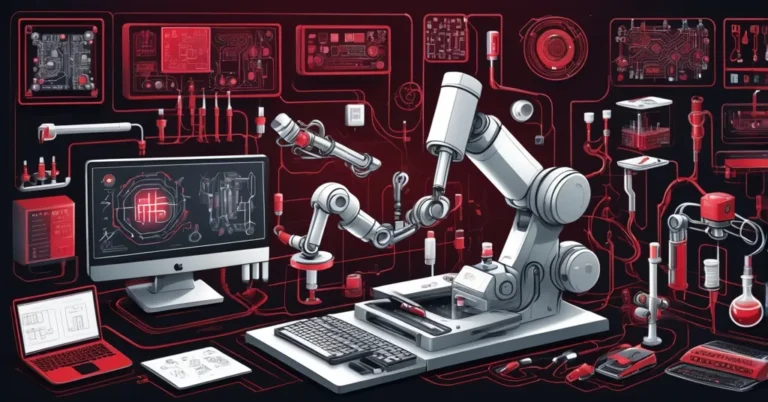
Anthropic’s Model Hardware Standard (MHS): a shared driver spec for AI agents to operate real devices
Getting a liquid handler, robot arm and plate reader to cooperate has long meant weeks of bespoke translators, fragile glue code, and a lot of late-night debugging. Anthropic’s Model Hardware Standard (MHS) aims to replace that one-off plumbing with a small, shared driver interface so AI agents can discover and control instruments reliably, with basic safety checks pushed down into the driver itself.
Anthropic claims setup that “typically runs weeks to months; MHS reduces it to hours or minutes” (research preview, Aug 27 2026). That’s a strong claim. The gated preview includes partner reports with concrete metrics that make the idea worth testing in your own lab or pilot cell.
What MHS is, in plain terms
MHS standardizes the device driver layer, the software interface that exposes device capabilities to higher-level software, orchestration systems, or agents, and presents a minimal set of operations: read() (e.g., get a temperature), write() (e.g., set a setpoint), and discover() (find devices on the network). Drivers also include human- and machine-readable metadata, plain-language tags that capture facts like mass, reach, payload, and safety rules.
“Safety limits live in the driver, not the prompt.”
MHS exposes three access paths: MCP (Model Context Protocol, a model-agnostic RPC-style protocol that lets an agent harness call devices), a CLI for quick ad-hoc commands, and programmatic client bindings or code files for long-running jobs and batch runs. “Model-agnostic” here means any agent that implements MCP or the client bindings should be able to interact with MHS devices, regardless of which model backend the agent uses.
How MHS fits into an automation stack
- Instrument (robot arm, plate reader, pump)
- Driver + manifest (exposes read/write/discover, metadata and safety constraints)
- MCP / CLI / client bindings (the access layer MHS standardizes)
- Agent harness or orchestration service (models, scheduling, logging)
- Monitoring, audit logs, and human supervision
What partners reported
The preview includes partner-conducted experiments and integration tests. Anthropic and participating organizations published summary metrics. Methods and full logs are not public for every experiment, so where the preview does not specify design details I flag that below.
- Genentech: Used Anthropic’s Claude to run a closed-loop BCA protein assay across a liquid handler, robotic arm and plate reader. Anthropic reports the system converged on ~140 µL/s for water with RMSE 0.016, and on 10 µL/s for viscous BSA with RMSE 0.181. The preview does not specify whether those RMSE values are expressed in µL/s, normalized units, or as a dimensionless score. Confirm units in partner appendices before interpreting absolute error.
- QuEra Computing: Compared a hand-built relock script (~58% success at ~150 s per attempt) to an MHS-enabled deterministic Python script that recovered lock 695 times out of 700 (99.3%). Anthropic reports the hardest cases completed in 10-14 seconds under the MHS workflow versus 5-10 minutes for a human. Servo residual error fell from 15.7 mV (specialist tune) to 1.55 mV (agent tune). Over the same reported 19‑hour run the agent tune “never lost lock, ” while the expert tune unlocked about 1.6 times per hour (as reported by QuEra/Anthropic).
- Carnegie Mellon University: Dose-response experiments ran roughly 3× faster. CMU reported going from raw equipment to a finished dose-response curve (including one autonomous rerun) in 8 hours versus “several weeks” with their vendor setup. They also reported that six induced fault conditions were blocked before any device moved, demonstrating driver-level safety checks in action.
- University of Washington: A PhD student connected six instruments (driver-writing included) in under a week, according to the preview materials.
- Other partners: Tetsuwan Scientific paired MHS with its ResearchOS platform for qPCR pollution profiling, and Janelia reduced a microscopy rig’s multi-program workflow down to a single dashboard action.
Where the preview shines, and where it leaves questions
The preview’s partner numbers consistently point to three practical benefits: much faster integration, reliable closed-loop control, and repeatable, agent-generated scripts. But the announcement is a preview; it’s gated, supervised, and does not publish every experimental detail. Several important technical and governance questions remain open.
- Authentication and provenance: The preview describes plain-language driver tags compiled into reference files, but it does not specify how manifests are signed, who can author or modify drivers, or whether a registry and role-based access control are part of the workflow. For safety-critical systems, driver signing and provenance are essential.
- Safety enforcement mechanics: Anthropic states safety limits are enforced at the driver (example shown: “Safety limit enforced at the driver: 4°C – 45°C”), but the preview does not clarify whether enforcement is purely software-based or backed by hardware interlocks, firmware attestations, or certified safety controllers.
- Metadata schema and transport: The preview implies a machine-readable manifest (likely JSON/YAML), but the exact schema and message formats for MCP are not published in detail. Confirm the exact manifest schema and protocol specs before integrating at scale.
- Model limitations: Agents retain gaps in physical reasoning. Anthropic notes an example where Claude could not infer bubble physics until explicitly instructed. Drivers and standardized interfaces reduce integration friction, but do not replace domain expertise.
- Scaling and vendor adoption: The preview shows promising lab and pilot scale results. How MHS behaves across large heterogeneous fleets in regulated production settings, and how quickly instrument vendors will ship MHS-compatible drivers, remain open issues.
Practical steps for businesses and labs
If you’re responsible for automation, experiments, or manufacturing strategy, MHS is worth a controlled pilot. Use this short checklist to get started and watch for a few red flags.
3-step pilot checklist
- Pick a narrow pain point. Choose one integration that currently costs weeks of engineering time, a multi-instrument assay or an equipment relock routine is a good candidate.
- Apply for preview access and prepare logs. Anthropic’s preview is gated (apply at modelhardwarestandard.com). Plan to capture detailed logs, safety incidents, and acceptance criteria so you can evaluate claims like RMSE and success rates against your own baselines.
- Run a contained experiment with rollback plans. Test MHS drivers in a sandboxed cell with monitoring, strict access controls, signed manifests if available, and a clear rollback/stop procedure before any production deployment.
Red flags before you adopt
- Unsigned or unverifiable driver manifests.
- No attestation or audit trail for driver edits.
- Safety limits that are enforced only by unverified software checks with no hardware interlocks.
- Lack of vendor uptake or no road map for maintenance and governance of the driver ecosystem.
Key questions and concise answers
-
What problem does MHS solve?
It standardizes the device driver layer so AI agents can discover and control heterogeneous instruments without bespoke translators, reducing the integration work that partners report previously took weeks to months (Anthropic preview, Aug 27 2026). -
What primitives and metadata does MHS expose?
MHS exposes three primitives, read(), write(), discover(), and a machine-readable metadata manifest of plain-language tags for mass, reach, payload, safety limits and operational constraints. The exact schema was not published in full in the preview. Confirm JSON/YAML details with the spec. -
How is safety enforced?
Anthropic reports safety limits live in the driver (example: “Safety limit enforced at the driver: 4°C – 45°C”). The preview does not fully disclose whether enforcement is backed by hardware interlocks, firmware attestation, or only software checks. That’s a verification step you should require. -
Do partner results show it works?
Partners reported substantial gains. QuEra’s relock success rose to 695/700 (99.3%), Genentech reported closed-loop convergence with RMSE 0.016 and 0.181 for water and viscous BSA respectively (units not specified), and CMU completed a dose-response curve in ~8 hours versus several weeks. These are promising but based on preview summaries. Request methods and raw logs for reproducibility. -
Is MHS production-ready and widely available?
No, the MHS announcement is a gated research preview. Anthropic is accepting preview applications (modelhardwarestandard.com). Broader availability, governance, and vendor adoption remain open. -
Will it work with any model?
The spec is model-agnostic: any agent harness that implements MCP, the CLI, or the client bindings should be able to call MHS drivers regardless of the underlying model backend.
Bottom line
MHS is one of the first efforts that explicitly targets the “integration tax” by standardizing the driver interface and pushing safety constraints into device drivers. The preview’s partner metrics, faster integrations, higher task reliability, and repeatable agent-generated scripts, are compelling enough to warrant a cautious pilot. But don’t skip governance and verification: insist on signed manifests, clear provenance, documented MCP specs, and hardware-backed safety where appropriate.
For teams automating wet labs or complex instrumentation, the smart move is to experiment now with a narrow integration, capture reproducible metrics, and demand answers on signing, attestation, and vendor support before rolling MHS-enabled control into production.
Figures from Anthropic’s MHS preview, Aug 27 2026. The preview is gated, reported partner numbers come from Anthropic and participating organizations’ summaries; full experimental methods and raw logs were not published for every test.