
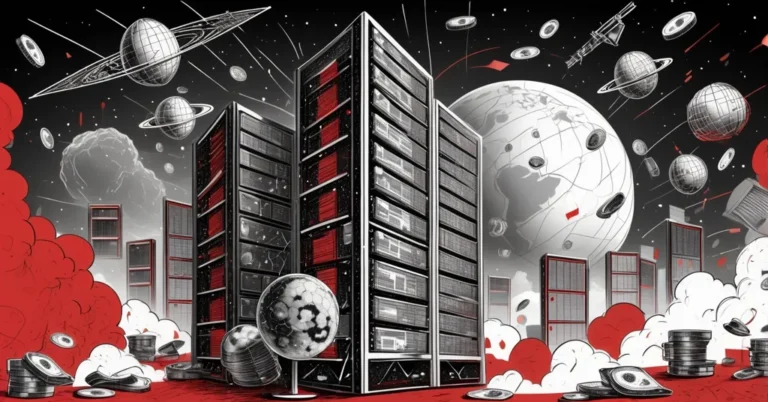
Could AI Data Centers Be Moved to Outer Space?
TL;DR (Quick take for leaders)
- Space-based data centers offer continuous solar power and avoid local water fights, but physics and operations make them impractical for most AI workloads today.
- The vacuum of space forces heat removal by radiation only, and radiative cooling doesn’t scale favorably with compute density—so you need huge radiators, pumps, and plumbing.
- A swarm of small satellites is more feasible thermally than one giant station, but it multiplies launch cost, radiation damage, and orbital-congestion risk (Kessler cascade).
- Prioritize chip efficiency, server-level liquid cooling, waste-heat reuse, and renewables on Earth before betting on space-based compute—space is a niche tool, not a shortcut.
Why orbital data centers sound attractive
The image sells itself: racks under uninterrupted sun, no local politics over water, and a “cold” environment that magically absorbs heat. That picture explains why companies and concept teams (Google’s Project Suncatcher is a notable internal idea) have considered moving compute into orbit. For businesses wrestling with AI infrastructure, the promises are seductive: continuous solar energy, theoretical reductions in the terrestrial footprint of power and water demand, and a high-tech PR narrative about off-planet compute.
Reality checks in quickly. The core trade is simple: you still must obey the laws of thermodynamics, pay to lift mass into orbit, keep hardware from degrading in a harsh radiation environment, and accept operational limits on latency and bandwidth for ground users.
The thermal reality: heat is the real problem
On Earth, servers throw heat into air and chilled water—fans and liquid loops make cooling efficient. In space there is no air; the only way to shed heat is to radiate it away as infrared light, like a hot stove glowing in the dark. That mechanism gets weaker fast as you pack more compute into a box.
Put another way: surface-area-to-volume scaling is unforgiving. If you double the linear size of a compute module, its volume (and heat production) grows eightfold while its surface area (where you can radiate heat) grows only fourfold. So bigger modules heat up faster than they can cool.
Concrete numbers help executives reason quickly. A rough order-of-magnitude: a 1 m² ideal radiator running very hot might dump about 1 kilowatt of heat. That’s enough for a single high-end rack but not for dozens of racks. Under simple assumptions, a 1 MW orbital compute node would require on the order of 980 m² of radiator area—panels that must be launched, structurally supported, and connected to servers with pumps and heat pipes. The International Space Station (ISS) uses pumped-ammonia loops and large external radiators to do exactly that, and maintaining those systems in low Earth orbit (LEO) is complex and costly.
“In the vacuum of space there’s no air to blow heat away with fans — radiating heat as infrared light is the only option, and it becomes increasingly inefficient as compute density rises.”
What this means in practice
- Large, monolithic orbital data centers quickly become radiator-dominated projects: most of the mass and complexity is not compute but cooling hardware.
- Radiators add mass and volume to every launch; plumbing and pumps introduce failure modes that terrestrial designs rarely face.
- Running radiators hotter increases heat throughput but shortens hardware life and complicates materials engineering.
Engineering and operational realities
Designers therefore favor distributed approaches: many small satellites rather than one mega-station. Small satellites have better area-to-volume ratios, so each unit can radiate heat more efficiently relative to the compute it carries.
But distributed swarms introduce other problems:
- Launch and replacement costs. Launch cost per kilogram has fallen significantly over the past decade thanks to reusable rockets, roughly halving in ballpark terms. Still, tens of thousands of refrigerator-sized compute satellites would cost vastly more to deploy and refresh than building efficient terrestrial facilities.
- Radiation damage. Electronics in LEO accumulate damage from charged particles; radiation-hardened parts or frequent replacement cycles add cost and supply-chain complexity.
- Limited repairability. Most small satellites can’t be serviced in orbit; failures mean lost capacity and replacement launches.
- Latency and bandwidth. LEO links add tens of milliseconds of round-trip latency compared with terrestrial fiber for local users; geostationary orbit (GEO) adds hundreds of milliseconds. Real-time AI inference (e.g., high-frequency trading, AR/VR) is sensitive to such delays—batch workloads and pre-processing of satellite sensor data are better fits.
Orbital congestion and the Kessler risk
Low Earth orbit already hosts roughly 10,000 active satellites and about 10,000 metric tons of tracked debris. The Kessler cascade is the scenario where collisions generate more debris that causes further collisions in a runaway chain reaction, potentially rendering important orbital bands unusable. Adding millions of additional small satellites (as some large filings and proposals have contemplated) would materially increase collision risk.
Business leaders need to internalize that orbit is a shared, congested resource. A strategy that treats space as unlimited infrastructure risks creating externalities—and regulations and insurers will respond. Expect stricter licensing, debris mitigation requirements, and higher insurance costs if orbital compute becomes a real industry push.
Where space-based compute could make sense
Space isn’t categorically useless for compute. There are narrow, high-value niches where orbital compute can provide unique advantages:
- Processing remote-sensing or Earth-observation data on-orbit to reduce downlink bandwidth and latency for large-volume imagery.
- Edge compute colocated with space-based instruments—satellite payloads that need immediate analysis before downlink (e.g., disaster monitoring).
- Highly secure, physically isolated computation for specific governmental or commercial needs where jurisdictional separation matters.
- Science and exploration contexts where compute must be near the sensor or experiment (e.g., lunar-orbit processing for Moon missions).
For general-purpose AI training and cloud serving—where customers expect low-latency access, rapid hardware refresh, and low cost per compute-hour—terrestrial data centers remain the better economic and operational choice for the foreseeable future.
Comparing environmental and lifecycle impacts
Moving compute to orbit trades some terrestrial environmental costs (like water consumption and grid demand) for lifecycle impacts of launch manufacturing and replacement. Launches emit greenhouse gases and require energy- and material-intensive manufacturing, while frequent in-orbit refresh cycles multiply those impacts. A comprehensive lifecycle assessment is necessary to judge net environmental benefit, and early analyses suggest the balance favors improving terrestrial efficiency and renewable supply before mass-moving compute off-planet.
Decision framework for business leaders
Use this checklist to evaluate whether orbital compute belongs in your infrastructure roadmap:
- Workload type: Is the workload tolerant of tens-to-hundreds of ms latency, or can it be batched? If not, avoid orbital hosting.
- Data locality: Does the data originate in orbit or remote locations where pre-processing on-site would save bandwidth?
- Cost sensitivity: Can your business justify higher TCO from launches, replacements, and radiation-hardening?
- Regulatory and reputational risk: Are you prepared for stricter regulations and stakeholder scrutiny around orbital debris?
- Timeline and dependency: Is your need immediate, or can you wait for in-orbit servicing and launch-cost reductions to mature?
Action list for executives
- Audit server efficiency and cooling: measure PUE, water consumption, and rack-level heat density. Prioritize investments that reduce waste on the ground.
- Accelerate server-level liquid cooling and heat-reuse pilots that can cut energy and water demand now.
- Run a focused feasibility study only if you have a niche orbital use-case (remote sensing, secure isolated compute). Include lifecycle emissions and TCO modeling.
- Monitor launch-cost milestones, in-orbit servicing demos, and debris-regulation trends as triggers for revisiting the strategy.
- Engage industry groups and regulators proactively if you plan any orbital deployments: debris mitigation, de-orbiting commitments, and sharing of positional data will be mandatory.
What to watch
- Launch-cost trends and reusability advances—halving of cost per kg changes economics but doesn’t erase thermal and operational constraints.
- In-orbit servicing and modular satellites that enable repair and upgrade—this reduces lifecycle replacement costs.
- Regulatory action on satellite licensing and debris mitigation, which can raise barriers to large-scale swarms.
- Hardware advances in energy efficiency and chip-level waste-heat reduction—better silicon could shift the balance over time.
“Small satellite swarms make radiative cooling more manageable, but they replace one set of engineering challenges with a longer list of operational and ecological ones.”
Final perspective
Space-based data centers are not magic cooling or energy solutions. The physics of heat radiation, plus the mass and failure modes of plumbing and radiators, make large orbital compute installations expensive and complex. A swarm approach mitigates some thermal issues but multiplies launch, maintenance, and orbital-risk costs. For most enterprises building AI infrastructure, the highest-return moves are on Earth: squeeze inefficiency out of current data centers, adopt server-level liquid cooling, tie capacity to renewables, and design workloads with latency and locality in mind.
Use orbital compute selectively—for niche missions, in-orbit processing of sensor data, or highly specialized secure applications—not as a distraction from the practical, high-impact engineering work that reduces cost and carbon here and now.