
A professor, a sidewalk, and a robot that would not get the hint
On a fall morning in a Philadelphia alley opposite Patriot Parking, Carolyn Marvin set a condition. Someone had to watch for police. She would stand in front of the food-delivery robot.
The Guardian followed her that day. Marvin is 78, a semi-retired communications professor at the University of Pennsylvania, and she does not do this on a schedule. “I have a life, ” she said. When she does show up, she plants herself in front of sidewalk machines the paper identifies as Uber Eats robots operated by Avride. Some passersby thank her. Others are annoyed that a paid order is stuck behind a person who will not move. A few weeks earlier, by her account, police handcuffed her after she refused to step aside.
Local color is the easy read. Look again and you see what happens when automation leaves the screen and takes the pavement.
Not a factory floor
Marvin is not a blanket opponent of machines. She told The Guardian she is “very supportive of the kinds of things that AI is doing in terms of medical breakthroughs, ” and that robots are fine on factory floors. Her line is narrower:
They don’t belong in public space. I take the position that this isn’t inevitable… who is public infrastructure designed to serve?
A chatbot can annoy you from a laptop. A delivery robot occupies a strip of concrete that a person with a cane, a stroller, or a bad knee also needs. Cute graphics do not change the geometry.
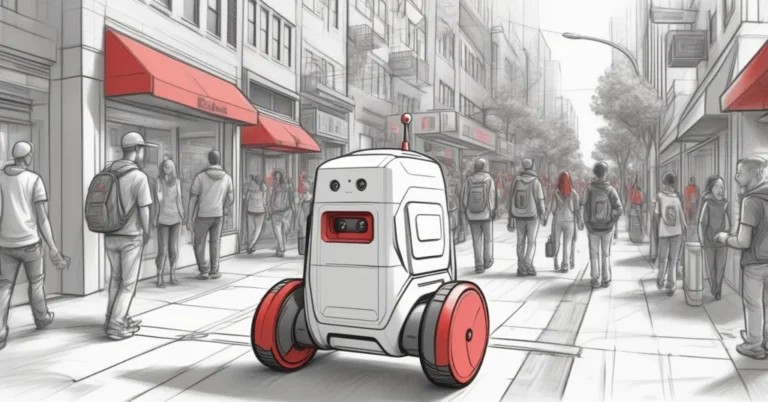
Avride has tried the cute route anyway. A spokesperson said humanizing the robots matters, “because they are a completely new entity, ” and that the company wants people comfortable rather than “scared about some weird box travelling down the sidewalk.” On the morning The Guardian watched, one machine wore Halloween graphics on the screen that passes for a face. Another displayed “zzz.” Avride says hibernating robots once drew emails from people who thought they were lost or broken, and that the sleep graphic cut those emails to none. That is the company’s account of its own inbox.
Asked about Marvin, a spokesperson paused, the reporter wrote, then said, “We are all well aware of this lady, yes.”
The unit she followed, robot 1617, left a holding spot for a nearby restaurant and then met her on Walnut Street. It appeared to power down and wait. She left for campus to prepare a class. The robot powered back up and returned to its garage. From the outside, you cannot tell whether that was a timeout, a glitch, or a decision made somewhere else.
A friendly screen did not move her. One persistent protester is not a market study. Cuteness failed with her. That does not mean it has failed everywhere.
A ticket is not a policy
After a flu shot, Marvin told The Guardian, she blocked a robot in a busy stretch of the city and stayed. A crowd argued. Police were called about reported “criminal mischief.” She refused to move. In her telling, she told officers: “no, it’s my first amendment to protest against corporations in the same public space the robots are occupying.”
What followed is her account, not a court finding. She said they came up from behind, took food from her hands, handcuffed her, and put her in a police car. “I tried to make it hard for them but there were three of them and one of me, ” she said. She also thinks they were unsure what they could charge her with, “because it’s all brand new stuff.” Police and court records cited in the reporting do not independently confirm that confusion.
The ticket that followed, as reported, was for disorderly conduct, on the rationale that she was blocking a business. She is waiting on a hearing date and plans to contest it. “The wheels of justice grind slow, but I’ll go make my arguments.” She has said the case has not stopped her.
Whether standing in front of a robot counts as blocking a business, and whether the First Amendment covers that stand, is for the hearing. A disorderly-conduct ticket is one enforcement event. Do not line it up next to a city bylaw as if a council had sat down and written a sidewalk policy.
What the statute actually says
The machines are newer to Philadelphia streets than they are to Pennsylvania law. Act 106 of 2020 added a subchapter on personal delivery devices. The practical point is blunt: a sidewalk is not open pavement for any company with a robot and a logo.
Section 8512 bars one of these devices from a roadway, shoulder, berm, or pedestrian area unless the operator holds a Department authorization, or is a device operator under the statute, and follows the rest of the subchapter. A pedestrian area, in that section, means a sidewalk, crosswalk, safety zone, pedestrian tunnel, overhead crossing, or similar space. The law opens those places to compliant, authorized machines. The text that defines them does not call the device a pedestrian.
The statute gives the state Department general and sole regulatory authority, except where § 8517 allows local rules. How far that exception reaches is not answered by the title of the act. Whether Avride holds authorization for these Philadelphia routes is not something a bystander can read off a screen.
What an applicant does have to put on paper is more concrete. The company must explain how a police officer or emergency responder can stop or disable a device, and it must describe training, models, municipalities, and intended routes. In the first phase, an operator has to stay within 30 feet and in line of sight. A second phase allows remote monitoring, if the system can still be controlled and overridden from a distance. Authorized operators must also report, within 24 hours, any accident that causes bodily injury, death, or property damage, both to the Department and to local law enforcement.
None of that says which phase, if either, Avride is in. It does say the state expected a human who can intervene, and a way for police to shut the machine down. Marvin’s sense that the encounter felt brand new describes the street, not a legal vacuum. The statute has been on the books since 2020. Whether those officers knew the disable procedure is a separate question. Her memory does not answer it.
Other cities already had this argument
Marvin points to Toronto, which restricted sidewalk delivery robots in 2021. She is right about the year and the direction. The fine print is a pause with a door, not a forever no.
The Robot Report covered the vote. Toronto City Council restricted automated or remote-controlled devices that do not run on muscle power and do not carry passengers. The rule covers sidewalks and bike lanes. The fine is $150. Council wrote the restriction to last until Ontario’s Ministry of Transportation pilot is in place and council decides whether to opt in.
The push came from the Toronto Accessibility Advisory Committee, which cited hazards for people with low mobility or vision, older people, and children. David Lepofsky, who chairs the Accessibility for Ontarians with Disabilities Act Alliance, framed the sidewalk the way Marvin does: a publicly funded resource “created for pedestrians to safely use, ” not something to be given over to private delivery fleets.
Then-mayor John Tory tried to hold both ideas at once. He was not interested in bragging about a tech economy and then refusing innovation. “But at the same time, ” he said, “it can’t just be a free-for-all.”
The provincial pilot Toronto did not rush into would have required yielding to pedestrians, insurance, and a speed cap of about 10 kilometers an hour, roughly 6 miles an hour. City staff said they had received no 311 complaints, while noting people might not have known where to send one. An empty complaint log does not prove there was no hazard.
San Francisco moved earlier, and not toward a blank check. In December 2017 it barred delivery robots from most sidewalks and tightly limited where they could go. Operation was effectively on hold until 2019, when Postmates Serve, now independent as Serve Robotics, received the city’s first sidewalk-delivery test permit. Two cities do not make a national pattern. Where this has actually been debated, the first move was a restriction, and the second, if it came, was a narrow permit.
Fleet claims, and what “autonomous” is doing
Avride says it operates almost 1, 000 food-delivery machines on more than 25 college campuses and in a growing list of cities, including Jersey City and Austin. It also says Philadelphia’s count moves with demand. Those are company figures, not an independent census, and the city total is unclear. The Guardian’s reporter wrote that early onlookers gawked and took selfies, and that most people now ignore the machines.
Ignoring the machines is not consent, and it is not a number you can brief to a board as acceptance. A company can be busy and visible and still end up one bad interaction away from a professor who will not move.
On Walnut Street, a 22-year-old recent graduate, Cadence, recognized Marvin and put the jobs argument in plain language. AI and robotics, she said, are “supposed to make life easier for us and help us do the things we enjoy, not take the jobs of other people.” She said she will back small businesses that skip AI, and that she values what humans make.
That is an opinion, and a common one, not a measured result. Nothing in the public record around this protest counts how many courier shifts sidewalk robots have replaced in Philadelphia, or whether they have mostly absorbed overflow the apps were already failing to cover. Treat the claim as a hypothesis the operator should be able to test, not as a fact either side has proved on the curb.
“Autonomous, ” in this market, often does more marketing than describing. Pennsylvania’s remote phase still assumes a person who can monitor, override, and, in the design the state asked applicants to explain, help police shut the machine down. Tiny Mile’s Toronto robots, which ran from September 2020 until the company pulled them before the 2021 vote, were remote-controlled, not self-driving in the science-fiction sense. A wheeled box with no one walking beside it can still have a human in the loop miles away. Anyone buying or selling last-mile robotics should say which loop they mean.
Public mood is easy to overread in the same way. Pew Research Center reported in June 2026 that Americans are deeply skeptical of AI even as personal chatbot use keeps rising. That survey covers chatbots and devices, not delivery robots. It is not a vote on who owns the sidewalk.
What an operator should hear in this
Put automation in a private warehouse and the politics are mostly internal: training, liability, which jobs change shape. Put a fleet on a public sidewalk and you are using infrastructure the customer did not commission. The city did, for people on foot.
You do not have to like Marvin’s tactics to hear the operating problem.
Friendliness is not a safety case. Faces, holiday skins, and sleep icons can stop a well-meaning stranger from reporting a waiting robot as broken. They do not answer a person who cannot get around the machine, and they do not answer a council that has already heard from its accessibility committee. Toronto’s fine and San Francisco’s permit were political products. Philadelphia’s disorderly-conduct ticket is a charge still headed for a hearing. None of them was designed in a robotics lab.
“We are legal” has to mean the regime you are actually in. Authorization for these routes. A disable method a police officer can use, not a sentence in an application nobody on the night shift can find. A human override that matches the phase you are in, line of sight or remote. The 24-hour crash report, sent to the state and to local law enforcement. Act 106 also has an insurance-and-liability section, § 8519. Know what it requires you to carry. If your team cannot say which phase you are in, you are not ready for a video of a professor and three officers.
Do not claim a labor result you have not counted, and do not dismiss one you have not counted either. Cadence’s instinct will show up in hearings and in vendor reviews. The honest answer is specific: which tasks the robot takes, what happens to the courier on that route, and whose paid routes it may absorb, a number the company should be able to show. Say whether the savings land with the restaurant, the platform, or the customer. Vague talk about freeing people for higher-value work sounds thin when the work in view is someone else’s lunch.
A protest that stops a paid order has a cost. Plenty of people in that Philadelphia crowd were not debating the commons. They wanted the food they had already bought. Treat every irritated customer as a nostalgic crank and you will misread the room. Treat every protester as a glitch and you will misread it just as badly.
Marvin’s own standard is usable even if you would never stand in an alley. Medical AI and factory robotics can be worth the disruption because the benefit is legible and the space is not shared in the same way. Public automation has to clear a higher bar. It has to be safe for the slowest pedestrian, governable by the city that owns the street, and honest about the paid routes it may absorb. Until that case is made on a given block, “inevitable” is a sales word.
Questions worth asking before the fleet rolls
- Are sidewalk delivery robots simply legal in Pennsylvania?
No, not as a free-for-all. Act 106 of 2020 bars them from sidewalks and other pedestrian areas unless the operator holds a Department authorization, or is a device operator under the statute, and follows the rest of the subchapter. The text that defines those areas does not call the robot a pedestrian, and it does not settle how far Philadelphia can go under the local-rules section.
- Did Toronto ban them for good in 2021?
Council restricted automated and remote-controlled delivery robots on sidewalks and bike lanes that year, with a $150 fine, largely on accessibility grounds. The restriction was written to last until a provincial pilot is in place and council decides whether to opt in.
- Do most Americans expect AI to harm society?
No. Pew Research Center’s June 2026 survey found deep skepticism, and more adults expect harm than benefit, but 40 percent, not a majority, expect a negative impact on society over the next 20 years. The survey did not ask about delivery robots.
- Have these machines been shown to wipe out delivery jobs?
Not in the record around this protest. Job loss is a reason some supporters give for backing Marvin. It is a serious hypothesis. It has not been counted.
- Was Marvin ticketed for an offense no statute had contemplated?
She says she was ticketed for disorderly conduct, and that officers seemed unsure what fit. Pennsylvania has regulated these devices since 2020, including a required way for police to stop one. Whether that charge is the right one is for her hearing, and her memory of their confusion is not a finding.
- Who is liable if a robot injures a pedestrian, and does authorization settle that?
Authorization does not, by itself, decide who pays. Act 106 includes an insurance-and-liability section, § 8519, but the minimums and fault rules are not established in the provisions available here, and a city permit would not automatically answer them either.
- What should a company do differently from adding a friendlier face?
Know the authorization it holds, keep a human override that matches the phase it is actually in, and make the police disable method usable on the street. A screen that says “zzz” is not a safety case, and it does not help the pedestrian who cannot step into traffic.
The sidewalk is still doing the unfashionable job it was built for: moving people who cannot be routed around a server error. A company that wants that space has to earn it in public, under rules that already exist, from neighbors who are allowed to say no.