
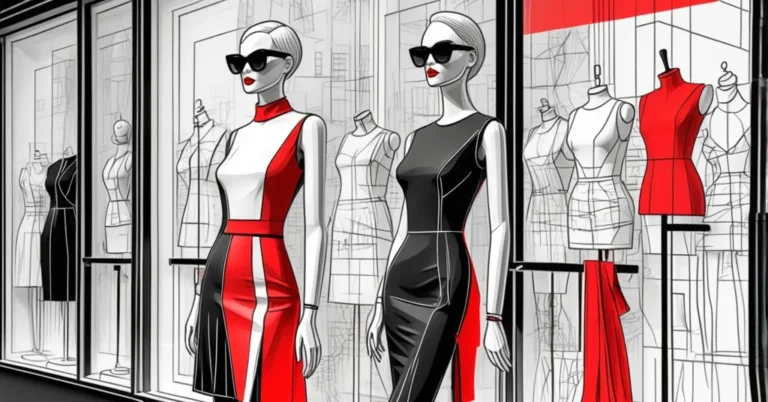
The high street is not trying to become Dior. Names that boomed in the 2000s, then lost ground to sustainability-minded shoppers and ultra-cheap online rivals, are renting the cues of a fashion house: the show, the famous name, the stylist. The price stays ordinary. The new layer on the garment is advice, from a person or from something labelled an AI stylist, and the commercial results of that advice are still unpublished.
Marks & Spencer made the price impossible to miss. It showed a collection at London Fashion Week and put the clothes on sale immediately. Half were under £50. Lisa Illis, the retailer’s head of design, framed the point as access rather than exclusivity.
making the buzz of London fashion week accessible to everyone.
Prestige, with the tag still on
Ella Baynes, insight manager at Savvy Marketing, reads the strategy this way. These retailers are not competing head-on with luxury, or with the cheapest sellers. They are borrowing luxury fashion’s cultural cues, then meeting what she calls shopper aspiration and shopper reality in the same product. Shoppers want something that feels more elevated. They still decide on price.
Gap has a collection with Victoria Beckham. Topshop is back on the shop floor, with concessions in 30 John Lewis stores and at Liberty. M&S used the catwalk, then opened the till.
Illis has also tied more fashion-informed seasonal collections to a 16% year-on-year rise in under-35s shopping at M&S. She has drawn a link. It does not prove one runway caused the growth. Price, range, and habit could all be in the mix.
Her longer argument is about how long the clothes get worn, not the spectacle. Design with longevity in mind, she says, from everyday staples to more fashion-led seasonal collections, and customers can build wardrobes they will actually keep. M&S first set out eco-commitments in 2007. Whether “wear it longer” still counts as an environmental promise, once the greener language has gone quiet, is a separate question. Andrea Cheong, author of Why Don’t I Have Anything to Wear?, thinks that language faded because it stopped paying once the economy weakened, and because politics got louder. That is her reading. It is not a measured study of campaigns.
The automated job is the outfit
Asos is where the comeback pitch turns into software. Law Roach, the Hollywood stylist whose clients include Zendaya, is stylist-in-residence. His brief covers campaigns and outfit ideas drawn from stock already on the site. Beside him, Asos has added AI stylists, virtual try-on, and Buy the Look, which lets someone purchase a whole styled outfit in one go.
Vanessa Spence, executive vice-president of brand, states the question those tools are built to answer. In Asos research she cites, 68% of consumers say what they need to know is how to wear something. Who was asked, when, and how, has not been published with that figure. Treat it as the company’s own finding. It is not a census of shoppers.
We’re helping customers find pieces that they want to wear. Then they can get more from every purchase and extend the life of their product.
Spence says Buy the Look is very popular. No usage or conversion figures have been published under that claim.
On anything Asos has described, the automated job is neither cutting fabric nor forecasting a season. It is the pause in the fitting room: what goes with this, and will it look like me? A human stylist answers that for a campaign. A tool that rearranges existing products answers it across a catalogue. That tool is a recommender. Leave the AI agent label off it. Buy the Look is a basket tool with a tasteful coat of paint. Virtual try-on is a bet that seeing the garment on a digital body cuts the doubt that produces a return.
None of that effect has been shown. The tools are named. How they are built, what they were trained on, whether a shopper can tell a Roach suggestion from a model’s, and whether any of it moves attach rate or returns all remain unpublished. “AI stylist” is a product label until those numbers exist.
There is a more grounded version of “help me wear this” in the same business. Asos worked with disability consultancy Tilting the Lens on an adaptive range, nothing in it priced above £65. Sinéad Burke, the consultancy’s founder, describes a capsule people can mix, including a magnetic waistcoat with the trousers, and says the hope is greater choice. Disabled people were in the room, and the garment changed. A styling model that only rearranges existing products did not do that work, and it should not be credited with it. Automate the combination. Do not pretend the model decided who the clothes were made for.
The rebound belongs to the cost line
Asos’s recent numbers do not belong to the bots. After a sharp post-Covid sales decline, with Shein among the ultra-cheap rivals on price, sales were down 12% in the August figures cited with that slump. Charging for returns sat inside a wider cost-cutting drive, after which the company announced 50% profit growth in a March update. Those two figures are not a clean pair. The public account does not pin either one to a calendar year, and it does not say whether the profit rise is statutory, adjusted, or flattered by a weak comparison. Baynes is blunt about the constraint that sits under every collaboration and every digital extra: whenever shopper attitude is measured, cost is king.
Stopping the subsidy on reverse logistics is a finance result. The published numbers do not show that an AI stylist found the margin.
Secondhand does not need a catwalk
Cheong is the counterweight, and she is specific about materials. Dress the branding up all you like, she argues, and you are still not using the cloth they use at Dior. She has pointed to man-made fibres, meaning synthetic cloth, not handmade fabric, in the M&S catwalk collection and in Asos Adaptive. “Elevated” describes a mood. The cloth has not been dressed up into couture, and that cloth is the difference.
She also thinks a large share of younger shoppers have already left the show. Her estimate is that 70% or 80% of her own audience is 25 to 35, and that they are jaded and more savvy than brands assume. That is her impression of the people who watch her. It is not a measure of Gen Z or millennial shoppers at large.
Resale is the live alternative. Cheong has called Vinted the UK’s third-biggest retailer. That rank is disputed. Even a generous reading keeps the argument inside fashion rather than all UK retail, and a marketplace’s gross sales are not the same as revenue a chain actually owns.
The motive is split, too. Some shoppers want a second life for clothes. Others are there because it is cheap and a wallet is tight. Convenience, including locker delivery, is part of the growth. Ultra-cheap garments were often not built to circulate. If secondhand wins on price and ease, a catwalk and a styling tool have to clear that bar. A branding test is the wrong one.
Questions worth asking before you copy this
- Are high-street brands becoming luxury? No. The visible move is cultural: celebrity and designer collaborations, fashion-week staging, stylists, and digital extras, with prices kept accessible. Cheong’s point on cloth still separates that from houses such as Dior.
- What do Asos’s AI stylists actually do? Publicly, very little is known. They sit beside virtual try-on and Buy the Look, and beside a human stylist-in-residence. There is no published account of training, disclosure, accuracy, or commercial effect.
- Did those tools produce the profit rebound? Nothing connects them. The 50% profit growth in the March update followed cost-cutting, including paid returns. Sales were down 12% in the August figures. An executive calling a feature popular is not a profit-and-loss statement.
- Is the under-35 growth at M&S proof the catwalk worked? Illis links more fashion-informed collections to a 16% year-on-year rise in under-35 shoppers. The show, the price, and the wider range have not been separated.
- What would you need before copying this? Disclosure that a suggestion is model-generated, an attach rate, a return rate, and a control against the human stylist. None of that is public, so popularity is not a result.
- Will sceptical shoppers buy the comeback? Unresolved. Cost still dominates attitude, in Baynes’s reading, and resale is a serious rival even where Vinted’s exact rank is argued. Brands may be answering a harder customer. That is different from having won them back.
Spectacle gets attention. Advice is what these retailers are now trying to sell on top of the garment, whether the adviser is Law Roach or a model with no published scorecard. Advice only converts if the price survives a stretched wallet. On that test, the high street’s return is a hypothesis in nice tailoring. It has not become a result.
Two Asos stories that sat outside the styling claim
The catalogue tools are only part of what Asos has put in public view: a security incident briefing, and a creator-led live shopping launch.
- What the Asos hack alert’s threatening message means
- Asos Live, the creator-led immersive video shopping experience after its trial