
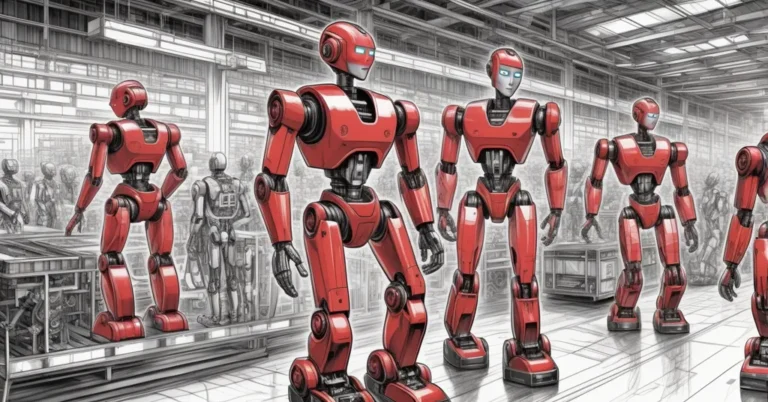
Chinese robot makers swept the first-half 2026 humanoid revenue top five. That is the claim. What has actually been published, in John Koetsier’s late-September reading of IDC data, is a shipment boom and one industry revenue total. Almost 25, 000 humanoids shipped in the first half of 2026, up 432.1% from a year earlier. Revenue topped $740 million, up 322.7%. Chinese vendors built more than 95% of the units shipped worldwide, and nine of the top 10 shippers were Chinese. A ranked revenue top five, with figures and a method, is not in that account.
Read the word “humanoid” with a pencil in hand. These charts are not a census of walking factory workers. Agibot’s own deployment talk includes smaller X2 units and wheeled G2 robots. Education platforms and full-size industrial machines show up in the same conversation, and often in the same totals. A unit is not a unit until someone defines it, and a cheap research machine does not throw off the same dollar as a shift-covering robot.
The leaderboard is a shipping chart, not a profit-and-loss
Three estimators agree on the winner and disagree on the size of the prize. IDC’s count is the largest: almost 25, 000 units, with Agibot at more than 8, 600 and about 35% share. Smart Analytics Global put the half at 19, 100 units, up 272%, with Agibot near 8, 400 and 44% of that smaller total. Counterpoint’s figure was 22, 000 units, up almost 300%, with Agibot near 9, 700. Of 22, 000, that is about 44%. Koetsier’s summary pairs those units with a 43% share, and the division does not land there. Cite one firm, or say the range. Do not average them into a false precision.
On the approximate unit chart Koetsier reads from IDC (most vendors drawn as bubbles, not exact bars), the first five names are all Chinese, in this order: Agibot, Unitree, Booster Robotics, UBTech, and Leju Robot. Figure AI is the only U.S. name in the top 10, at a few dozen. Treat everything except Agibot’s “more than 8, 600” as a chart reading, not an audited tally. On that same reading, vendors outside the top 10 still account for about 28% of units. The leaderboard is not the whole market.
Agibot’s own estimated volume moves too, from about 8, 400 in one count to near 9, 700 in another. Share percentages refuse to sit still because the company’s unit estimates differ and because the market-size denominators do not agree. The strategic fact survives that fight. Chinese makers own the volume race. A revenue ranking does not fall out of a shipping chart.
The sticker fell. Nobody published the margin.
Koetsier’s back-of-the-envelope average selling price (his division, not a published IDC price) comes out near $29, 600, against about $37, 000 a year earlier. The implied 2025 base in that envelope is about 4, 700 units and $175 million. Units times that average is how he gets back to a revenue figure in the neighborhood of the total IDC said topped $740 million. The two-decimal growth rates, 432.1% on units and 322.7% on revenue, are IDC’s. The $29, 600 is not. Volume up, sticker down. That is what a category looks like when education models and smaller platforms flood the count.
Profit is not in the packet. The one vendor-level revenue hint cuts against a simple “top shipper equals top earner” story. IDC’s bubbles also encode revenue, and Koetsier notes that UBTech’s revenue bubble is noticeably larger than its unit rank, because it sells full-size industrial humanoids rather than cheaper research and classroom machines. That is enough to warn a CFO that the revenue order may not match the shipping order. It is not enough to name a revenue top five, or to say anyone swept it.
Growth, on that same chart reading, is uneven the way early markets usually are. Several smaller vendors multiplied off a low base. Unitree’s percent growth was slower because the base was already much higher. Unitree then listed on Shanghai’s STAR Market in August 2026. A listing and a shipment rank are related stories. They are not a revenue league table.
Most of these machines were not on the clock
Two China figures get skimmed into one, and they are not the same fact. Chinese vendors built more than 95% of the units shipped worldwide. Chinese customers bought about 78% (more than 19, 000 units, up 426.3%). Making them and buying them are different questions.
Before anyone treats that 78% as factory demand, look at the job mix. Research and education, performances and exhibitions, and government data centers (robot schools and sites collecting motion, not cloud halls) were 69% of first-half shipments. That is down from 83.8% for all of 2025, so the mix is inching toward manufacturing, retail, logistics, and tourism. More than two-thirds still were not in traditional productive jobs.
Koetsier’s caveat belongs in the same breath as those two percentages. A large share of those “customers” may be government training centers, not plant managers writing a purchase order against labor savings. He states that as a likelihood, not a measured split. If you are modeling demand for AI automation, public-sector training demand and commercial replacement demand are different markets wearing the same costume.
Agibot is the clearest volume story, and its own numbers show why “shipped” is a slippery verb. IDC puts the company at more than 8, 600 units shipped in the half. Agibot says its 15, 000th robot came off the line in June 2026, and that cumulative production reached 20, 000 by September. Production, external shipments, and paid deployments are three counts. The deployments cited alongside those claims are a thin slice of either total: more than 300 robots at Chimelong Spaceship Park in Hengqin (guidance, entertainment, retail, and hospitality), 100 smaller X2 units in ASD retail stores, and wheeled G2 robots on a live line at Longcheer Technology.
In a May 2026 interview, Dr. Yao Maoqing framed the tipping point as sustained productivity in live environments, not demo reels or production counts. Agibot calls 2026 the start of a deployment stage. That is the company’s claim about itself. Hours on a park concourse are not the same evidence as hours in a warehouse.
Off the shipping chart, on the work chart
A capability roundup is not a sales ranking, and it should not be dressed up as one. Robozaps, last fully re-checked on 13 July 2026, weights verified external deployment at 30% of its score. On that method it put Agility Robotics’ Digit first for overall use and for warehouses, Boston Dynamics’ Atlas first on agility and the highest verified payload, and 1X’s NEO first for the home. Chinese machines took narrower lanes: Unitree’s G1 as best value at $13, 500, Fourier’s GR-3 for care, and others on price, outdoors, or open source. That is one roundup’s weighting, not an industry census. Hardware reputation and boxes shipped are not the same sport.
Agility does not appear in the IDC shipment top 10 in Koetsier’s account. What the company has disclosed, via its SEC filing and its own statements as cited in that roundup, is operating time: more than 65, 000 hours across nine facilities, and more than 100, 000 totes handled at GXO’s Flowery Branch site by November 2025. Named customers include Schaeffler, GXO, Toyota Motor Manufacturing Canada, and Mercado Libre. Amazon is an investor and has piloted Digit. On that account, Digit is not deployed across Amazon fulfillment centers.
On 5 July 2026 Agility announced a SPAC with Churchill Capital Corp XI at roughly $2.5 billion, alongside more than $300 million in contracted orders for Digit v5. The unpublished number in that story is the robot’s price, not the deal. Contracted orders are not first-half recognized humanoid revenue, and they do not prove Agility out-earned Chinese vendors on the books. They are also not a rounding error. More than $300 million in orders sits beside an industry half whose revenue, on IDC’s count, topped $740 million. The chief executive frames the machine against a two-year payback versus roughly $30-an-hour labor. That is a pitch about hours, which is the right variable, and it still has to be earned on a floor.
Figure AI’s volume is an unresolved definition problem, not a number to “correct.” IDC’s external-shipment reading puts the company at a few dozen. In April 2026 Figure AI said it was doubling deliveries every month and had delivered roughly 240 Figure 03 robots that month. One plausible reconciliation, offered in Koetsier’s account of the IDC figures, is that the analyst count includes only units shipped to paying outside customers, while much of the fleet is internal or tied to the company’s own data work, including renting 30 homes to train on chores. Do not pick a winner between those two numbers. Ask which definition your business case actually needs.
The next ranking is a model, not a motor
Sheet metal is no longer the scarce input. The loop IDC China research manager Lily Li described (technology, data, engineering, scenario) is. In Koetsier’s translation:
Whoever closes the loop of “technology, data, engineering, scenario” fastest is better placed for the next stage.
That is the sentence a buyer of AI for business should tape above the shipment chart. A humanoid that cannot close that loop is an expensive intern. An AI agent that cannot either is a chatbot with a budget.
A shared model stack already runs on both U.S. and Chinese hardware. In the Robozaps roundup, NVIDIA’s Isaac GR00T has named adopters including Agility, Boston Dynamics, and 1X, and GR00T N1.6 has been validated on Unitree’s G1 and Agibot’s Genie-1. Google DeepMind’s Gemini Robotics is on Apptronik’s Apollo. At CES 2026, DeepMind and Boston Dynamics said Gemini models would go onto electric Atlas and Spot, with testing planned in Hyundai plants.
On 30 July 2026, that same account described Gemini Robotics 2 as a single control policy for legs, torso, arms, and hands, demonstrated on Apollo 2, with the whole-body version limited to early-access partners. Published task success ran from 92% unscrewing a light bulb down to 32% sweeping with a dustpan. That spread is the product. A demo that unscrews a bulb is not a janitorial worker.
The policy layer is peeling off the chassis flag in other places too. Figure AI ended its OpenAI collaboration in February 2025 and built Helix in-house. Unitree open-sourced UnifoLM-VLA-0 in January 2026, a vision-language-action model that turns what the robot sees and is told into movement. Who retrains that model on your floor is a purchasing question, and the unit chart is silent on it.
What the 2030 forecasts are asking you to believe
IDC, in Koetsier’s account, raised its long-term forecast by about 50% and now expects global shipments to exceed 750, 000 units in 2030. Smart Analytics Global’s figure is 500, 000 by 2030. Koetsier notes that getting from something like 50, 000 to 60, 000 units in 2026 (his inference, not a printed full-year actual) to IDC’s 2030 number implies roughly doubling every year for four years.
That doubling only holds if 2026 really lands in the 50, 000-to-60, 000 band and the second half does not accelerate. IDC’s first half is already almost 25, 000. A flat second half is a strong assumption, not a neutral one. If the back half runs hotter, the starting point is higher and the climb to 750, 000 is less steep. Possible. Not a plan.
His view, and it should stay labeled as his view, is that U.S. and European makers are still refining products before they ship in volume, and that 2027 is when these league tables start to describe real work rather than channel fill and exhibition halls. If that is right, a 2026 purchasing decision based only on who shipped the most boxes will age badly. If it is wrong, and Chinese industrial humanoids convert exhibition volume into paid hours faster than Western pilots scale, the window is shorter than a two-year robot payback slide assumes.
For operators, the practical cut is simpler than the nationalism. Ask what a unit is, and whether a wheeled G2 or a classroom platform is inside the number. Ask whether the buyer is a factory, a school, or a center collecting motion. Ask whether the vendor sells a $13, 500 research platform or a machine meant to displace a $30-an-hour shift. Ask for hours, totes, and failure rates, not cumulative production. And ask who owns the model that will be retrained on your floor.
Questions worth asking before you rewrite the budget
-
Did Chinese makers sweep a first-half humanoid revenue top five?
Not on the evidence in hand. They dominated unit shipments in the first half of 2026. A ranked revenue top five, with figures and a methodology, has not been published alongside these shipment charts.
-
How big was the market?
Unit estimates range from about 19, 100 to almost 25, 000, depending on whether you cite Smart Analytics Global, Counterpoint, or IDC. The revenue figure is IDC’s alone, via Koetsier: revenue topped $740 million, up 322.7%. The other two firms are not a consensus on dollars.
-
Who led shipments?
Agibot is first across all three estimates, and Unitree is second. On IDC’s approximate chart, the next names are Booster Robotics, UBTech, and Leju Robot. Share math moves because Agibot’s own unit estimates differ (about 8, 400 to near 9, 700) and because the market-size denominators do not agree.
-
Were these robots doing productive work?
Mostly not yet. Research, education, performances, exhibitions, and government data centers (robot schools and motion-collection sites, not cloud facilities) were 69% of first-half shipments, down from 83.8% in 2025. The commercial mix is growing. It is not the majority.
-
Does a missing U.S. name on the unit chart mean no U.S. commercial proof?
No. Agility’s disclosed record is hours and customers (more than 65, 000 operating hours, and more than 100, 000 totes at one GXO site), not a top-10 shipping rank. Figure AI’s delivery claims and IDC’s external-shipment count still do not match, and the gap has not been resolved.
-
What decides the next stage?
IDC’s Lily Li points to whoever closes the loop of technology, data, engineering, and scenario fastest. Shipment rank will not settle that. Paid hours and the model on the robot will.