
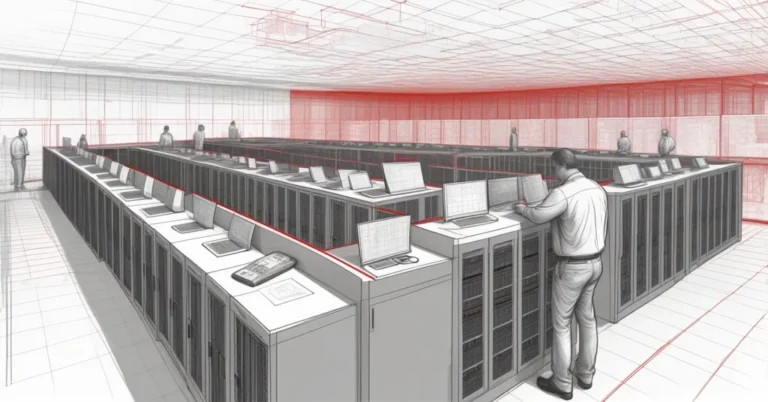
The county approved the map and postponed the campus. A judge said the campus had to be reviewed.
Imperial County just showed what happens when the race for AI compute tries to skip the hearing.
On April 7, 2026, county supervisors approved a lot merger tied to a 950, 000-square-foot computing campus beside neighborhoods in Imperial and El Centro. The developer is Sebastian Rucci, CEO of Imperial Valley Computer Manufacturing, a Huntington Beach firm KPBS described as brand-new. IVCM wants to lease the site to a hyperscaler, the class of company that runs the largest cloud and AI platforms. KPBS has listed Amazon, Google, Meta, and Microsoft as examples of that category. None of them is a confirmed tenant.
The county signed off on the land assembly. KPBS reported that county officials accepted Rucci’s argument that a review under the California Environmental Quality Act was unnecessary because the project was planned to meet local zoning. On August 31, 2026, Imperial County Superior Court Judge L. Brooks Anderholt issued a tentative decision that the county could not split the question that way.
The court finds the county prejudicially abused its discretion by approving the lot merger without first completing the CEQA review required for the whole project.
KPBS reported the next day that the decision was not yet final, and that both sides could still comment. Construction has not started. The project is not dead. A judge said the county skipped the review the whole project required.
A few numbers will travel farther than the paperwork. The power comparison, the water figure, and a claim of $100 million a year in local public benefits are developer estimates or Rucci’s account of a county economic study. They have not been independently audited in the reporting. They are still why the neighbors showed up.
What “the whole project” means
CEQA is California’s basic environmental-review law. It is supposed to force a public look at air, water, energy, and the people next door before the concrete sets. The legal fight is about segmentation: approving one slice so the campus never has to be reviewed as a campus.
Kathryn Pettit, an attorney in the Sierra Club’s case, called the county’s approach “classic segmentation, which is absolutely prohibited under CEQA.” The San Diego Chapter’s suit, reported by KPBS on May 27, 2026, challenges the April lot merger. The chapter has about 1, 000 Imperial Valley members. Mark West, the chapter’s director, said the club did not entirely oppose a data center. It wanted the impacts analyzed and mitigated, and community feedback considered. The suit also alleged that the board overrode the planning commission before a formal decision.
That case sits beside an earlier one. On December 12, 2025, KPBS reported that the City of Imperial had sued to force environmental review. These are separate suits. IVCM has its own federal case against Imperial city officials, alleging unfair treatment and a conspiracy with other local agencies to block the project. The docket is real. It is not yet a verdict on whether this campus should exist.
Anderholt said the county should have looked harder at several effects together: energy demand, water supply, drainage, a large battery system, and natural-gas backup generators, including local air pollution and greenhouse gases. The tentative decision pointed to significant environmental effects. No completed environmental study is in the public reporting of this fight. The ruling requires the questions. It does not answer them.
A fence line, a river, and a substation
“Study it later” drew a crowd because the later part is the actual campus.
KPBS reported in January 2026, and again on September 1, that chips and cooling at the site could draw more power than all of Imperial County used in 2024, according to state data and estimates by IVCM. A rate of draw is not the same unit as electricity used over a year, and the county figure itself is not in the story. The comparison belongs in KPBS’s words. It is not a signed power contract, and it is not a finding that the local grid can or cannot take the load.
Water is the developers’ number, and it is specific. They have put daily use at 750, 000 gallons. In a desert county whose water already runs through the Colorado River, that is the argument, not a footnote.
Francisco Leal lives in the Victoria Ranch neighborhood, next to the proposed complex, and has lived in Imperial for over a decade. After the tentative decision he told KPBS, “This court ruling just proves that all of our claims were correct.” The ruling was still tentative. Leal was reacting as a neighbor, and the court had not turned his view into a judgment. From his side of the fence, the merger was the fight, and it is not over.
The anger was already public months earlier. On December 9, 2025, residents packed a Board of Supervisors meeting. City Manager Dennis Morita and Councilmember Katie Burnworth were pushing for transparency. Alene Taber, counsel for the city, later said the tentative decision vindicated residents, and that they had legitimate concerns that “need to be heard.” County spokesperson Eddie Lopez did not comment.
Rucci said he respected the judge and would seek a hearing to contest the findings. He told KPBS that a county economic study found “$100 million a year in county-directed public benefits, ” and that each year of delay costs the local economy. That is not a count of the people who would run the building after the construction crews leave.
The load you are actually buying
Training a model, then answering with it, is why hyperscalers are hunting generation, transmission, and water at the same time. The software does not hover above that. An AI agent that writes the sales follow-up, or a workflow sold as AI automation, is a small repeated withdrawal from a substation somebody has to permit. If you are buying AI for business, you are also buying a bet on that permit.
The size of the withdrawal is not one clean number. According to the International Energy Agency, in figures carried by a Brookings briefing published in April 2026, global data-center electricity use was about 415 terawatt-hours in 2024, roughly 1.5 percent of world electricity. That use had grown about 12 percent a year since 2017, more than four times the growth rate of total electricity use. The IEA’s base case reaches about 945 terawatt-hours by 2030. Other estimates run higher, and some measure capacity rather than annual energy. The forecasters do not agree. A slide that pretends they do is editing the argument.
The local point does not need the rest of the spreadsheet. AI workloads are a fast-growing share of data-center load, disclosure of that load is poor, and grid, water, and backup generation are exactly the effects Imperial County was told it could postpone.
A lease premium does not assign the bill
There is a real market for speed. Land and power at this scale are scarce, and a developer who can hand a tenant a shorter clock may be able to charge for it. In court filings, as KPBS reported, IVCM has said it stands to make billions leasing this complex to a major tech company. That is the company’s claim. Neighbors heard a different one: natural-gas generators and a battery bank, advanced through a lot merger, before anyone finished the review.
Both can be partly right. A premium for speed does not say who pays if the power estimate is low or the water figure is high. A protest does not, by itself, prove the emissions. The missing study was supposed to sort that out.
The room this project walked into was not empty. The Sierra Club has a separate suit against the Imperial Irrigation District over a Colorado River conservation deal, arguing that communities near the Salton Sea could face more toxic dust. That case is not this data center. It is why a new industrial water user arrives in a county that is already keeping score.
The wires do not stop at the county line either. Data-center proposals in the Coachella Valley are drawing opposition of their own. A campus large enough to worry one county’s grid is also a neighbor’s reliability problem. People meet that growth as a bill, a hum, or a curtailment.
Skip the public process and the delay you were trying to outrun comes back as litigation. The tentative ruling did not ban AI infrastructure. It refused to let a lot merger stand in for the campus.
Questions worth asking before the next campus breaks ground
- Did a judge stop the Imperial Valley project for good?
No. On August 31, 2026, Judge L. Brooks Anderholt issued a tentative decision that the county abused its discretion by approving the lot merger without a CEQA review of the whole project. KPBS reported the next day that it was not yet final, and Rucci said he would contest the findings.
- How much power and water are we actually talking about?
Only estimates. KPBS reported that chips and cooling could draw more power than Imperial County used in 2024, based on state data and IVCM’s figures, without publishing the county number. Daily water use of 750, 000 gallons is the developers’ figure, and neither number comes from a completed environmental study.
- What did the county skip, in plain terms?
Energy, water, drainage, batteries, and natural-gas generators were supposed to be reviewed with the campus, not after the map. The tentative ruling called approving the merger first a prejudicial abuse of discretion. Those impacts still have not been measured in a finished study, which is not the same as disproven.
- What should a buyer of AI automation take from a county lot merger?
Ask who holds the power, the water, and the permit behind the computing you are about to depend on. A fast site with a thin review is not a bargain if the review returns as a lawsuit. The Sierra Club’s position here was not a ban on data centers. It was measure the impact, mitigate it, and let the people next door speak before the lots are merged.
Speed is a real premium. So is the hearing.
AI infrastructure will keep getting built. Even where the forecasts disagree, the IEA’s growth rates do not leave room for a fantasy in which models scale and the buildings do not. Imperial County is a preview of the terms. It is not a verdict on the industry.
The terms are unglamorous. Disclose the load. Review the generators and the batteries with the building, not after it. Set the developer’s water figure next to the river that actually supplies the region. Separate a lease prospectus from a public benefit.
Rucci said he would contest the findings. The city and the Sierra Club wanted the record opened before the campus was treated as inevitable. Taber’s point survives either outcome: people living beside the site had legitimate concerns, and those concerns needed a hearing. For the companies racing to rent the compute, that hearing is part of the product. Skip it, and the cheapest megawatt on the spreadsheet becomes the most expensive month on the calendar.