
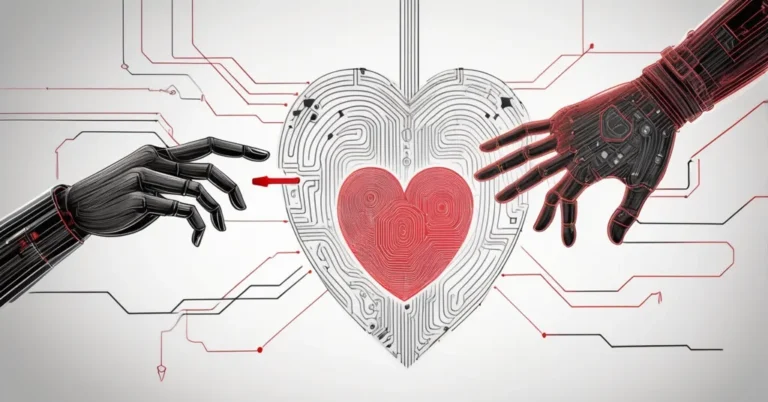
It used to be our imperfect bodies that made us insecure. With AI, it’s our minds as well
Scrolling social feeds used to deliver a single kind of chill: a face that looked almost sculpted, a body that had been engineered. Lately those jolts land on speech, slide decks, brand copy and playlists, the places where human minds used to show their rough edges. A Cannes clip of John Travolta might look subtly off. A flattering shot of Carla Bruni can feel unnaturally smoothed. The reaction is the same: a recognition that something human has been reshaped toward mechanical perfection. That recognition is spreading from skin to thought.
From an uncanny body to an uncanny mind
Masahiro Mori named the “uncanny valley” in 1970 to describe the discomfort we feel when a robot is almost, but not quite, human. Earlier still, in 1956, Günther Anders warned about a different consequence of technological perfection in Die Antiquiertheit des Menschen (commonly translated as The Obsolescence of Man). He imagined machines growing ever more beautiful while humans remained “malformed” by birth:
“Each day out of machines arise
ever more beautiful machines.
Only we remain malformed,
only we’re born obsolete.”
Anders used phrases like “bodily clumsiness” and “corporeal imprecision” to capture the shame of being born rather than manufactured. That shame shows up in real trends. The Economist reported on January 2, 2025, that surgical cosmetic procedures are booming globally, and The Guardian covered the online culture of “looksmaxxing” (practices aimed at optimizing appearance) on January 27, 2026.
Now the same psychology, measuring ourselves against engineered perfection, is extending to mental labor. AI systems such as ChatGPT (publicly launched in late 2022) routinely produce polished text, music scaffolds and strategy outlines that read as if they were designed, not born. The result is a new, blurred “uncanny valley” where human and machine outputs converge and people begin to view their own thinking as flawed.
Signals that language and culture are shifting
There is data behind the hunch. A 2025 analysis by the Max Planck Institute for Human Development examined large bodies of online speech, reportedly some 360, 000 YouTube videos and 772, 000 podcasts, and compared word frequencies before and after ChatGPT’s public release. The researchers found increases in certain terms that the chatbot tends to favour, examples cited include “delve”, “boast” and “meticulous”. The study is correlational (comparing usage before and after the model’s launch), so it points to influence rather than proving a single causal path.
Platforms are also registering side effects of automated scale. The Guardian reported on September 25, 2025, that Spotify removed roughly 75 million spam tracks over the prior year, many tied to automated music generation and industrial-scale content farming. Across journalism, marketing and entertainment, AI is both producing content and nudging stylistic defaults that human creators start to imitate.
Why mimicry stings, and why leaders should care
Two reactions drive organizational consequences. First, a pragmatic response: adopt the efficient, polished style that wins clicks, passes filters and scales. Second, an existential recoil: a private sense of betrayal when a colleague’s uneven, idiosyncratic voice is supplanted by algorithmic polish.
That recoil matters for business:
- Brand trust. If customers can’t tell which communications are genuinely human, authenticity becomes scarce. Scarcity erodes loyalty and lowers the premium brands can charge for distinctiveness.
- Talent identity. Workers whose value depends on judgmental nuance, senior advisors, creative leads, salespeople, may feel pressured to conform to AI-driven templates, reducing the differentiated judgment that companies sell.
- Operational risk. Automated volume without curation invites platform penalties, copyright disputes and reputation spikes. Spotify’s purge is a concrete reminder of that risk.
Use AI for business, just not as a straightjacket
Resisting all automation would be foolish. AI agents, ChatGPT-style assistants and AI automation can boost productivity. The practical move is to be selective. Decide where AI should raise the baseline and where human roughness is the strategic asset. Anders’ ethical nudge, a call to keep an inner resistance to wholesale assimilation, translates in business terms to naming and protecting the domains where human authorship matters.
Three practical moves for C-suite leaders
-
Audit voice and provenance, 90‑day sprint.
Map your top 10 customer touchpoints (emails, help articles, sales decks, flagship blog posts, ads). For each, log whether content is human-authored, AI-assisted, or fully AI-generated and who reviews it. Deliverable: a public internal map and a simple label format for external content (for example: “AI-assisted; edited by Jane Doe”). KPI: percentage of customer-facing items with provenance labels. Target 100% in 90 days.
-
Protect idiosyncrasy, designate human-first channels.
Reserve certain outputs for human authorship, executive op-eds, strategic proposals, key account presentations, flagship storytelling, and require at least one human rewrite pass. Measure distinctiveness with a simple rubric (tone, narrative risk, personal viewpoint) and a “Distinctiveness Index” survey of customer reactions. KPI: maintain or increase the index score quarter over quarter.
-
Train for literacy, not mimicry, operationalise editing standards.
Run weekly “prompt clinics” and a monthly review where teams benchmark AI drafts against human-edited versions. Teach staff to evaluate outputs for context, ethics, and business nuance and to edit for personality, not merely clarity. KPI: percentage of AI-assisted drafts that pass a human-authorship checklist before publication.
These moves keep AI for business where it helps, reducing toil and speeding iteration, while protecting the unpredictable human judgment that drives trust and differentiation.
A quick counterweight: AI can amplify, not only flatten
Not all mimicry erases personality. Some creators use AI to prototype wilder ideas, riff off unexpected outputs, or multiply a distinct voice at scale. The point for leaders is not to ban AI but to channel it. Use automation to expand human range, not to replace the human imprint.
Three short actions to start this week
- Begin a 90‑day voice audit of your top customer touchpoints.
- Publish a one‑page authenticity policy that defines human‑first channels and labeling rules.
- Run a pilot “prompt clinic” for a single team and track the percent of edited outputs that retain a human signature.
Key questions leaders are asking, and straight answers
-
Is AI really changing how people speak and write?
Evidence suggests so. A 2025 Max Planck Institute analysis of some 360, 000 YouTube videos and 772, 000 podcasts found shifts in word choice after ChatGPT’s public release, with noted increases in words like “delve”, “boast” and “meticulous.” The finding is correlational, suggesting influence rather than proving a single cause.
-
Are cosmetic and content-based “optimizations” connected?
They look like parallel responses to a cultural pressure: The Economist reported a global boom in cosmetic surgery on January 2, 2025, while platforms and publishers have documented rising volumes of AI-influenced content. Both trends reflect an appetite for manufactured perfection, one in appearance, the other in expression.
-
Should companies ban AI in creative work to preserve authenticity?
Not usually. Bans are blunt. A better approach is clear boundaries: require human sign-off in high-stakes creative areas, label AI involvement, and measure human distinctiveness where it matters strategically.
-
How do we measure “human authenticity” at scale?
Start simple: a Distinctiveness Index that combines a qualitative rubric (tone, narrative risk, personal perspective) with customer feedback metrics (NPS or qualitative responses). Track before-and-after scores as you introduce AI controls.
We won’t be replaced by error-free machines tomorrow, but we are being nudged, subtly and persistently, into smoothing ourselves into machine templates. The managerial task is to decide what must remain imperfect and to protect the value that imperfection creates. Start with a 90‑day audit, publish clear rules of engagement for AI agents and automation, and make a measurable commitment to preserve human distinctiveness. That discomfort you feel when something seems too perfect? Treat it as an early warning light and act on it.
Note: Joseph de Weck, an associate fellow with the German Council on Foreign Relations who writes from Zürich and Paris, captured the ethical kernel of this unease: “As long as something in us recoils from that world, there is hope.” Use that recoil constructively, it’s the prompt that tells you where to put human judgment back in the driver’s seat.