
When efficient AI hiring becomes a slow bleed: Lovett’s “tragedy of the cognitive commons”
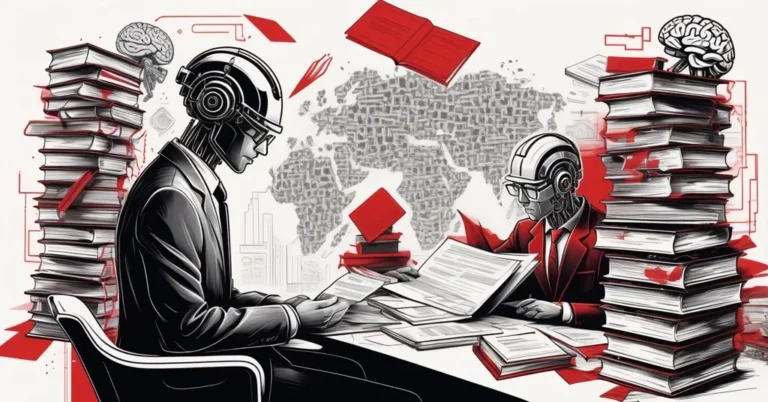
Nolan Lovett, a researcher at NATO Special Operations University, argues that individually rational choices to replace entry‑level work with AI can slowly eat away the tacit knowledge professions rely on, what he calls the “tragedy of the cognitive commons” (Lovett, arXiv:2607.29380; Human Resource Development Review, DOI 10.1177/15344843261470602). Matthias Bastian summarized Lovett’s paper for The Decoder on August 15, 2026. The idea is straightforward: every firm that cuts junior roles keeps the immediate gain, while the cost, the thinning of a profession’s reservoir of expertise, gets spread across everyone who depends on that pipeline.
The two mechanisms that hollow expertise
- Entry‑level elimination. Firms replace junior roles with AI. Each employer keeps the efficiency payoff. The long‑term cost, fewer trained professionals, falls on the profession as a whole.
- Shallow apprenticeship via AI assistance. Remaining juniors can show high measured productivity because the AI supplies answers. They hit targets without doing the mental work that builds tacit knowledge. Lovett calls this fragility the “validation tether”: overseeing AI requires deep domain know‑how, and that tether frays as hands‑on experience disappears.
Lovett frames the issue as the “Human Reserve Paradox”: organizations need a reserve of deep expertise for crises and validation, but no single firm has the incentive to pay the full cost of producing that reserve when AI boosts short‑term returns.
Why this is a slow, systemic risk, not an HR glitch
Two features make the risk dangerous.
- Long lag times. Lovett projects that entry‑level cuts starting around 2023 could produce broad, system‑level weakness between roughly 2030 and 2045, a window long enough for incentives to harden before harms become obvious.
- Validation dependency. Safe AI use requires people who can spot plausible but wrong outputs. As that expertise shrinks, organizations lose their ability to validate model results, and errors are more likely to propagate unnoticed.
Who’s most exposed (and who has some protection)
Lovett points to jobs that are highly substitutable and modular, where tasks are discrete and codified. Clear examples are software engineering, financial analysis, and legal research. These fields mix modular tasks, light regulation, and large pools of entry‑level work that firms can cheaply hand off to models.
Medicine and civil engineering have stronger regulatory and professional pathways that slow the shift, but they are not immune. Regulation slows adoption but does not stop the risk if on‑the‑job learning is repeatedly short‑circuited.
What the evidence says so far: mixed labor signals, greener warnings from cognitive science
The empirical picture is mixed. Lovett’s argument rests on a plausible mechanism. Evidence so far supports parts of it, but it does not prove that whole professions will collapse.
Labor‑market studies
- A summer 2025 study (reported in The Decoder) found employment declines concentrated among young workers in AI‑exposed occupations, while more experienced workers’ employment held steady or grew.
- The Federal Reserve Board reports that growth in programming jobs “has nearly halved” since the public arrival of ChatGPT, a striking shift in hiring dynamics.
- Anthropic’s March 2026 labor study (reported by The Decoder and Anthropic) found no measurable overall impact on aggregate employment, but it did record a drop in the job‑finding rate, about half a percentage point, for people aged 22-25.
These labor results vary because studies use different definitions, windows, and methods. Some spot cohort effects among young hires; others find little aggregate displacement. That mix is exactly why Lovett’s commons argument matters: local incentives can look rational long before any systemic signal appears.
Cognitive and learning research
- An MIT EEG study (reported in The Decoder) found that even brief AI use weakened measures of neural connectivity and that “over 80 percent of participants struggled to recall content from their own AI‑assisted writing.”
- In a developer experiment reported by Anthropic, participants with AI access scored “17 percent worse” on knowledge tests when they treated the model as an answer machine. Using the model for explanations produced much smaller learning losses.
- A Swiss study of 666 participants reported a strong negative link between AI use and critical thinking, most pronounced for 17-25 year‑olds.
- A large study of Chinese students (sample ≈26, 000) found homework grades rose by 18% after AI adoption while exam performance later fell by up to 24%, with the full negative effect appearing after roughly two years.
The consistent, policy‑relevant pattern across cognitive studies is simple: how people use AI matters. Treating AI as an “answer‑machine, ” where it replaces retrieval and effort, produces the largest learning and critical‑thinking harms. By contrast, AI used to explain, prompt reasoning, or guide practice tends to preserve or improve learning.
Where Lovett recommends we steer: policy‑lite, design‑heavy fixes
Lovett does not call for broad bans. He offers interventions that shift incentives and protect training pathways: AI‑free learning environments; phased model introductions after baseline human performance is shown; certification of domain competence alongside AI skills; and incentives for employers to train early‑career staff rather than simply eliminating them.
Practical playbook for leaders (specific, measurable steps)
- Create AI‑free apprenticeship lanes. Reserve a defined share of early training for unaided practice, for example 20% of onboarding tasks or the first 3-6 months of rotations without model assistance. Assess progress with timed blind tasks that exclude AI help.
- Require baseline competence before AI reliance. Set observable competency tests, such as a blind review accuracy benchmark or a proctored case exam. Make passing those tests a precondition for using AI in live workflows and reassess quarterly.
- Measure training outcomes, not just output. Change bonus and promotion rules to reward supervisors for trainees’ demonstrated learning gains (for example, certification pass rates or error‑catch rates) rather than only short‑term throughput.
- Design models to explain, not just answer. Prefer product defaults that return step‑by‑step reasoning, ask clarifying questions, and require users to justify accepting outputs. Track and nudge explanatory use through UX analytics.
- Monitor leading indicators. Watch entry‑level hiring rates, early‑career promotion velocity, apprenticeship enrollment, certification pass rates, and internal validation catch rates. For example, trigger a review if entry‑level hiring falls by more than 15% year‑over‑year in a critical occupation.
Policy levers that fit the problem
- Subsidize AI‑free apprenticeships and internships to correct the collective‑action problem where firms underinvest in training.
- Encourage, or require for high‑risk sectors, certifications that prove domain competence under proctored conditions or without AI assistance.
- Fund research comparing “answer‑machine” versus “explanatory” AI designs on medium‑term learning outcomes and on real‑world error detection.
Countervailing forces and why they may not be enough
Markets can and will adapt. Some firms will invest in training to stand out, new roles like AI‑orchestrators and validation specialists will appear, and professional associations may step up credentialing. Labor economics research shows automation often creates new tasks as it destroys old ones.
Those forces matter. Still, Lovett’s point is structural: without coordination or incentives, the privately rational path, replace juniors, raise short‑term productivity, will be the default. That leaves society exposed to the slow loss of deep expertise, which only becomes painfully visible when models fail in edge cases, crises, or regulatory audits.
Three measurable warning signs to watch now
- Rapid, sustained decline in entry‑level hiring or internship slots in a profession, for example greater than 15% year‑over‑year.
- Falling early‑career promotion rates or widening performance gaps between cohorts trained before and after heavy AI adoption.
- Decreasing internal validation catch rates, more model errors slipping into production undetected.
Short, honest Q&A
- Could firm‑level AI adoption really hollow out entire professions?
- Which fields face the biggest risk?
- Is there strong evidence AI is already causing this harm?
- Can AI design reduce the risk?
- Do we need regulation or nudges?
Lovett argues it could: replacing entry‑level roles and allowing juniors to shortcut learning with AI can collectively weaken the shared pool of tacit expertise, a “tragedy of the cognitive commons.” The effect is a social‑coordination problem that may not show up in firm‑level P&Ls until later.
Professions with high task substitutability, modular work, and light regulation, software engineering, financial analysis, legal research, are most exposed because AI can replicate large chunks of codified work and firms face weak external pressure to preserve apprenticeships.
The labor evidence is mixed: some studies report declines among young workers in exposed occupations, while others find little aggregate effect. Cognitive‑science experiments and education studies more consistently show learning harms when AI is used as an “answer machine.”
Yes. Experiments indicate that using AI as an explanatory tutor or prompting users to reason through solutions preserves learning much better than single‑shot answer use. Product defaults and UX nudges can steer users toward those safer interaction patterns.
Lovett favors incentive and design interventions, AI‑free training, phased rollouts, certification, because they directly address the incentive mismatch. Regulation may still be needed in safety‑critical domains where the cost of expertise loss is high.
Final frame: treat expertise as infrastructure
Expertise is slow infrastructure. You cannot rebuild it overnight. Lovett reframes AI adoption as a structural choice about how professions reproduce themselves. Short‑term productivity gains from substituting juniors with models are real, and so is the risk that a profession’s ability to validate and correct AI outputs will atrophy.
Actionable bottom line for executives: map which workflows are training pipelines, protect a measurable share as AI‑free practice, make baseline competence a gating condition for AI use, and track a few simple KPIs that show whether your cognitive commons is being preserved or depleted.
“Every company that cuts entry‑level jobs benefits individually, but the collective expertise of entire professions erodes.”
Lovett coins related terms including the “validation tether” and the “Human Reserve Paradox.” See Nolan Lovett, The Tragedy of the Cognitive Commons, arXiv: https://arxiv.org/pdf/2607.29380 and Human Resource Development Review (DOI 10.1177/15344843261470602). Matthias Bastian summarized the paper in The Decoder on August 15, 2026.