
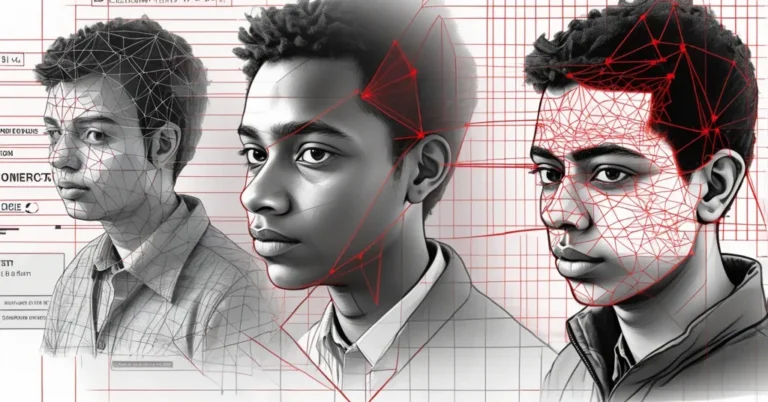
AI age‑checks risk turning young migrants into adults on paper, and into danger in practice
At least 755 young people who arrived in the UK in 2025 were later found to be children after initial assessments had placed them in the adult system, the Helen Bamber Foundation reports from Home Office figures. Those numbers map directly onto real harms: placement in adult accommodation, exposure to detention, and the risk of removal while a child’s claim and protection needs go unrecognised (Helen Bamber Foundation).
In May 2026 the Home Office published procurement material naming facial age‑estimation technology and naming Cognitec, a German face‑recognition company, in tender documentation. The agency says it intends to use these tools to support initial age assessments and make decisions “more robust and consistent” (Home Office spokesperson). Independent investigators and charities warn the plan risks magnifying existing errors, especially for people of sub‑Saharan African origin, and that the operational context at first contact will make matters worse (Lighthouse Reports; NIST FATE test data).
What the technology actually predicts
Facial age‑estimation models estimate apparent or perceived age from an image, how old someone looks in that photograph, not a person’s legal (chronological) age. Apparent age is affected by genetics, nutrition, illness, trauma and photo quality. Models can also be poorly calibrated, meaning they systematically over‑ or under‑estimate age for particular groups. Those two facts together explain why a face estimator is fundamentally a noisy signal for a legal determination that carries immediate protective consequences.
Independent testing and what it shows
Lighthouse Reports’ June 18, 2026 investigation combined a leaked Home Office internal test report with public vendor results from NIST’s FATE/FRVT benchmarks. Their reanalysis found substantial demographic disparities in performance. In Lighthouse’s reanalysis of NIST benchmark data, the mean absolute error (MAE) for female subjects of sub‑Saharan African ancestry under 18 was about 4.6 years, large enough that a 14‑year‑old could plausibly be estimated as 18 or older on average in those test sets (Lighthouse Reports; NIST FATE).
Benchmarks also show that image quality matters: NIST distinguishes higher‑quality “Application” images from lower‑quality “Border” or webcam images. The Home Office’s intended operational images (first‑encounter photos, often low‑quality and taken under stressful conditions) resemble the lower‑quality sets where performance degrades substantially. That implies lab numbers can understate real‑world error.
Some press reporting has attributed a “30‑month” margin of error to the Home Office’s description of FAE uncertainty. That specific figure was not found in the Home Office documents Lighthouse analysed; Lighthouse’s leaked tests and NIST reanalysis indicate larger average errors for some demographic groups, underscoring that any single‑number claim needs careful context (Lighthouse’s methodology note).
Bias, adultification and real harms
Investigators found a clear tendency for some systems, including the Cognitec submission tested in NIST datasets, to overpredict ages for people of sub‑Saharan African ancestry. Tech monitor Foxglove has warned of systemic racialised error in these tools; civil‑society groups say using such systems against vulnerable migrants is equivalent to experimenting on children (Foxglove; Refugee and Migrant Children’s Consortium).
“This is not about protecting children, this is about shoring up the decisions that [the authorities] are making, ”, Maddie Harris, Humans for Rights Network.
Petra Molnar of Migration and Tech Monitor frames facial age‑estimation as a modern return to judging people by physical features: “The context really matters here… We know that trauma ages you. We know that malnutrition, dehydration, torture, even just the journey itself, has physical impacts on your face, on your body.” Molnar warns this is effectively “neo‑phrenology”, categorising people by appearance rather than evidence.
The practical consequence is straightforward: once a young person is recorded as an adult, case pathways change immediately. NGOs warn that those wrongly recorded as adults face adult accommodation, detention decisions, and the fast‑moving possibility of removal before correctage is established (Helen Bamber Foundation; Maddie Harris).
How the Home Office plans to use the tool, and why process matters
The Home Office says facial age estimation would be used alongside immigration officer checks as a support tool rather than an automated decision maker. In principle that reduces risk. In practice, however, advisory outputs can become de facto determiners unless workflows, thresholds and legal safeguards are strictly defined and enforced. Key unanswered operational questions include: how outputs will be displayed (single point estimate versus probability distribution/confidence interval), what weight an officer is permitted to give the output, and whether detention or removal actions can proceed when the only reason is an AI estimate (Home Office procurement notes; Lighthouse Reports).
What must change before any live processing
Three facts make the current plan dangerous unless substantial safeguards are added:
- Real‑world misclassification already exists: Helen Bamber’s analysis of Home Office data found about 755 children in 2025 were wrongly treated as adults after initial assessments.
- Benchmarks show measurable disparities: Lighthouse’s reanalysis of NIST data found MAE in tested sets that can measure multiple years for some demographic groups, enough to push many minors over an 18‑year threshold in the tests.
- Context skews appearance: trauma, malnutrition and poor capture conditions at first encounter can make children appear older, compounding algorithmic error rather than correcting it.
Before any pilot that processes live cases, the Home Office should publish and commit to concrete, measurable safeguards and transparency measures (not a checklist of intentions):
- Publish the procurement/contract terms, scope (pilot versus rollout), and the operational workflow showing precisely how AI outputs are presented to officers and how much weight they may carry.
- Require vendor performance reporting broken down by age cohort, sex and ancestry on representative border‑quality images, using standard metrics: MAE (mean absolute error), bias (systematic over/underestimation), false positive rate for classifying under‑18s as 18+, calibration curves and confidence interval behaviour. Public sample sizes must be stated.
- Mandate independent, third‑party algorithmic audits before any live deployment and yearly thereafter, with public disclosure of findings and remediation steps. Audits must use representative, ethically sourced evaluation images and include civil‑society observers with child safeguarding expertise.
- Forbid any detention, removal action or placement in adult accommodation that relies solely on an automated age estimate. AI outputs must be non‑binding prompts; a legally defined human re‑assessment with a high safety threshold must be mandatory.
- Create immediate redress and appeal routes, and retention limits for biometric data that comply with data protection law (Data Protection Act/GDPR) and safeguard vulnerable people. Record and publish cases where AI output contributed to an incorrect decision and the remedies applied.
Alternatives and better practice
Facial age estimation is a single, noisy signal. Safer practice prioritises multidisciplinary assessment: culturally competent interviews, trained caseworkers and interpreters, psychosocial assessments, corroborating documents where available, and targeted medical evidence only where ethically appropriate and clinically justified. Medical methods (bone or dental X‑rays) carry their own ethical and accuracy limits and should not be a default. A robust age assessment system combines multiple information sources and defaults to protection when uncertainty exists.
Regulators and policy makers should also define measurable success criteria for any trial before it begins. Here are three testable gates that would represent success:
- Independent audit shows the system reduces the baseline rate of misclassification of minors (measured against Helen Bamber/Home Office baseline) on representative border images before live processing begins.
- Binding legal safeguards prevent any detention or removal action being taken on the sole basis of an AI estimate; this is codified in operational guidance and oversight mechanisms.
- Transparent public reporting of demographic performance metrics, remedial actions and case outcomes at defined intervals (quarterly for pilots), with civil‑society access to audit findings.
What success looks like
If AI is used at the border, success is not faster decisions, it is fewer children wrongly denied protection. That requires meaningful transparency, measurable performance by demographic group on realistic images, independent oversight, and legal bars on actions that would harm a misclassified young person.
Key takeaways: questions you should be asking
- How many children are already being misclassified?
According to the Helen Bamber Foundation’s analysis of Home Office figures, about 755 children were wrongly treated as adults in 2025 after initial assessments (Helen Bamber Foundation).
- Does facial age‑estimation make fewer mistakes?
No. Independent analysis by Lighthouse Reports, using leaked Home Office tests and NIST FATE benchmark data, finds age‑estimation models can have mean absolute errors measured in years for some demographic groups; Lighthouse reported an MAE of about 4.6 years for female sub‑Saharan African subjects under 18 in tested datasets, large enough to flip many minors into adult classification in those tests (Lighthouse Reports; NIST).
- Is the technology racially neutral?
No. Lighthouse’s reanalysis found patterns of overprediction for people of sub‑Saharan African ancestry in the tested systems. Tech monitors including Foxglove have warned these systems embed racialised error patterns, which can amount to discriminatory outcomes in practice (Lighthouse Reports; Foxglove).
- Will the AI be the sole decider of age?
The Home Office says the AI will be used alongside officer checks, not as the sole determinant. However, NGOs warn advisory tools often become determinative in practice unless legal safeguards, mandatory human re‑assessment and strict operational limits are enforced (Home Office statements; NGOs).
- What must happen before deployment?
Publish the contract scope and workflow; disclose vendor performance broken down by demographic groups on border‑quality images (MAE, false positive rates for <18, calibration); commission independent audits; and ensure legally binding safeguards so children cannot be detained, removed or housed with adults on the basis of an automated estimate alone.
Technology can amplify care, or it can amplify shortcuts. In the context of age assessment at borders, speed without demonstrable accuracy and legal protection risks turning a tool into a machine of harm. Policymakers should treat this as a high‑risk public policy decision that requires measurable tests, full transparency and binding safeguards before any live use with vulnerable children.