
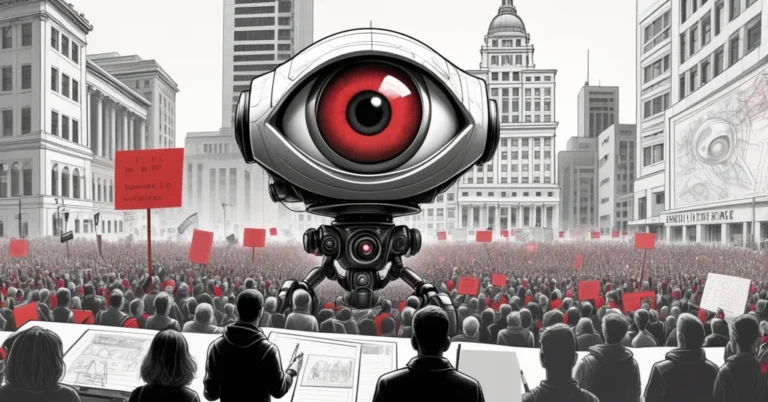
AI surveillance is being supercharged, and it will chill social progress
In 2018 NPR reported the case of Lao Duan, a man placed on an administrative blacklist in China whose photograph, name and citizen ID were displayed on a large electronic billboard as an “untrustworthy person.” He was barred from buying high‑speed train tickets, had accounts frozen and became locally stigmatized, a vivid example of reputational sanctions tied to data‑driven systems (NPR, Oct. 31, 2018).
Security technologist Bruce Schneier and researcher Jon Penney warn that moments like this are not isolated curiosities but a preview of what happens when facial recognition, pervasive cameras, massive behavioral databases and automated analytics are fused. They put it bluntly: “The chilling effects are the point.” Systems designed to observe, identify and enforce at scale will produce self‑censorship, conformity and a quieter public square.
What’s new about AI‑enhanced surveillance
Surveillance itself is not new. The FBI’s mid‑20th century domestic programs relied on wiretaps, informants, opened mail and paper index cards. What is different now is scale, speed and automation. Modern systems can identify people in near‑real time, link sightings to historic records, and in some deployments trigger automated responses with minimal human review.
Schneier and Penney highlight four mechanisms that amplify democratic harm: surveillance, personalization, uncertainty and authority. Briefly:
- Surveillance, continuous sensing and recording across public (and increasingly private) spaces.
- Personalization, enforcement that adapts to an individual’s history, affiliations or risk score, directing more scrutiny at some people than others.
- Uncertainty, opaque thresholds and proprietary algorithms leave people unsure what actions will trigger penalties.
- Authority, when state power or major vendors back systems, consequences become tangible and harder to contest.
Together these effects change behavior. People weigh the social and legal costs of speaking up, protesting, experimenting or simply deviating from norms, and often choose silence or conformity.
Where this is already happening
China’s use of integrated identity‑linked systems provides the clearest, well‑documented case of large‑scale social control through technology, from travel bans tied to administrative lists to public shaming (NPR, Oct. 31, 2018). Experimentation and procurement are happening globally.
In the United States, procurement records and investigative reporting summarized by the American Immigration Council document a rapid expansion of biometric and analytic tools within DHS/ICE. Those summaries report contracts and purchases such as Palantir’s ImmigrationOS (roughly $30 million in identified procurement activity), a Clearview AI purchase (about $3.75 million), and multimillion‑dollar buys of biometric devices (American Immigration Council). These figures show how tools that began as specialized capabilities for immigration and border enforcement can spread into routine agency toolkits and potentially other domestic contexts.
Debates and legal challenges over police and municipal use of facial recognition, and scrutiny of vendor contracts, show deployment is not uniform, but the technology’s reach is widening across regions and institutions.
Technical bias matters, but it’s not the only danger
Independent technical evaluations show important accuracy and bias issues. The National Institute of Standards and Technology’s Face Recognition Vendor Test (FRVT) and academic work (for example, research by Joy Buolamwini and colleagues) document higher error rates for women and people of color under many operating conditions. Those errors translate into unequal harm when systems feed enforcement decisions.
Schneier and Penney argue the democratic risk goes beyond accuracy. Even a highly accurate system changes social dynamics when it is opaque, automated and backed by authority. Automated enforcement shortens the time between detection and penalty, personalization makes penalties feel targeted, and uncertainty about how systems operate drives preemptive self‑censorship. Better models reduce some harms, but they do not remove the incentives that normalize surveillance and chill dissent.
Balancing safety and civic space
Public‑safety and border‑control officials say these tools improve efficiency and can help prevent harm. Those uses are real and consequential. The critical question for leaders is the tradeoff: how much civic breathing room are we willing to trade for operational gains, and under what governance conditions? History shows surveillance technologies often outpace rules, and the downstream social impacts, fewer protests, less experimentation, curtailed minority expression, are not incidental.
Policy levers and governance options
Schneier and Penney and allied civil‑liberties groups point to concrete policy responses:
- Bans or moratoria on identity‑linked technologies in public spaces (for example, prohibiting general surveillance‑grade facial recognition in public).
- Stronger privacy and data‑retention limits to reduce how long behavioral records can be linked to identities.
- Targeted AI regulation to forbid or tightly limit automated enforcement where fundamental rights are affected.
- Procurement and structural reforms to reduce dependency on a narrow set of vendors and create meaningful oversight of vendor‑state relationships.
What business leaders should do this quarter
Treat surveillance tech as a strategic governance choice. Practical first steps:
- Run a Data Protection Impact Assessment (DPIA) for any identity‑linked system before purchase or rollout. Document who is affected, the data flows, retention windows and the legal basis for processing.
- Fix vendor contracts to require audit rights, prohibit resale or unapproved sharing of identity data, cap retention, and mandate human review before any enforcement action. Insist on data provenance logs and the ability to revoke vendor access.
- Operationalize human oversight by design: require a human‑in‑the‑loop for actions that impose sanctions or restrict rights, and publish accessible redress mechanisms for individuals.
Track simple governance metrics monthly: number of identity‑link queries, percent of flagged cases reviewed by a human, average retention age of linked records, and number of contested decisions resulting in reversal. These metrics turn abstract risk into board‑level visibility.
“The chilling effects are the point.”, Bruce Schneier and Jon Penney
That formulation is intentionally stark. It reframes the debate: these systems are not merely imperfect tools that occasionally misidentify people; in many designs they institutionalize control by making surveillance and punishment predictable, scalable and hard to contest.
Questions leaders ask, and straightforward answers
- Is AI surveillance already widespread enough to change behavior?
Yes in key contexts. Documented cases like public blacklists and administrative shaming in China (NPR, 2018) and DHS/ICE procurement of biometric and analytic tools show the technology is operational where it can affect travel, employment and civic activity. Broader, population‑wide measurement of AI‑specific chilling effects is still an active research area. - Are accuracy and bias the main danger?
No, they matter and compound harms, but the larger structural danger is opaque, automated systems backed by authority that normalize monitoring and deter dissent even when models improve (see NIST FRVT and academic bias studies for the technical side). - Can policy stop this trajectory?
Potentially, with targeted legal limits, procurement rules and transparency mandates. Feasibility varies by political context, but concrete tools exist: bans in public spaces, retention caps, mandatory human review and stronger vendor oversight. - What immediate steps should businesses take?
Perform DPIAs, negotiate audit and data‑provenance clauses into contracts, require human review for enforcement actions, and publish redress channels. Track governance metrics so risk becomes actionable at the C‑suite level.
What still needs more evidence
Scholars and policymakers agree the concept of chilling effects is well grounded in social science, but measuring the precise magnitude and long‑term societal impact of AI‑specific surveillance remains an open empirical question. Researchers need longitudinal studies that trace how awareness of automated, personalized monitoring changes civic participation, creativity and minority expression over time.
Meanwhile, procurement records and reporting (for example, the American Immigration Council’s synthesis of investigative articles) show concrete steps by governments and vendors that should alert leaders: capability is expanding faster than governance. Treating surveillance as a neutral utility is a political choice with social consequences.
Final thought for executives and policymakers
Surveillance technology is not value‑neutral infrastructure you can bolt on and forget. It shapes behavior, incentives and power. If the goal is safer, more accountable institutions, build oversight and limits into procurement and operations now: require auditability, human intervention where rights are affected, short retention windows, and transparent redress. If leaders fail to do that, the likely outcome is quieter civic life, less protest, less experimentation, fewer marginal voices, precisely the outcome Schneier and Penney warn will be produced and, in some designs, intentionally so.