
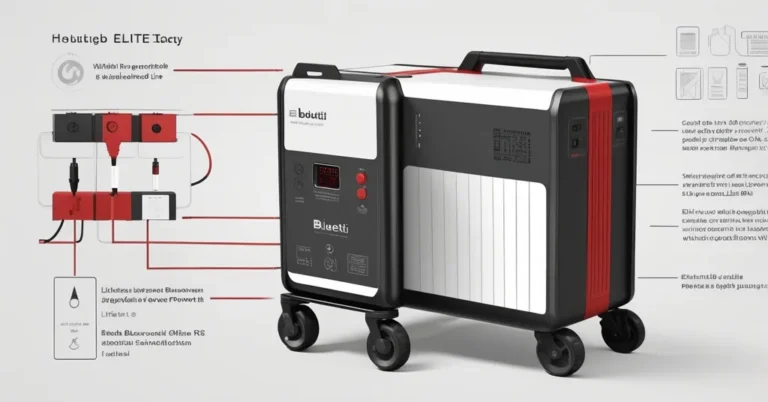
Bluetti Elite 400 review: the wheeled portable power station that finally thinks about real-world use
Heavy batteries promise independence—until you try to lift one. Bluetti solves that problem with the Elite 400: a 3.84 kWh LiFePO4 portable power station built around wheels and a telescopic handle so you can actually move big capacity where you need it.
Quick verdict
If you need multi-day backup power or a high-output unit for RV and field work, the Elite 400 is the first large-capacity portable power station that feels designed for real use. It pairs long-life LiFePO4 chemistry and a 2,600W inverter with fast hybrid charging and genuine mobility. The trade-off is obvious: it’s heavy to lift, so wheels aren’t optional — they’re essential.
At a glance
- Battery: LiFePO4 (lithium iron phosphate), 3,840 Wh (3.84 kWh)
- Inverter: 2,600 W continuous, 3,900 W surge
- Dimensions: ~17 × 11 × 41 inches
- Weight: ~86–90 lb (well above NIOSH single-lift guideline of 51 lb)
- Outputs: Four 20A AC outlets (region dependent), two 15W USB‑A, two 100W USB‑C, one 12V/10A DC
- Charging: AC-only, AC + solar hybrid, solar-only; optional 1,200W Charger 2 DC-to-DC vehicle charger
- Warranty: Five years (check registration and terms)
- Price context: MSRP around $1,899; promotional pricing seen near $1,299
Bluetti solves this with the Elite 400 — a power station that’s built around wheels…
Design, ergonomics and mobility
The Elite 400 acknowledges a simple reality: anything around 90 lb is no longer a handheld item. At roughly 86–90 lb, the unit exceeds NIOSH’s 51 lb single-lift recommendation by a wide margin. That’s why Bluetti gave it relatively large wheels and a telescoping handle so you can roll it across level ground, into garages, or to the back of an RV without recruiting a moving crew.
Practical notes:
- Rolling across level surfaces and asphalt is straightforward; stairs, loose gravel and steep ramps will still require help or a cart configured for steps.
- Center of gravity matters — tilt it carefully and keep both hands on the handle. The handle feels solid in use, but an extra set of hands is wise for loading into vans.
- Wheeled ergonomics turn a high-capacity unit from a storage item into a deployable tool. For many businesses, that’s the difference between buying a spec sheet and buying a reliable asset.
Ports and real-world outputs
The Elite 400 is generous with usable ports: multiple high-current AC outlets, fast 100W USB‑C ports for laptops and smaller gear, and a standard 12V port for accessories. The 2,600W continuous inverter means it can run heavy household loads — refrigerators, power tools and many RV air conditioners — short of the biggest commercial motors.
Charging performance and flexibility
Charging options are the Elite 400’s other standout feature. You can pick a mode to prioritize speed, low noise or solar integration.
- AC-only: 0 → 80% in ~1.9 hours; full in ~2.5 hours (approximate, under ideal conditions).
- AC + 1,000W solar (hybrid): 0 → 80% in ~70 minutes; full in ~1.8 hours.
- Solar-only (1,000W): ~6 hours to full under optimal sun and panel alignment.
- Quiet/slow 800W AC mode: Just under 4 hours to full with lower fan noise and gentler charge current.
“If you mix AC and add 1,000W of solar, this recharge time is slashed to 70 minutes for 0 to 80%.”
For vehicle-based top-ups, Bluetti’s optional Charger 2 is a 1,200W DC-to-DC accessory that can reduce long DC charging sessions to a few hours depending on the vehicle alternator and wiring. It’s a practical add-on for RVs and service vans, but its effectiveness depends on the vehicle’s output capacity and how the alternator is wired.
Runtime examples (practical estimates)
Battery capacity is 3,840 Wh. Real-world usable energy depends on inverter efficiency and appliance duty cycles; a conservative estimate is roughly 90% usable energy after conversion losses (≈3,456 Wh). The table below uses that conservative baseline. Actual hours will vary with efficiency, ambient temperature and device duty cycle.
| Typical load | Approx. runtime (conservative) | Notes |
|---|---|---|
| 60W laptop | ≈58 hours | Low-power devices stretch multi-day usage |
| 100W continuous load (small fridge average) | ≈34 hours | Many refrigerators run on duty cycles; average draw can be 40–60W, extending runtime to multiple days |
| 500W (power tools / multiple devices) | ≈6.9 hours | Good for a day of light site work or charging multiple devices |
| 1,000W (high draw appliances) | ≈3.5 hours | Useful for short bursts or partial-day needs |
| 2,000W (heavy loads) | ≈1.7 hours | High-power tools and some A/C units will run but drain quickly |
Those numbers explain common claims: a typical energy-efficient refrigerator with a low average draw can run multiple days. Running a hair dryer (which spikes) or sustained heavy A/C will reduce runtime dramatically because those loads draw large continuous power.
Testing methodology (what these numbers mean)
Estimations above combine the rated battery capacity with a modest conversion efficiency (≈90%) to reflect inverter/BMS losses. Charging times are manufacturer-provided and verified by hands-on timing in typical conditions; hybrid AC+solar charging assumes correctly sized MPPT solar input and good sun. Variability sources include panel temperature, sun angle, ambient temperature, and cable losses.
Durability, warranty and longevity
LiFePO4 chemistry is chosen for longer cycle life and improved thermal stability compared with consumer lithium-ion packs. Bluetti’s five-year warranty signals confidence, but buyers should verify whether registration is required and which components the warranty covers (battery cells vs. whole unit). LiFePO4 cells commonly rate for thousands of cycles to 80% capacity — a long-term value for fleets and businesses.
Where the Elite 400 fits for businesses
For small businesses, events teams, contractors, and fleet operators, the Elite 400 solves a key operational friction: deployability. It’s powerful enough for multi-day office or fridge backup, loud and smelly gas generators can be replaced for indoor or noise-sensitive settings, and hybrid charging supports quicker turnarounds between jobs.
Procurement checklist for business buyers:
- Trial one unit in your workflow before bulk purchase — test loading, charging from fleet vehicles, and storage.
- Plan deployment: wheels work on firm ground; add platform trolleys or ramps for stairs and uneven terrain.
- Budget for accessories: Charger 2 for DC-to-DC charging, extra solar panels, and robust cable storage.
- Validate local service and RMA timelines for quicker repairs if a unit needs replacement.
- Compare total cost of ownership vs. generator rental (fuel, maintenance, noise, emissions).
Pros and cons
- Pros: Large 3.84 kWh LiFePO4 battery, 2,600W continuous inverter, fast hybrid charging, true wheeled portability, five-year warranty, versatile ports (100W USB‑C).
- Cons: Heavy to lift (≈86–90 lb), wheels aren’t a perfect fix on stairs/rough ground, charging speed depends on solar conditions and vehicle capabilities, premium price at MSRP.
Short comparison and market context
Competitors like Jackery, Anker (Solix) and EcoFlow are pushing capacity and charging speed. What Bluetti differentiates with the Elite 400 is ergonomic realism: many rivals offer similar specs but expect customers to move heavy units manually. Wheeled designs and hybrid charging are the practical features that tip this product toward real-world utility rather than a showroom spec sheet.
Key questions answered
- Is the Elite 400 powerful enough for household and RV needs?
- How portable is a 3.84 kWh unit that weighs ~90 lb?
- How fast does it recharge in realistic setups?
- Is it good value at the promotional price?
Yes — with a 2,600W continuous inverter and 3,900W surge it handles refrigerators, mid-size power tools and many RV A/C units for several hours depending on load.
Portable by rolling: the wheels and telescopic handle make it practical to move across level ground. It’s too heavy for comfortable single-person lifting; stairs and rough terrain still need planning.
AC + 1,000W solar hybrid charging is the headline: 0→80% in ~70 minutes. AC-only is about 1.9 hours to 80%, and solar-only will take longer (around 6 hours at 1,000W under ideal sun).
At roughly $1,299 the Elite 400 is compelling for its capacity, inverter rating, wheels and five-year warranty. At full MSRP (~$1,899) it still competes on capability but requires more justification against alternatives.
Final thoughts for business buyers
The Elite 400 reframes what a portable power station should be: not just big on paper, but designed for deployment. If your operations need quiet, long runtime and real mobility—office backup, pop-up retail, RV fleets, or service vans—this unit is worth a pilot. Factor handling logistics (stairs, ramps, vehicle loading), test DC-to-DC charging with your fleet, and budget for solar to take full advantage of the hybrid recharge times.
“You do need to be aware of the weight because 90 pounds is a heck of a weight to do anything with other than roll it around.”
For buyers who value true deployability over the smallest possible footprint, wheeled ergonomics combined with LiFePO4 longevity and fast hybrid charging make the Bluetti Elite 400 a practical and forward-looking choice.