
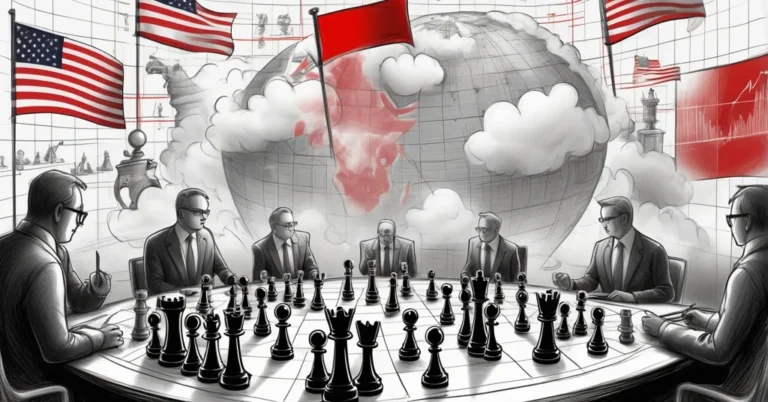
When cloud infrastructure becomes a front line: geopolitical risk, election rules, and prediction‑market growing pains
When data centers get pulled into conflict, corporate uptime stops being just an IT problem and becomes a board‑level survival question. Recent events—public threats from Iran’s Islamic Revolutionary Guard Corps against U.S. tech assets in the Middle East, domestic moves to tighten how voting is run ahead of the 2026 midterms, and a high‑profile prediction‑market rollout that failed in public—outline a new risk landscape. Together they show how geopolitical pressure, regulatory change, and the commercialization of prediction markets can turn political events into business continuity and reputational crises.
Geopolitical risk to cloud infrastructure
In late March the IRGC publicly warned it would “begin targeting” American companies operating in the Middle East, naming roughly 18 firms and setting an April 1 deadline. Public reporting also confirmed two strikes on Amazon Web Services regional data centers the prior month—physical damage to hyperscale cloud infrastructure that supports services globally.
“Kinetic” here means physical, armed attacks rather than purely digital intrusions. When kinetic action hits a cloud provider’s regional hub, the business impact is immediate: outages, slow or blocked services, and disrupted supplier networks. For firms running AI agents, ChatGPT automation, or latency‑sensitive models, that translates into failed SLAs, lost revenue, and potentially unsafe automated decisions.
Iran named household names—Apple, Microsoft, Google, Meta, IBM, Tesla, Palantir—among the targets. Markets reacted. Tech stocks dropped as investors re‑priced the added country and infrastructure risk; some names saw double‑digit moves on the news. Beyond share price, the strategic dilemma for AI and cloud‑heavy firms is concrete: executives such as Sam Altman have pursued data‑center deals in the Middle East, while some experts, notably Dario Amodei, have warned against placing sensitive infrastructure in unstable regions.
What this means for leaders:
- Cloud availability is no longer purely a software resiliency problem. Physical security, diplomatic risk, and local political stability are now input variables in infrastructure decisions.
- Multi‑region and multi‑cloud strategies matter, but they carry tradeoffs—data residency, latency, and cost for AI training and inference workloads.
- Insurance and contract language should explicitly address kinetic risk and force‑majeure clauses tied to regional conflict.
Election rules and business continuity
On the domestic front, legislation and executive action are shifting how elections are administered. The SAVE Act, passed narrowly by the House, would require stricter voter identification—effectively a passport or birth certificate in many cases—which critics argue would disenfranchise voters who lack those documents. An executive order conditions USPS mail‑ballot delivery on states providing lists of eligible voters 60 days before an election, a new procedural lever that increases federal oversight of a function traditionally managed at the state and local level.
Reports of politically aligned operatives placed across federal agencies and discussions about nontraditional deployments (including mentions of ICE at polling places in some commentary) create further uncertainty. For businesses that rely on predictable civic rhythms—financial firms, platforms that run time‑sensitive political advertising, or identity verification providers—changes to election mechanics are an operational and legal risk.
Election security 2026 is not only a political story. It’s a supply‑chain and identity problem for products and services that depend on trustworthy voter rolls, timely postal operations, and clear regulatory guardrails around political content and payments.
Prediction markets, regulation, and AI automation
Prediction markets—platforms that let people trade contracts based on the probability of future events—are moving from niche experiments to mainstream fixtures. For context, prediction markets convert opinions into prices: a contract that pays $1 if a candidate wins trading at $0.60 implies a 60% market probability. “Margining” is a mechanism that lets traders post collateral and take larger positions; Kalshi recently received margining approval, which opens the door to institutional capital and much higher liquidity.
Polymarket’s Washington, D.C. “Situation Room” pop‑up was meant to showcase how real‑money prediction markets can operate in public. Instead it highlighted operational and governance fragilities: TVs and terminals malfunctioned, the event opened late, and attendees were offered free drinks. Polymarket’s chief marketing officer, Josh Tucker, apologized on site:
“As a result of an electrical issue earlier tonight, we had to reset all of the TVs… Overnight, we will remedy it so that the situation can be properly monitored tomorrow.”
There are bigger stakes than embarrassment. The entry of institutional money via margining changes incentives: more liquidity and larger positions increase the potential impact of manipulation or coordinated trading. Partnerships with analytics firms—Polymarket announced a deal with Palantir to help police sports‑market integrity—add monitoring muscle but introduce complex optics when surveillance vendors become gatekeepers of market integrity. Political figures are also involved: reporting has linked Donald Trump Jr. to advisory roles on prediction‑market platforms, which raises questions about conflicts of interest as markets price political events.
The Commodity Futures Trading Commission is watching. When prediction markets intersect with automated trading, AI agents and ChatGPT‑style automations that generate trading signals or cross‑platform bets become another attack surface for regulatory scrutiny and operational failure.
Synthesis: compound risk to AI and enterprise
These three threads—cloud infrastructure risk, election rule changes, and prediction‑market maturation—don’t exist in isolation. They compound.
- If a regional cloud outage coincides with a contested election window, automated systems used by platforms or polling vendors could fail at precisely the moment they’re needed to ensure continuity and transparency.
- Prediction markets pricing election outcomes could face sudden liquidity squeezes or manipulation attempts during periods of infrastructure instability or legal uncertainty—especially if institutional players can quickly move large positions due to margining.
- AI agents used for customer support, automated moderation, or trading need clear governance. When they act on degraded inputs—delayed voter lists, interrupted cloud storage, or faulty model outputs—they can amplify mistakes at scale.
This is why the debate about whether to place data centers in a region is not academic. For AI for business initiatives—large language models, continual retraining pipelines, and ChatGPT automation—data residency and availability directly affect model reliability and compliance. Model governance must account for geopolitical and regulatory tail risk, not just algorithmic bias or model drift.
Practical checklist for C‑suite and boards
Actions to prioritize now, with suggested owners:
- Stress‑test cloud resilience (CISO/CIO): Run scenarios that include regional kinetic events, degraded connectivity, and vendor outages. Verify failover for AI training and inference workloads across regions and providers.
- Audit vendor contracts (GC/CFO): Ensure SLAs, insurance, and force‑majeure clauses explicitly cover kinetic risk and cross‑border obligations. Confirm data residency commitments and exit/evacuation clauses.
- Review identity and compliance dependencies (Head of Product/GC): Map where business processes rely on voter rolls, postal timelines, or other civic systems that could shift under new election rules.
- Harden AI agent controls (Head of ML/CPO): Add kill switches, throttles, and human‑in‑the‑loop gates for actions tied to market or civic outcomes. Log decisions and maintain audit trails for automated trades or moderation actions.
- Establish market integrity monitoring (Risk/CISO): If your product interacts with prediction markets or external trading venues, monitor for abnormal price moves and potential manipulation, and coordinate with compliance and legal.
- Board oversight (CEO/Board Chair): Add geopolitical risk and election‑related scenarios to the enterprise risk register and require quarterly reporting on mitigation progress.
- PR and customer communication plan (CMO/Head of Ops): Prepare clear messaging for outages that could be attributed to geopolitical events or regulatory changes; rehearse responses with legal counsel.
Questions boards should ask now
- Do we know which parts of our stack depend on regional cloud providers in unstable geographies?
Identify data centers, control planes, and backup locations—then quantify recovery time objectives (RTOs) and recovery point objectives (RPOs). - Could new election rules affect our customer flows or regulatory obligations?
Map dependencies on voter lists, mail‑ballot delivery, or electoral timelines that intersect with product operations. - Are our AI agents allowed to trade, post, or act on market signals without human review?
Implement governance if automation touches financial outcomes or political content. - Do our vendor contracts and insurance cover kinetic and political risk?
Get legal to review and tighten language where necessary. - Have we rehearsed communications for a combined technical/regulatory incident?
Simulate scenarios where an outage coincides with a political event to test cross‑functional response.
“We negotiate with bombs.”
That archival line—attributed to a public commentator—captures a blunt reality: political disputes can and do show up as kinetic pressure. Leaders must plan with that fact in mind, not as a political stance but as a strategic input to continuity planning.
Operational discipline matters. The Polymarket pop‑up is more than a marketing hiccup: it exposed how fragile public-facing systems can be when they become political theater. Partnerships that add monitoring capability may help, but they also shine a light on governance questions and potential conflicts of interest.
Immediate work is practical: stress‑test cloud strategies, audit vendor and insurance coverages, and harden AI‑agent governance so automated systems can’t unintentionally escalate incidents. The longer work is structural: build governance that can handle the blurred line between geopolitics, policy and product. When infrastructure, law, and markets all become battlegrounds, leaders can’t outsource strategy to vendors or PR teams—preparation, not surprise, will determine who weathers the next storm.