
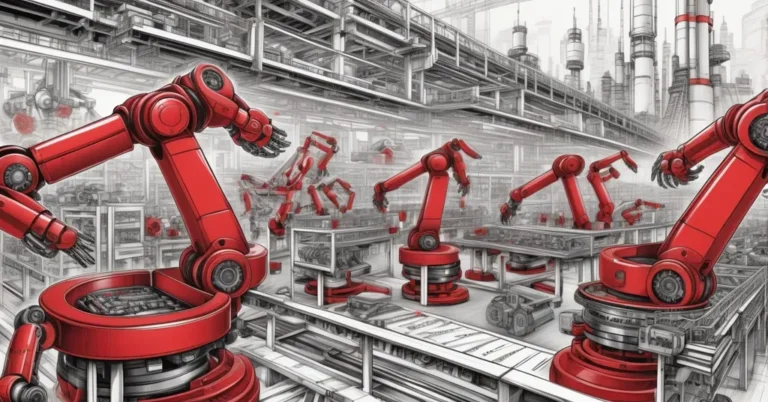
Inside China’s Robotics Revolution: Practical AI Automation for Manufacturers
Executive summary: China is shipping cheap, single‑task robots at commercial scale—driven by deep pockets, local subsidies, and dense supply chains. That matters because narrow, low‑cost AI agents will reshape factory economics now, while general‑purpose humanoids remain a longer‑term research problem. Three short actions: Pilot narrow automation, Protect supply chains and IP, and Prepare People through reskilling.
Why China’s approach to AI automation matters for manufacturers
China treats robotics as an industrial sprint — rapid, funded, and practical. Municipal governments and Beijing are underwriting factories, training centres and subsidies. Reported government moves include a roughly $125 billion fund announced for strategic tech in 2025, focused in part on robotics. That capital plus manufacturing clusters where parts, sensors and prototyping are minutes apart is lowering iteration time and cost for robot suppliers.
What you need to know fast:
- Chinese firms are prioritizing low‑cost, single‑task robots you can buy and deploy now, rather than waiting for general humanoids.
- Data is the bottleneck for vision–language–action (VLA) models: models that link camera input, language/context and robot control.
- Teleoperation and simulation are the two dominant ways companies gather the action‑sequence data VLA systems need.
The Chinese playbook: cheap, focused, and scaled
There are roughly 140 Chinese companies chasing humanoid-style robotics. China also accounts for more than half of global new industrial-robot installations each year. Hardware specialists like Unitree are shipping thousands of low‑cost units (reportedly over 5,500 humanoid-style robots last year). Galbot sells humanoids for roughly 700,000 yuan (≈$100,000) and powers them with Nvidia chips. Guchi builds final‑assembly systems—wheel, dashboard and window installation machines—that are already reducing headcount on real production lines.
“Automation is an engineering problem and the goal is to liberate or replace as many factory roles as technology allows.” — Chen Liang, founder of Guchi
The commercial logic is simple: deliver a robot that does one job very well, at a low enough price to justify replacing labour on that task. That approach compresses time‑to‑value. For executives, the practical corollary is straightforward: narrow robots will change operating costs and takt time (production cycle time — how often a finished unit must come off the line to meet demand) long before we get reliable, general‑purpose humanoids.
How the technology actually works
The technical choke point is high‑quality, real‑world action sequences — long streams of video, sensor telemetry and controller signals that show how humans perform tasks. Firms resolve that in two ways:
- Teleoperation: Humans remotely control robots in real environments to collect labelled trajectories. Large teleop centres act as both R&D factories and employment hubs. Leju, for example, operates such centres and publicly released a 100‑hour slice of training data to accelerate progress.
- Simulation: Synthetic environments generate millions of diverse scenarios cheaply. Simulation is faster and safer for edge cases, but real‑world teleop data remains crucial to close the sim‑to‑real gap.
Teleoperators typically earn 6,000–10,000 yuan per month (≈$850–$1,400). One person can manage or train many robots, creating a new labour category that sits between skilled manufacturing and gig work. As Ulrik Hansen of Encord puts it: teleoperations are becoming the “new manufacturing job” — one human supervising many AI agents, but with complex net labour effects.
“Teleoperations are becoming the ‘new manufacturing job’; one human can manage many robots, but the net labour dynamics are complex.” — Ulrik Hansen, Encord
Business impact and case studies
Real deployments are already changing factory floors. A visible example: Guchi’s wheel-installation machines were chosen by General Motors and are expected to remove about a dozen assembly operators on a single production line. That kind of swap—labour for a capital asset that reduces takt time and defects—will be evaluated on ROI, integration cost and up‑time.
Other commercial use cases gaining traction:
- Pharmacy and retail kiosks dispensing goods with humanoid-style pick‑and‑place robots.
- Final‑assembly cells where a narrow robot inserts parts repetitively with better consistency.
- Logistics and sorting where simulation-trained pickers run 24/7 at lower marginal cost than temporary labour pools.
Micro‑story: a teleoperator’s shift. Li (pseudonym) logs into a teleop centre at 9 AM, reviews yesterday’s failed grasp attempts, tweaks a pick policy with an engineer, then runs four hours of supervised demonstrations across different lighting conditions. Her sessions yield labelled trajectories that directly reduce failures in production trials. Li’s role is monotonous and low‑paid, but it is essential to the data pipeline powering closed‑loop improvements.
Where concerns concentrate: social, supply‑chain and security risks
Three risk clusters require executive attention:
- Workforce displacement and precarity: China has roughly 120 million factory workers today. Narrow automation can eliminate many roles. Teleoperation jobs absorb some displaced workers, but they are often lower paid and precarious unless paired with robust reskilling and labour protections.
- Supply‑chain interdependence: Western chips and research interact with Chinese hardware and manufacturing. That interdependence complicates policy responses and increases vulnerability to export controls and component bottlenecks (e.g., advanced AI accelerators).
- Dual‑use and geopolitical risk: Unitree robot dogs appearing in military drills and other blurred military–commercial links raise export‑control and reputation risks for buyers and partners.
Municipal competition to attract robotics firms has produced heavy subsidization in some cities, amplifying market noise and producing winners more tied to local politics than product‑market fit. That dynamic can flood the market with underpriced hardware that fails to deliver long‑term serviceability — a procurement trap.
“There is scepticism in parts of the research community that current deep‑learning paradigms alone will deliver human‑level physical dexterity.” — Yann LeCun
This scepticism matters: while progress on perception and policy learning is fast, many experts argue that current deep‑learning approaches will struggle to reproduce full human dexterity without new paradigms or massive, diverse real‑world datasets.
Practical steps for the C‑suite: a 90‑day checklist and 1‑year roadmap
3‑step executive playbook — Pilot. Protect. People.
90‑day checklist
- Identify 2–3 narrow tasks with high repetition and quality sensitivity for pilot automation (e.g., wheel insertion, repetitive pick‑and‑place).
- Run supplier due diligence: map chip and actuator dependencies, check dual‑use flags, and require service and spare‑parts commitments.
- Set KPIs for pilots: cycle time reduction, defect rate, total cost of ownership (TCO) and time‑to‑integration.
- Launch a reskilling sprint: basic teleop training, maintenance skills, and data‑annotation fundamentals for affected workers.
1‑year strategic moves
- Scale successful pilots horizontally across lines and sites after proving integration and ROI.
- Diversify suppliers for critical components (chips, sensors) and negotiate multi‑year support contracts with performance SLAs.
- Invest in an internal data ecosystem: capture action sequences, anonymize and label ethically, and retain ownership clauses in procurement contracts.
- Establish governance: ethics, safety, and dual‑use risk assessments for any robotics procurement.
Quick Q&A — common boardroom questions
Should my factory buy Chinese single‑purpose robots now, or wait for general humanoids?
Adopt selectively: pilot narrow tasks now to cut costs and learn integration. General humanoids are not yet a predictable ROI for most routine manufacturing work.
Can VLA and current deep‑learning approaches achieve human‑level dexterity soon?
Unlikely in the near term. Progress is real, but data scarcity and architectural limits mean full dexterity is a longer‑term challenge.
Will teleoperation save jobs or just shift precarity?
Teleoperation creates new roles and can absorb displaced workers, but without deliberate reskilling and labour protections it risks shifting precarity rather than solving it.
How risky is relying on Chinese suppliers given geopolitics?
There are real risks—export controls, component dependencies and reputational exposure—so diversify suppliers, audit critical parts and demand robust service agreements.
Key takeaways
- China is commercializing robotics at scale with a clear bias toward cheap, single‑task AI agents that deliver near‑term ROI.
- Data—especially real‑world action sequences collected via teleoperation—is the limiting factor for more general robotic intelligence.
- Leaders should pilot narrow automation, shore up supply chains for critical components, and invest aggressively in reskilling to manage social and operational risk.
For operations teams, the immediate question is not whether robots will matter, but how quickly to incorporate them, how to protect the business from geopolitical and supply‑chain shocks, and how to transition people into higher‑value roles that make the automation sustainable.
“There is a pragmatic race here: commercialise quickly, collect the data, and ship scale—because the factory floor rewards solutions that simply work.” — sector synthesis