
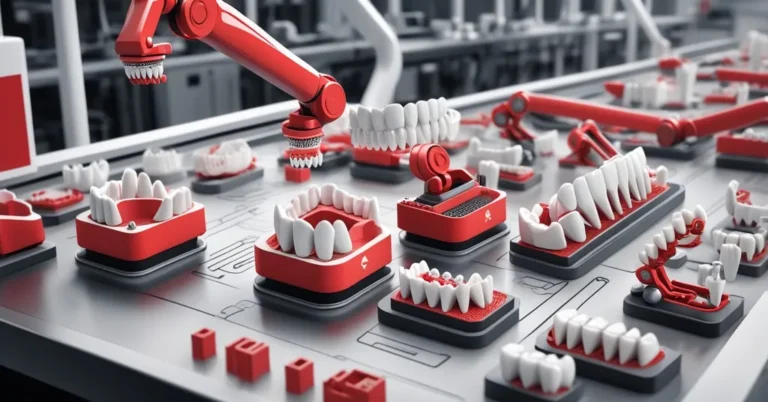
How Align turned 3D printing from prototype trick into industrial muscle — and why it matters for business
TL;DR: Align Technology scaled additive manufacturing (3D printing) from prototyping to factory-scale production by owning the full digital thread: intraoral scanners, AI treatment planning, and manufacturing. The company is moving from printing molds and vacuum-forming to directly 3D-printing finished aligners using a custom high‑viscosity resin (via its Cubicure acquisition). That shift promises lower waste and long‑term cost improvements, but it raises regulatory, logistics, and environmental challenges that executives need to plan for now.
Why custom medical devices break traditional factory rules
Mass customization — making one-off products at factory scale — is a different animal than classic assembly-line manufacturing. Here’s why: each clear aligner must match a particular patient’s anatomy down to sub-millimeter tolerances, so production looks less like repeating the same step and more like running millions of bespoke short jobs with tight quality control.
Key terms, defined plainly:
- Additive manufacturing (3D printing) — building objects layer by layer instead of cutting or molding them from bulk material.
- Vacuum-forming — heating a plastic sheet and pulling it over a shape (a mold) to create a part.
- Throughput — the number of units a line or machine produces in a given time (per hour/day).
Align’s digital thread: scanners, AI planning, and factories
Align doesn’t just sell aligners. It controls the whole workflow: intraoral scanners that capture a patient’s teeth, AI-powered treatment-planning software that maps a multi-week tooth-movement plan, and global factories that turn digital plans into physical aligners. Last year Align reported roughly $4 billion in revenue: about $3 billion from aligners, $800 million from scanners, and the balance from retainers and other services. The company handled a record 2.6 million cases last year and has served roughly 22 million patients to date.
“I enjoy seeing patients’ smiles,” CEO Joe Hogan says, framing the company plainly as “Align Technology.”
That vertical integration is the competitive core. The treatment data generated by scanners and planning feeds R&D and quality control, and it gives Align a closed-loop system that’s hard for newcomers to replicate quickly.
The technical bottleneck: why printers weren’t enough
Printers capable of high throughput have been commercially available for years. The real bottleneck was materials. A finished clear aligner needs a specific set of properties: optical clarity, elasticity, fatigue resistance, biocompatibility, and the ability to cure reliably when printed.
Until recently, printed resins tended to be brittle, discolored, or otherwise unsuitable for a device that must flex, hold force, and remain clear in the mouth. Align historically solved this by printing molds and vacuum-forming aligners from SmartTrack and similar polymers — a reliable two-step process but one that adds material waste, labor, and touch points.
“It was maddening that we couldn’t directly print an aligner,” Hogan says. Align hired polymer chemists and acquired Austria’s Cubicure to develop a high‑viscosity resin and the processing know‑how to print finished aligners.
Buying Cubicure brought both chemical formulations and machinery capable of handling those tougher resins. That’s the move from hardware-first thinking to chemistry-first thinking: the new bottleneck isn’t the printer; it’s the resin and the process that makes a printed part behave like a medical-grade aligner.
What direct 3D-printed aligners change for the business
- Fewer manufacturing steps. Skip the mold, skip vacuum-forming. That reduces waste and cuts finishing labor.
- Tighter quality control. When the whole digital-to-physical path is owned, traceability and batch control improve — critical in regulated medical markets.
- Potential cost declines. Over time, better materials and higher throughput can lower per-unit costs, though savings flow through doctors to consumers unevenly because clinicians set retail prices.
- Logistics optimization. Align describes itself as “a very large small-volume shipper.” Lighter, simpler packaging and shorter processing can shave shipping costs, a major line item today.
- A larger moat. Software, materials IP, and manufacturing know-how compound into an advantage that’s hard to replicate quickly.
Still: scale is hard. CEO Hogan calls industrial 3D printing a “monster” because orientation, post-curing, finishing, inspection, and shipping create many downstream complexities. Direct printing should reduce some labor over time, but it shifts the type of work toward materials science, automation, and software-driven QA.
Regulatory, QA, and environmental realities
Moving to a new printed material at millions of units per year requires rigorous regulatory and quality frameworks. Typical pathways and standards for dental devices include:
- FDA 510(k) clearance for devices substantially equivalent to existing legally marketed products, or a PMA path for novel devices.
- ISO 10993 biocompatibility testing for materials that contact body tissues.
- ISO 13485 quality management standards for medical device manufacturing.
Scaling QA means robust lot control, traceability from scanner to finished device, and extensive post‑market surveillance. Batch testing, validated curing recipes, and automated inspection (computer vision) become mandatory as volumes ramp.
Environmental trade-offs deserve equal attention. Thermoforming produces throwaway molds and scrap material; direct printing uses resin chemistry that can generate different waste streams, potentially including uncured resin and microplastics. Executives should push for lifecycle analyses that compare cradle-to-grave impacts — and for recycling or reclamation strategies for resin waste.
AI, automation, and where AI agents fit
AI already powers Align’s treatment planning. The same techniques and AI agents (autonomous software that runs tasks and coordinates systems) can be extended to manufacturing:
- Orientation and nesting optimization. AI can pick how to orient hundreds of parts in a build to maximize throughput and minimize waste.
- Automated visual inspection. Computer vision models flag surface defects or curing inconsistencies faster than manual inspection.
- Predictive maintenance. Machine-learning models predict printer failures before they happen, reducing downtime.
- Dynamic scheduling and logistics agents. AI agents can re-route builds to different sites based on capacity, material availability, and shipping cost, shaving days and dollars.
These functions turn printing farms into data-rich, self-optimizing factories — where AI for manufacturing and AI automation is as important as the chemistry in the resin.
Competitive landscape and strategic risks
Align’s vertically integrated model — scanners, AI, materials, printers, and factories — creates a high barrier to entry. But there are trade-offs:
- Concentration risk. Owning the stack centralizes regulatory risk. A material or process issue affects the entire product line.
- Capital intensity. Building chemistry and factory scale needs heavy upfront investment.
- Potential disintermediation. Startups or labs-as-a-service could offer lower-cost direct printing as a networked service, creating a two-tier market.
Potential competitors include large dental OEMs expanding into aligners, startups with novel resins or decentralized printing networks, and third-party contract manufacturers specializing in direct-print production. Expect a mix of vertical copycats and specialized niche players.
Timing scenarios: how quickly might direct printed aligners become common?
- Aggressive (1–3 years) — Rapid material approvals, successful scale-up in one major factory, and immediate throughput gains. Direct-print aligners appear in limited markets; hybrid workflows coexist.
- Baseline (3–5 years) — Phased rollouts as regulatory clearances and process validations complete. Hybrid production persists; meaningful per-unit cost reductions start to appear.
- Conservative (5–7+ years) — Extended validation, tougher-than-expected regulatory hurdles, and slower adoption among clinicians. Direct printing becomes mainstream only after multiple quality and environmental standards are proven.
Which path unfolds depends on three variables: material cost and performance, printer throughput/automation, and regulatory timelines. Any executive modeling the shift should stress-test those variables.
What executives should ask now
- Do we own key materials IP?
Owning resin formulations or exclusive partnerships reduces supplier risk and creates pricing leverage.
- Can our AI systems optimize production and QA?
Think beyond design—can models handle orientation, visual defect detection, and predictive maintenance?
- Have we modeled shipping and logistics at current volumes?
Smaller, lighter packages change unit economics; run a scenario analysis on freight cost sensitivity.
- What regulatory pathways and test standards apply to new materials?
Map FDA 510(k)/PMA requirements and ISO 10993/13485 steps before scaling.
- What’s our environmental plan?
Commission lifecycle assessments and explore resin reclamation or circular-material partnerships.
- Could we pilot a hybrid workflow?
Start with mixed production (printed molds + pilot printed aligners) to validate supply chain, QA, and clinician acceptance.
Key takeaways and the strategic play
Align’s shift from printed molds to direct 3D-printed aligners is a blueprint for how additive manufacturing and AI automation can move from R&D curiosities to core industrial capabilities. The hard work isn’t buying printers; it’s developing materials, validating processes with regulators, and automating inspection and logistics with AI agents.
For leaders evaluating 3D printing for business, the lesson is simple: invest early in the hard stuff — materials and process engineering — and pair that with software and AI that turns data into production decisions. That combination is where durable advantage lives. At the same time, be honest about the risks: regulatory concentration, environmental footprint, and heavy capital needs will test corporate resolve and strategy.
Align claims it already prints more parts in-house than any other company worldwide. If that scale and its material breakthroughs hold, it may have done more than upgrade a factory: it may have redefined what industrial 3D printing looks like for regulated, mass-custom products.