
When CEOs Blame AI for Layoffs: Signal, Noise, and What Leaders Should Do
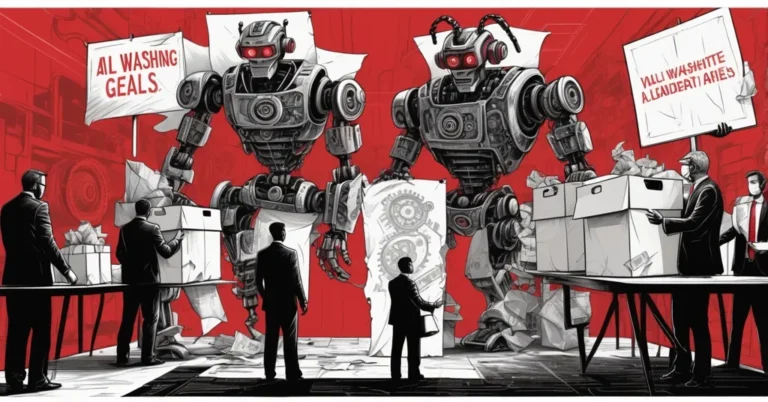
A CEO announces “we’re cutting roles because of AI” and the narrative locks into place: modern, efficient, future-ready. It’s a tidy storyline. Reality is not tidy. Pandemic hiring swings, cost-cutting, tariffs and normal business cycles are all in the mix. So is genuine automation—particularly for routine, task-based jobs. What’s harder to see is where the line between real AI-driven change and PR-friendly “AI-washing” sits.
The headline claims vs. the evidence
Some corporate numbers are stark. Challenger, Gray & Christmas reported more than 54,000 layoffs in 2025 that companies attributed to AI. Amazon announced roughly 30,000 role cuts across two rounds (about 14,000 in October 2025 and 16,000 in January 2026). Hewlett-Packard suggested AI-driven productivity might allow roughly 6,000 fewer roles “in the next years.” Salesforce executives have said AI agents reduced their customer-facing headcount from around 9,000 to 5,000.
Those numbers matter. So do independent estimates that push back on rapid, broad automation. Forrester projects only about 6% of U.S. jobs will be automated by 2030, and their analysts caution that realistic replacement generally requires mature, well-integrated systems—deployments that can take 18–24 months to implement, if they work at all.
“CEOs can frame layoffs as ‘we’re adopting the latest tech, so these roles aren’t necessary’ — a convenient narrative for being seen as a tech leader.”
— Fabian Stephany, Oxford Internet Institute
“Many CEOs lack deep AI expertise and may assume they can replace 20–30% of staff quickly with AI, but mature AI deployments are required and can take 18–24 months — if they work at all.”
— JP Gownder, Forrester
Why executives lean on “AI”
Saying “AI” is politically and reputationally cleaner than saying “we mismanaged hiring” or “we underpriced risk.” CEOs face investor pressure to show both innovation and cost discipline. Blaming tariffs or macro policy can be awkward. For example, tariffs were cited in some company explanations but accounted for fewer than 8,000 layoffs—far less than the total numbers attributed publicly to AI.
Framing layoffs as technological progress positions leaders as builders rather than as managers who missed a turn. That framing can soften public scrutiny. It can also invite skepticism when the operational reality doesn’t match the rhetoric.
What real AI automation looks like (and where it doesn’t)
AI for business already replaces specific tasks. Chat-based customer support, templated content production, and scripted technical diagnostics are prime examples. But replacing an entire job category is different from automating parts of the workflow.
Example: an AI agent can handle an initial support ticket—verify identity, pull up account details, resolve common issues. That reduces routine work. It does not replace complex escalation handling, relationship management, or cases that require cross-functional judgment.
Salesforce provides a concrete case: executives claim deploying AI agents materially reduced headcount on customer-facing teams. That can be legitimate when the ticket mix is highly repetitive and volumes justify tooling. Still, a successful shift required workflow redesign, retraining for staff who now focus on escalations, and integration with CRM systems.
Common limitations of near-term automation:
- Data quality and integration gaps that make AI unreliable for end-to-end processes.
- Need for human oversight on edge cases and compliance-heavy interactions.
- Change management costs—retraining, tooling, and governance—that often offset short-term labor savings.
Timeline for a mature rollout:
- Pilot: 3–6 months (data collection, small-scale tests).
- Integration & validation: 6–12 months (system integrations, workflow redesign).
- Scale: 6–12+ months (wider deployment, continuous improvement).
How companies actually shift work
Patterns visible across multiple firms show that companies often redesign staffing mixes before they eliminate roles entirely. Contractors and temporary staff are frequently the first to go. Tasks get reassigned to lower-paid employees. In some cases AI tools enable supervisors to compress roles rather than remove the underlying work.
“The work didn’t disappear; it was reassigned to cheaper staff — AI may have enabled that shift.”
— Former Amazon employee (anonymized)
Duolingo’s initial public statements about replacing contractor work with AI later clarified that full-time employees would not be laid off. Amazon leaders have both invoked AI and downplayed its sole role. Beth Galetti framed AI as “the most transformative technology since the internet,” while CEO Andy Jassy later emphasized culture and organizational change as drivers of workforce decisions. These mixed messages matter: they reveal how executives test narratives and adjust under scrutiny.
Claim vs. evidence: quick read
- Challenger, Gray & Christmas: Reported >54,000 layoffs attributed to AI in 2025. That tracks public statements but not the operational detail behind each cut.
- Amazon: ~30,000 cuts publicly announced; internal accounts suggest reassignments and contractor cuts played a role.
- Salesforce: Leadership credits AI agents with reducing customer-facing headcount; plausible in task-heavy segments where KPIs showed improvement.
- Hewlett-Packard: Projected productivity gains could enable ~6,000 fewer roles over years—this is a forward-looking projection, not an immediate layoff explanation.
- Forrester: Estimates ~6% of jobs automated by 2030 and warns mature deployments take 18–24 months.
Key questions for leaders
Is AI the main cause of recent layoffs?
Partially. AI explains reductions in some routine roles, but pandemic overhiring, cost-cutting and market cycles are big, often larger, drivers.
How many jobs are realistically automatable by 2030?
Independent research points to limited near-term automation: Forrester’s estimate is about 6% of U.S. jobs by 2030.
Can companies replace large swaths of staff quickly with AI?
Rarely. Mature, scalable AI deployments typically take 18–24 months and careful integration. Quick, large-scale replacement is the exception, not the rule.
Are contractors more vulnerable than full-time employees?
Yes. Companies often target contractors first, using AI to reassign tasks rather than eliminate the underlying work immediately.
Checklist for boards and executives
- Document system maturity: Publish a short internal summary showing pilot results, error rates, and what the AI actually does—step-by-step.
- Measure the right KPIs: Track time-to-resolution, escalation rates, cost per ticket, and customer satisfaction before and after deployment.
- Publish realistic timelines: Expect 18–24 months from pilot to mature scale. Use QA gates, not wishful thinking.
- Protect contingent workers: Avoid using AI as a pretext to offload obligations. Contractors should be assessed transparently and fairly.
- Budget for change: Include retraining, redeployment, and human oversight costs in ROI models—not just licensing fees.
- Communicate honestly: Share what’s automated, what’s shifted, and what remains human. Prepare regulators and employee representatives with facts, not slogans.
- Validate with external reviewers: Use independent audits for customer-impacting systems and keep a public record of validation where appropriate.
Final thought
AI agents and AI automation will reshape parts of the workforce. They are powerful levers when applied to repetitive, well-defined tasks. They are poor excuses when used as a blanket explanation for broad workforce reductions. Boards and executives who treat AI as a disciplined operational program—measured pilots, clear timelines, transparent metrics and humane transition plans—will capture value without sacrificing credibility. All the rest looks like spin, and spin has a way of coming back around.