
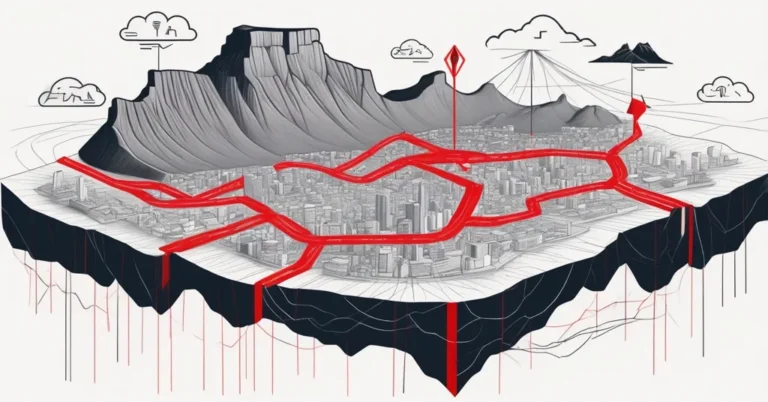
Amazon Bedrock brings Claude 4.5 cross‑Region inference to Cape Town (af‑south‑1): enablement, costs, and governance
So what: Amazon Bedrock now lets applications in Cape Town call Anthropic’s Claude 4.5 models (Sonnet, Haiku, Opus) locally while Bedrock transparently runs the compute in other AWS Regions when needed—so you keep your logs and configs in af‑south‑1 but gain elastic inference capacity to absorb spikes.
Why this matters for AI for business
Scaling production generative‑AI features is often less about model quality and more about predictable throughput and latency during peak demand. For teams in South Africa, the new Bedrock cross‑Region inference option removes the hard engineering task of building multi‑region failover: keep a single control plane in Cape Town and let AWS distribute inference across Regions to maintain performance. That’s a win for customer‑facing chatbots, large‑scale summarization jobs, and sales or support automation that needs to remain responsive under bursty traffic.
Concrete business use cases
- Sales assistants that must handle a product launch surge without costly overprovisioning in a single Region.
- Customer support chat that scales during peak hours while audit logs and knowledge bases remain local for compliance.
- Nightly batch summarization or content-generation pipelines that use spare capacity across Regions to finish faster.
What Bedrock cross‑Region inference does (plain English)
Your application makes a Bedrock call from af‑south‑1. Bedrock keeps your control plane — configurations, log storage, Knowledge Bases — in af‑south‑1, and then, when local capacity is tight, routes the actual inference to another AWS Region over the AWS Global Network. Persistent data stays put; transient compute may run elsewhere and the network traffic is encrypted by AWS while in transit.
“Global cross‑Region inference allows apps in Cape Town to call Claude 4.5 locally while Amazon Bedrock routes requests to Regions with capacity, improving throughput and user experience.”
Who should consider global routing vs. geographic routing
Two routing modes let you pick the right trade‑off:
- Geographic cross‑Region routing — restricts routing to a defined geography (for example EU, US, Japan, Australia). Use this when data‑residency rules demand regional limits.
- Global cross‑Region routing — allows routing worldwide for maximum capacity and lower tail latency. Use this for non‑residency‑constrained, high‑throughput workloads.
Decide by workload class: low‑latency, highly regulated interactions (payments, sensitive health records) usually prefer geographic or no cross‑Region routing; high‑throughput, resilience‑focused workloads typically benefit from global routing.
How to enable cross‑Region inference — a practical checklist
- Request any required model access from Anthropic (use case approval may be necessary).
- Request token quota increases in af‑south‑1 via AWS Service Quotas.
- Insert the global inference profile ID into your Bedrock API calls (example model ID pattern: global.anthropic.claude-opus-4-5-20251101-v1:0).
- Grant three IAM permission scopes so Bedrock can resolve and route models across Regions:
- Access to the regional inference profile resource (regional inference profile ARN).
- Access to the regional foundation‑model (FM) resource (regional FM ARN).
- Access to the global FM resource (global FM ARN — this ARN intentionally omits region and account information).
- Verify your Service Control Policies (SCPs) allow requests where aws:RequestedRegion = “unspecified”, otherwise routing will be blocked.
- Test in a dev environment and validate CloudTrail entries to confirm which Region executed each inference.
Important security, compliance and governance points
Persistent data — logs, Knowledge Bases, stored configs — remains in af‑south‑1. Transient inference may execute in other Regions, so check local regulations such as POPIA to determine acceptability. Transmission is encrypted over AWS’s network, but governance still requires explicit IAM, SCP, and monitoring controls.
“Data at rest — such as logs and knowledge bases — remains in the source Region, while transient inference can run elsewhere over the secure AWS network.”
Practical governance controls:
- Create explicit IAM roles scoped to the three required resources and audit use.
- If policy forbids cross‑Region execution, either revoke the routing IAM permissions or add an explicit deny condition with aws:RequestedRegion = “unspecified” in your SCPs.
- Use CloudTrail to produce auditable reports showing which Region handled each inference request.
Quotas, token economics and a worked example
Capacity planning needs an adjustment for Sonnet and Haiku 4.5 models: output tokens consume quota at a 5x rate compared with input tokens (input = 1:1). That changes throughput estimates and cost forecasts considerably.
Worked example:
- Average user prompt: 200 input tokens.
- Average model response: 800 output tokens.
- Quota burn = 200 (input) + 800 × 5 (output multiplier) = 4,200 quota tokens per call.
Use that formula to estimate concurrent capacity and to request Service Quotas in af‑south‑1 before production traffic begins.
Monitoring and observability
CloudWatch metrics and CloudTrail logs remain centralized in the source Region (af‑south‑1). Important observability tasks:
- Track latency and error‑rate metrics; set alerts for spikes that might indicate cross‑Region routing anomalies.
- Inspect CloudTrail fields for model ARNs and routing metadata to determine which Region served a given request.
- Create dashboards that correlate user‑facing latency with routing events so product and infra teams can tune SLOs.
How to disable global routing if required
Two straightforward options:
- Remove the IAM statements that grant Bedrock the three permission scopes needed for cross‑Region resolution — Bedrock will then only run inference locally.
- Add an explicit deny in your SCPs that targets the condition aws:RequestedRegion = “unspecified”. This blocks global routing while leaving other region‑specific operations intact.
Testing & rollout playbook (4‑week example)
- Week 1 — Preparation: Request Anthropic model access, raise Service Quotas in af‑south‑1, draft IAM/SCP changes.
- Week 2 — Dev testing: Use a dev Bedrock environment; enable a geographic profile first; verify telemetry and region attribution in CloudTrail.
- Week 3 — Canary: Move a small percentage of production traffic to global routing; monitor latency, errors, and quota burn.
- Week 4 — Gradual ramp: Increase traffic while validating cost forecasts and compliance reviews; finalize runbooks and dashboards.
Quick executive action items
- Approve Service Quota requests in af‑south‑1 so teams can validate throughput.
- Decide which workload classes may use global routing and which must remain local.
- Assign security owners to update SCPs/IAM and to produce audit reports from CloudTrail.
Appendix — technical notes and examples
Model family: Anthropic Claude 4.5 variants — Sonnet, Haiku, Opus — are supported via Bedrock cross‑Region profiles. Supported Bedrock capabilities include prompt caching, batch inference, Guardrails, and Knowledge Bases.
Example model ID pattern (used in Bedrock API calls): global.anthropic.claude-opus-4-5-20251101-v1:0
IAM and ARN guidance (illustrative):
- Regional inference profile ARN: arn:aws:bedrock:af-south-1:{account}:inference-profile/{profile-id}
- Regional FM ARN: arn:aws:bedrock:af-south-1:{account}:foundation-model/{model-id}
- Global FM ARN (no region/account): arn:aws:bedrock::foundation-model/global.anthropic.claude-opus-4-5
Where to adjust quotas: request increases in the AWS Service Quotas console scoped to the af‑south‑1 Region.
Final perspective
Bedrock’s cross‑Region inference from af‑south‑1 smooths a major operational wrinkle: scaling LLM workloads without building a multi‑region platform. It doesn’t eliminate governance decisions — teams still need to decide which workloads can tolerate transient processing outside Cape Town and to plan around the Sonnet/Haiku output token quota multiplier. For many AI for business deployments (sales assistants, chatbots, batch summarization), the trade‑offs favor enabling global routing; for tightly regulated data, the geographic mode or local‑only operation will remain essential.
If you want IAM policy templates, a sample Bedrock API call, an SCP deny pattern for aws:RequestedRegion = “unspecified”, or a simple spreadsheet calculator that applies the 5x output token rule to your traffic profile, those artifacts can be assembled to match your environment and compliance needs.
Credits: AWS regional authors who shaped the capability include Christian Kamwangala, Jarryd Konar, Melanie Li PhD, Saurabh Trikande, and Jared Dean.